Real Estate Sellers

8 Ways to Make a Space Feel Larger

  • By
  • Posted

Feeling cramped at home? These tips can help open up a room without knocking down a wall.

  • Accentuate the vertical. Draw the eye upward so a room looks more spacious. Add a bookshelf that reaches to the ceiling. Install vertical shiplap or wallpaper with vertical stripes. Hang a pendant light fixture.

  • Consider “see-through” furniture. Choose chairs and sofas with visible legs instead of furniture with skirts that reach the floor. This allows you to see under and around pieces so they appear to float in the room rather than dominate it. Glass coffee tables are a good choice, too.

  • Lighten up surroundings. We all know white walls reflect light and makes a room look bigger. But why stop there? HouseLogic recommends painting walls, ceilings, and trim the same shade of white to present a soaring, bright space.

  • Go big with accents. Many people think small when designing a small room. Instead, add a couple of oversized accessories, like a big piece of art or a single large chair. A lot of little objects make a room appear cluttered while one or two big ones make it feel more spacious.

  • Get away from the wall. Create a central layout instead of pushing a sofa up against the wall. When there’s a wall right next to a piece of furniture, your eyes are drawn to the wall, which can make the room seem more cramped.

  • Simplify the color scheme. Use a monochromatic color scheme for walls, furniture, and accessories. When objects are a similar color, your eye doesn’t dwell on each one but rather sees them in a unified, uncomplicated form.

  • Skip the curtains. Curtains block natural light and the view to the outdoors, making a room feel smaller and darker.

  • Bring nature indoors. Add plants and use natural textures in furniture to tie indoor decor to the outdoor view that’s visible through the windows that aren’t blocked by curtains.


Sources: Denise Balassi, Spaces Of Distinction; Laura Britt, Britt Design Group; Melissa Grove, Laura U Interior Design; HouseLogic.com


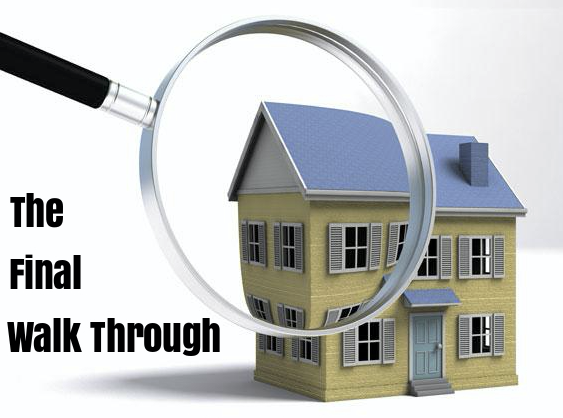
Closing on a House: The Common Problems to Spot in a Final Walk-Through

  • By
  • Posted

Both buyers and sellers should be aware of the issues that can arise during a final home walk-through. The final walk-through typically takes place mere hours before the closing itself. It’s one last opportunity for the buyer, along with his or her agent, to inspect the home and make sure there aren’t any last-minute problems.


final walk through before closing


By Deanna Haas, Contributor for U.S. News and World Report

For homebuyers and sellers alike, the final walk-through can be one of the most significant steps in the real estate process. It may also be one of the most nerve-wracking.

Hopefully, your final walk-through will be smooth sailing. Every now and again, though, issues do arise – and they can go as far as to derail the entire home sale.

Here are the most common final walk-through discoveries that can potentially throw a wrench into the transaction:

  • The home isn't empty.

  • The house is a mess.

  • The negotiated repairs haven't been completed. 

  • Included personal property has gone missing.

  • The lawn hasn't been cared for.

  • The utilities have been shut off.

  • The appliances aren't working.

  • There's major damage to the walls or ceilings.

  • The HVAC systems aren't working.

  • The home was damaged in the moving process.

  • Garage door openers don't work.

  • Toilets don't flush properly.

  • Garbage disposal and exhaust fans don't run right.

  • Open and close window/doors to make sure they're in check.


The Home Isn’t Empty

Unless otherwise agreed upon, the sellers should be totally moved out of the house by the time of the final walk-through. Now, if they left behind a can of paint or a couple bags of trash, that’s probably not the end of the world. But if they left behind much more, the buyer may have to request they come by and clean up.

The House Is a Mess

The typical agreement is that the seller leave the property in broom-clean condition. This is a somewhat nebulous term, and it may mean different things to different people. The house doesn’t necessarily have to be spotless, but neither should it be a disaster area. Ideally, the house should appear move-in ready for the new homeowners.

The Negotiated Repairs Haven’t Been Completed

When buyer and seller negotiate on repairs or renovations, it’s expected that they all be finished by the time of the final walk-through. If the seller needs a little additional time due to unforeseen circumstances, this should be communicated to the buyer well in advance of the closing.

Included Personal Property Has Gone Missing

Did the seller take items they said they would leave for you? Light fixtures? Window treatments? A piece of furniture you wanted to buy along with the house? That’s definitely something that can stall the closing or lead to some tumult.

The Lawn Hasn’t Been Cared For

Generally speaking, real estate contracts stipulate that the seller will keep the lawn areas maintained until the date of closing. That doesn’t mean everything has to be perfectly manicured, but if the grass is five feet tall, or has died during the escrow period, that’s a problem.

The Utilities Have Been Shut Off

Typically, your real estate contract will stipulate that the utilities have to be on through the final walk-through. If you don’t have power or running water during the walk-through, that could technically be a breach of contract.

The Appliances Aren’t Working

For homebuyers, it’s important to use the final walk-through as an opportunity to test all the appliances included in the sale, confirming they work as intended. If something doesn’t work, you can ask the seller for a repair allowance.

There’s Major Damage to the Walls

Did the seller remove a wall-mounted TV, a piece of artwork, or some kind of home automation technology? And if so, did it leave behind damage to the wall? This could be a big issue.

The HVAC Systems Aren’t Working

Buyers should test out both the heating and cooling capabilities of the home. See that they work satisfactorily. If not, that’s something for which you’ll likely want to negotiate repair costs or a price adjustment.

The Home Was Damaged in the Moving Process

If the sellers did any kind of damage to the home while they moved out, that’s something for you to take stock of. In some cases, it may be worthwhile for you to request a repair allowance.

These are some of the main items you’ll want to look out for if you’re a buyer going through your final walk-through. And if you’re in the process of selling a house, let these serve as words of caution. Make sure to avoid these common hurdles to the home closing.


How to Write an Offer Letter to a Seller

  • By
  • Posted

Connect with home sellers to make them feel good about letting you purchase their home. A personal letter to a home seller allows you to provide better context to the offer price and conditions, and also allows you to make a personal connection by sharing everything you love about the home. 

Couple in front of new home

Getty Images

By Tania Isacoff Friedland, Contributor to U.S. News & World Report

First impressions are everything. Whether you’re buying a home, an apartment or some other type of property, presenting your initial offer in a positive light paves the way for a productive and smooth negotiation process. 

Typically, formal offers are sent by the buyer’s broker to the seller’s broker in writing via email. In some cases, a buyer will also write a personal note to the seller to send along with it.

In this case, the buyer’s broker will often include a short profile about the buyers and express their love for the property, but brief enough so the buyers' personal letter remains impactful and is not redundant. If the buyer is not working with a real estate broker and does not have representation, the offer would come directly from the buyer.

So, if you truly love a home or want to acquire an investment property, how do you write the perfect offer letter that combines your personal touch with a formal offer? 

Keep it simple, and focus on three things: State your intentions, show that you have the financial means to make the purchase and make a personal appeal to the seller.

Here's how to write your letter to the seller:

  • Start with the details.

  • Paint a picture.

  • Romance the seller.

  • Go the extra mile.

Start With the Details

At the beginning of your offer letter, express your appreciation for having the opportunity to visit the property, and state your terms upfront. Note the example below is intended for an offer on a private residence – an offer for a different type of property should be modified accordingly:

“Thank you for allowing me to visit [INSERT ADDRESS]. I love [INSERT ADDRESS] and I’m eager to make it my new home. I’m pleased to present my offer of [INSERT OFFER PRICE].” 

Next, include information about how you plan to pay for the purchase (all cash or financing), your requests for contingencies (financing contingency and inspection contingency, for example), your desired closing time frame and any other special conditions. If you’re financing the purchase, a preapproval letter from your bank should be provided along with the offer letter. 

It is important to make it clear that you’re a serious buyer and you're prepared to sign a contract upon completion of the due diligence process. You should also be in touch with a real estate attorney to help with the transaction.

If you’re making an offer that’s substantially lower than the seller’s asking price, you might consider including your reasoning for the low offer. To help build your case, consider contextualizing current market conditions and recent sales of comparable properties in the same neighborhood or building to put things into perspective. If the property is older or in need of repairs and renovations, outlining what specific updates need to be done and the approximate renovation costs can also help justify your offer.

Paint a Picture

Presenting yourself as a human being, rather than a simple dollar amount, is key to establishing a successful negotiation position. Provide the seller with a brief personal background and tell them about your spouse or family, if applicable.

Include career details, such as your current job and a description of your professional industry, as well as a quick summary of your career path leading up to your current position. This could also include where you grew up and which schools you’ve attended. You can even tell them about any pets you have.

Now, you’re a person with a story – you’ve painted a picture about who you are, which is harder for a seller to ignore. The seller will think of you as a human being, not just another buyer who offered a certain price for the property. 

Romance the Seller

Once you’ve shared a bit about who you are, shift your focus to romancing the seller when it comes to his or her home. Flatter the seller by highlighting all the things you love about the house, and explaining why it is the place you want to call home. Be enthusiastic, but don’t go overboard. 

While a real estate negotiation is a business transaction, if the sellers identify with you on a personal level, they can develop an affinity towards you – particularly in a competitive bidding situation – which may mean that they offer some flexibility during a negotiation. The sellers can feel pleased that they are passing their home on to someone who will love and appreciate it as much as they have.

Go the Extra Mile

In a competitive bidding situation, buyers can send flowers or cookies to the seller, along with a handwritten note. A small gesture like this indicates your thoughtfulness and authentic love for the property. Just be sure to keep it simple and tasteful, as you never want a seller to feel uncomfortable by being overly aggressive.

In the end, the important thing to remember is that you want to make sure your offer letter clearly states your intent to purchase a home, that you are in a sound financial position to make the purchase and that you’re providing a personal appeal to the sellers so they know their home will be in caring and responsible hands.


The Guide to Buying a Home

  • By
  • Posted

Here's what you need to know to get from start to finish in the home buying process. From when to begin your search to how to secure financing to the right way to make an offer, buying a house requires carefully navigating a number of steps. 

Handing the keys over to your home

By Devon Thorsby, Editor, Real Estate at U.S. News & World Report

Whether it’s your first home or your fifth, the home buying process can be daunting. Not only does the housing market change from season to season, but the process of searching for a house, making an offer and working toward closing evolves over time.

For any homebuyer, you first need to account for your current financial situation, needs in a new home and what features and amenities you hope to have at your fingertips. Before you start touring houses, study your local real estate market to get a better grasp of what’s available and within your budget.

With home prices rising across the U.S. and many markets reporting few homes available for sale compared to the number of buyers, it can be easy to get discouraged. It may take a little extra time to wait for the right house, or it may take some work to improve your credit and save for a higher-priced house, but either way, buying your next home is possible. 

The biggest determining factor in your ability to buy a home, of course, is your ability to pay for it. While some people can liquidate assets and pay for a house in cash, most opt for mortgage programs through a bank, credit union or other type of lender to leverage the total cost of the property.

The first steps to buying a house always revolve around the financial side of the deal – how much you can afford and how you plan to pay for it.

Getting a mortgage

Financing through a mortgage is the most common, and often the most attainable, way to buy a house or condo. 

To avoid being shocked if a bank turns you down for a loan or approves a far lower maximum price than expected, it’s important to know how your credit history and current financial status measure up. The interest rate or amount you pay upfront to the lender (points) is all connected to how attractive a borrower you appear on paper: “How much you can afford also ties into what your future cash flow looks like, and that then ties into rates and points.”

It’s free to receive your credit report once a year through annualcreditreport.com, where you can access reports from the three major credit bureaus, which will provide you with all the information a lender will see about your financial history.

Also take a look at your current financial situation, including the amount of money you have in savings, gross income, recurring expenses and how much you’re able to put toward savings on a regular basis. From this, you should be able to determine how much you can comfortably spend on monthly mortgage payments.

Next, it’s time to shop around for lender and mortgage program options. The most common type of mortgage is a 30-year, fixed-rate mortgage, which typically comes with a slightly higher interest rate in exchange for the guarantee that the payment amount won’t change for the life of the loan. 

The interest rate is typically the most-discussed aspect of a mortgage, as it can differ from lender to lender and program to program. The interest rate offered to you based on your financial situation can be completely different from what’s in a mortgage rate table.

“That’s why the interest rates advertised online are worthless,” he says. “If the lender doesn’t know essential information such as your credit score, your debt-to-income ratio or the size of your down payment, it’s impossible to provide you with an accurate rate quote.”

Buying a home with no money down

If you’re lacking the savings needed for a down payment, you may not be out of the running to buy a home just yet. Active members of the military and veterans can apply for a VA loan through the U.S. Department of Veterans Affairs, which requires a small additional monthly cost in lieu of a down payment, but otherwise requires zero percent down.

There are plenty of other low down payment options – as low as 2 or 3 percent – available to first-time homebuyers, buyers with nontraditional credit histories or those who have recovered their credit over time, among other situations, with additional regular fees. Keep in mind, however, that the less you put down, the more you’ll be required to pay each month.

Buying a house with bad credit

A blemish or two on your credit report can be a problem when it comes to getting approved for some mortgage programs. But fortunately there are options aimed at homebuyers who don’t have a perfect credit history. For example, if you're a borrower with a credit score of at least 580, you may be considered for an FHA loan through the Federal Housing Administration.

Bad credit doesn’t have to keep you from homeownership. Lenders are more likely to look past a low credit score if you’re planning to make a high down payment or have solid proof of a high income that will be consistent for a long time, for example.

Buying a house with cash. If you’ve got the funds to skip financing altogether and pay for your house with cash, you should have a faster transaction, as you won’t have to wait for a loan to be underwritten, the property to be appraised and the lender to formally approval the mortgage.

But that doesn’t mean you don’t have to get your financials in order ahead of time. “The way a cash buyer can be prepared is to be willing and able to show proof of funds, whether it’s stock they’re going to liquidate or cash that’s already in the bank,” says Gannon Forrester, an associate broker with Warburg Realty in New York City.

Additional costs of buying a home

The costs don’t stop at the agreed-upon purchase price and interest to the lender when applicable. Homebuyers should prepared for other costs leading up to and at closing, plus they should have some cash remaining in savings afterward for unexpected repairs to the house. 

Costs include:

  • Inspection

  • Property appraisal

  • Attorney’s fees, points paid to lender and other fees required at closing

  • Property taxes

  • Rainy day fund for repairs


Best Time to Buy a Home

Home sellers and buyers alike favor spring as the ideal time for homes on the market. If you’re looking for the widest variety of home options, this is often the best time to start your search. Early fall also often sees a surge in buyers and sellers looking to strike a deal before the weather turns cold.

However, there are also benefits to shopping for a home in the off-season, when there are fewer buyers to compete with. You’ll have fewer houses to choose from, but you may be less likely to find yourself in a multiple-offer situation, which can make it easier to get a seller to take a serious look at your offer. 

Either way, if you live in a market currently low on housing inventory, don’t expect a sizable price difference from season to season. Sellers can wait a few extra days or weeks if a lowball offer doesn’t appeal to them, so keep your offer realistic for what you think a home is worth.

The absolute best time to start shopping for a house, however, is when you’re ready, both financially and personally. If you have children, for example, closing on a house during the summer months is ideal because you don’t have to worry about packing up while kids are doing homework or making a rough adjustment due to midyear school transfers.

The most important rule of thumb is to wait to start house hunting until you’re actually in a position to make an offer. “If you do that beforehand … you’ll end up finding the house of your dreams, you won’t be ready, and someone else will buy it,” says Amin Dabit, director of advisory service for Personal Capital, an online financial advisory and wealth management company.

Where to Start House Hunting

Once you know your budget and how you intend to fund your purchase, you can start looking for the right house to buy. You can begin your search online by searching consumer-facing listing sites like Zillow, Trulia or Redfin, which can help you get a feel for which neighborhoods and houses fall inside your budget.

You’ll also want to interview several real estate agents before you start working with one. It’s important to trust your agent to advocate for you in the deal, so you shouldn’t feel you have to withhold details about the reason you're moving or what’s included in the right home for you. Ask about the agent or Realtor’s schedule and experience and who you’ll be working with most often, and see if the answers meet your expectations as a client.

Be ready to answer questions from your real estate agent about how many bedrooms you need, your preferred neighborhoods – whether that’s based on public schools, access to public transportation or proximity to shops and restaurants – and anything else that’s nonnegotiable for you in a home purchase.

Especially in markets where housing inventory is low, your agent may have to discuss compromising on your vision of your dream home to help ensure that you have enough properties to tour in your price range. Zeibert notes many homebuyers are becoming more willing to sacrifice some square footage or a bedroom for the chance to live in the neighborhood they want: “The house is not the end-all, be-all. While super important, it is the neighborhood and the lifestyle that they are trying to purchase by going out and buying that house.”

How to Win Over a Seller

When you do find that right home in the right neighborhood, it’s time to put in an offer. And in a popular neighborhood, you may have to work fast. It’s important to start the house hunting process with your financial information on hand so you and your agent can put together a formal offer quickly.

Included in that financial information is a preapproval letter from your lender that notes the company’s willingness to work with you to purchase the home. A prequalification letter is also an option, though preapproval tells the seller that the lender has already done a deep dive into your finances and hasn’t found any surprises.

“A preapproval letter will give the buyer an edge when they put an offer in on a house, showing the seller they’re serious and have a good chance of obtaining a mortgage,” Simmons says.

Writing a personal letter to accompany the offer can also provide some additional insight to sway the seller, since people like to hear their house is going to someone planning to make memories in it. Especially if the seller has lived in the house for a long time, sharing your plans to raise a family in the house could make him feel comfortable selling the house to someone looking to make similar memories.

However, Forrester says it’s not always necessary and can occasionally backfire by leaving room for discrimination – intentional or not – and muddling an offer when a seller is focused on the financial details. There are also scenarios when a personal letter won’t have much of an impact. “Sometimes personal things can sway someone, but a lot of times in New York it’s a financial thing,” Forrester says.

Appealing to the seller is important, but don’t get caught up in the heat of a bidding war or negotiations – any agreed-upon price shouldn’t leave you skimping on meals for the next three years or otherwise make it difficult for you going forward. Forrester says buyers can have trouble making the connection between the purchase price in negotiations and actually paying the money when it’s time to close the deal: “They don’t realize they actually have to come up with the cash or be happy signing that down payment check.”

Closing on Your New House

It may take a few tries with different houses or it may require a little back-and-forth negotiation, but eventually the right seller will accept your offer. Now under contract, you feel like you’re in a whirlwind of activity working toward the day you close on the property.

You’ll need to schedule an inspection on the house, which helps to find any code violations or maintenance issues that you should be aware of. The inspection is key to catching any existing problems the seller may not know about or hasn't yet disclosed, and it's often a required step by the lender. Depending on the results of the report, you may need to renegotiate with the seller about needed repairs, a change in price due to the needed fixes or if you’re now questioning the purchase entirely.

Meanwhile, your lender will be working through the formal loan application process, which includes an appraisal on the property to ensure the lender feels comfortable with the sale price. If the appraisal comes up short, you may have to negotiate again with the seller to see if you can lower the price, or you may have to come up with the difference in cash to follow through with the deal.

Combined with fees for your real estate attorney and title insurance that are a part of the process on closing day, you should expect to pay an additional 2 percent to 5 percent of the purchase price.

The home buying process may be done once closing is completed, but your expenses certainly haven’t stopped. Make sure that even after the down payment and closing costs, you still have close to six months of expenses. It’s something that is very important because there is a lot of unexpected cost that pops up when you first move into a home.

How to Successfully Buy a Home in a Tight Seller's Market

  • By
  • Posted

If you’ve decided to buy a home this fall, good luck to you. Your challenge will be not just finding a home you like, but also beating out all the other homebuyers who like it and want to make an offer on it, too.

One key with multiple homebuyers

By Teresa Mears, Contributor, U.S. News & Report

The number of homes for sale is low, particularly in the price ranges desired by first-time homebuyers. 

That means if you want to end up with a nice home, you need to be strategic. Expecting to find the home of your dreams by nonchalantly walking into a few open houses or perusing some online listings is not realistic in this seller’s market.

Here are nine tips to help you get the house you want.

Get your finances in order first. Before you intend to start looking, you should get copies of your credit reports to make sure you’re in a financial position to buy. Shop for mortgage financing before you start looking at houses and get a preapproval letter or proof of funds to show the seller.

Move quickly once you find the house you want. That often means making a decision to purchase new homes within hours of them being listed and writing up an offer immediately if you like the house.

Don’t make snap judgments based on listing photos. A house that doesn’t look appealing in photos could still be a great house. Homes being sold by an estate or homes with tenants inside often yield particularly poor photos. Plus, photos fail to convey the feeling of a home or the floor plan. Unfortunately, sometimes pictures don’t tell the true story, you have to be willing to look past them.

Be realistic about the inspection and repairs. The more competitive the market, the less likely a seller will be to make repairs, though some sellers may lower the price if the inspection reveals expensive defects. The purpose of the inspection isn’t to get the seller to repair every small problem but to find out for sure that the house is what you thought it was. 

Start with your best offer. A competitive market is not the right environment to negotiate a bargain. You may get only one chance to make an offer, and your offer may be one of several the seller will choose from. You need to come in with your highest and best. Remember that the offer includes not only the price, but also your financing package and other terms such as the closing date and contingencies.

Write a personal letter to the sellers. Some sellers are interested only in how much money their home sale will yield, but others love their home want it to go to a new family that will love it just as much. If you really like a house, include a personal letter and a family photo with your offer.

Make a big earnest money deposit. The expected size of the earnest money deposit, and the rules about when you get it back, vary by locality. But sellers often see a larger deposit as a sign that you’re serious about the deal.

Make a backup offer. Many prospective buyers don’t want to make an offer on a house that has a pending contract. But deals fall apart over inspections, financing and other terms. If you found the perfect house, you can make a backup offer that will put you in first place if the initial buyer walks away.

Consider waiving or shortening contingencies. Most offers are made contingent on the buyer getting a mortgage, the appraisal being equal to the purchase price and the buyer approving the inspection. Waiving any one of those contingencies can be risky, but may be the right move in some circumstances.

15 Predictions For The Real Estate Market In The Second Half Of 2020

  • By
  • Posted

This year has been a rollercoaster for every industry. With global economies expecting to shrink significantly throughout the end of the year, it's the best time to take stock of what real estate can expect as the year closes. What can we expect for the latter half of 2020?


By Expert Panel® Forbes Councils Member

The unpredictability of this year is forcing real estate professionals to reassess the future of the industry.

Expert Panel asked 15 entrepreneurs from Forbes Real Estate Council their opinions on the current state of the market and what they expect to see in the closing half of this year. Here's what they said. (Forbes Real Estate Council is an invitation-only, fee-based organization for senior-level executives in the real estate industry).


Members of Forbes Real Estate Council share their predictions for the industry in the latter half of the year.

 PHOTOS COURTESY OF THE INDIVIDUAL MEMBERS.

1. Demand For Housing Will Remain Robust

I expect demand for housing to remain robust as millennials and baby boomers power through to keep the economy moving. Many homeowners will fall behind on their mortgages, creating distressed property sales. As developers assemble and develop new homes, old architecture and decaying mechanical systems in 1960s, 70s and 80s homes will be replaced by a new home revolution. - Gary LanhamGary Lanham Group

2. Home Sales Will Get Closer To 2019 Levels

Existing home sales will return closer to levels seen in the second half of 2019. White-hot summer activity due to pent-up demand will work its way through the system and pandemic-inflicted economic challenges will come home to roost. - Craig CheathamThe Realty Alliance

3. Refinance Demand Will Continue

We'll likely see the flood of new refinance demand continue while ongoing Covid-19 fears will force mortgage originators to shift most of their process to being fully digital. This means that getting and closing on a mortgage will finally start to become more of an instant experience for consumers, mirroring other industries like groceries, prepared meals, transportation and even medical care. - Max SimkoffStates Title

4. Substantial Increase In Foreclosures

There will be a substantial increase in foreclosures, short sales and bank-owned properties. This will happen toward the end of the year and the beginning of next year as banks start foreclosing on delinquent mortgages. - Lex LevinradThe Distressed Real Estate Institute

5. Remote Work Will Affect Home-Buying Decisions

The ability to work remotely will weigh heavily in home-buying decisions over the next six months. Remote work expands a lot of buyers’ geographic options and influences the features buyers are looking for. Unsurprisingly, home offices are becoming more important, but our research shows that people are also looking for a quiet location, an updated kitchen, a large backyard and an open floor plan. - David DoctorowMove, Inc.

6. Mass Adoption Of Tech To Limit Human Interaction

Covid-19 is speeding up the mass adoption of technology in order to limit human interaction. We’ll see the real estate space increasingly implement tools like keyless entry systems, voice-activated appliances, etc. to minimize anything face-to-face or anything that requires physical touch. This also includes using automated messaging solutions to send emails noting amenities in-property, check-in instructions and more. - Vered SchwarzGuesty

7. Virtual Tours With Human Guidance

Virtual tours are here to stay. Although there’s clearly a shift in consumer behavior toward a more digital homebuying experience, the human element remains a critical piece. The vast majority of buyers, especially those in higher price ranges, want to see a home in person—with the guidance of a skilled agent—before they put in an offer. - Adam ContosRE/MAX Holdings, Inc.

8. Capital Reallocation Between Real Estate Classes

We expect capital reallocation between real estate classes and a surge of capital deployment for multifamily and industrial assets. These classes have shown their resilience and weathered the storm of Covid-19 well, and should attract capital previously designated for retail and office. Couple this with the low-interest rate environment and we’ll see a wave of deal activity the second half of this year. - Carlos VazCONTI Organization

9. More Preferred Equity Fund Offerings

I see more preferred equity fund offerings. Investors are more risk-averse in this environment and are interested in higher fixed income with lower risk. Multifamily apartment operators are seeing new tighter lending restrictions with Covid-19 limiting their ability to finance deals. More funds are coming out of raising capital from investors to fill the gap by providing the funding for preferred equity. - David ThompsonThompson Investing

10. Class B Multifamily Properties Will Remain Solid

Class B multifamily properties will remain solid with stable cap rates as occupancy and around 95% of rent collections nationwide remained high during Covid-19. Class C properties and workforce housing naturally has more exposure to Covid-19 implications as many tenants work in the service industry. Hence, I expect Class C prices to slightly drop, especially those with delinquency issues. - Ellie PerlmanBlue Lake Capital LLC

11. More Opportunity To Acquire At A Discount

The end of 2020 will likely see certain sellers willing to accept a lower price for their assets. While some owners will hold on and weather the storm, others will no longer want nor have the flexibility to wait and will decide to liquidate their holdings. This means investors on the buy side will have an opportunity to acquire assets at a discount from their current price. - Todd SulzingerBlue Elm Investments

12. Commercial Real Estate May See A Slowdown

While residential sales remain strong in many markets, mainly due to the still-pent-up demand for inventory, commercial real estate may see a slowdown. With more and more companies allowing or even insisting employees work remotely, a rise in commercial vacancy rates is a distinct possibility. - David BolingerThe McDevitt Agency

13. Warehousing Market Will Continue To Grow

The industrial warehousing markets will continue to see growing demand as warehouse users look for distribution and last-mile delivery locations near major population centers. In many areas, office markets will be in a holding pattern due to changing Covid-19 guidelines and mandates of local and state governmental officials. - Josh GopanSimone Development Companies

14. Growing Interest In Suburban Or Rural Living

Right now, homeowners are adapting to a new lifestyle and realizing what doesn't work in their current home. The global shift toward remote work—and lack of commute—may cause homebuyers to reconsider suburban and even rural living. They’ll also desire more square footage and outdoor space, which is more readily available and affordable in suburban and rural areas. - Jennifer AndersonAnderson Coastal Group

15. More Interest In Properties With Fitness Amenities

With people spending most of their time at home, the value of on-site dining, fitness and leisure options in multifamily properties has never been greater. As leases expire during the second half of the year and renters seek new apartments in which to live, work and stay entertained, people will be drawn to properties with amenities and easy access to outdoor activities like parks and beaches. - Salvador GarciaMAS Development Group


5 Projects to Increase Your Home's Resale Value

  • By
  • Posted

Small improvements can make a big impression on potential buyers.
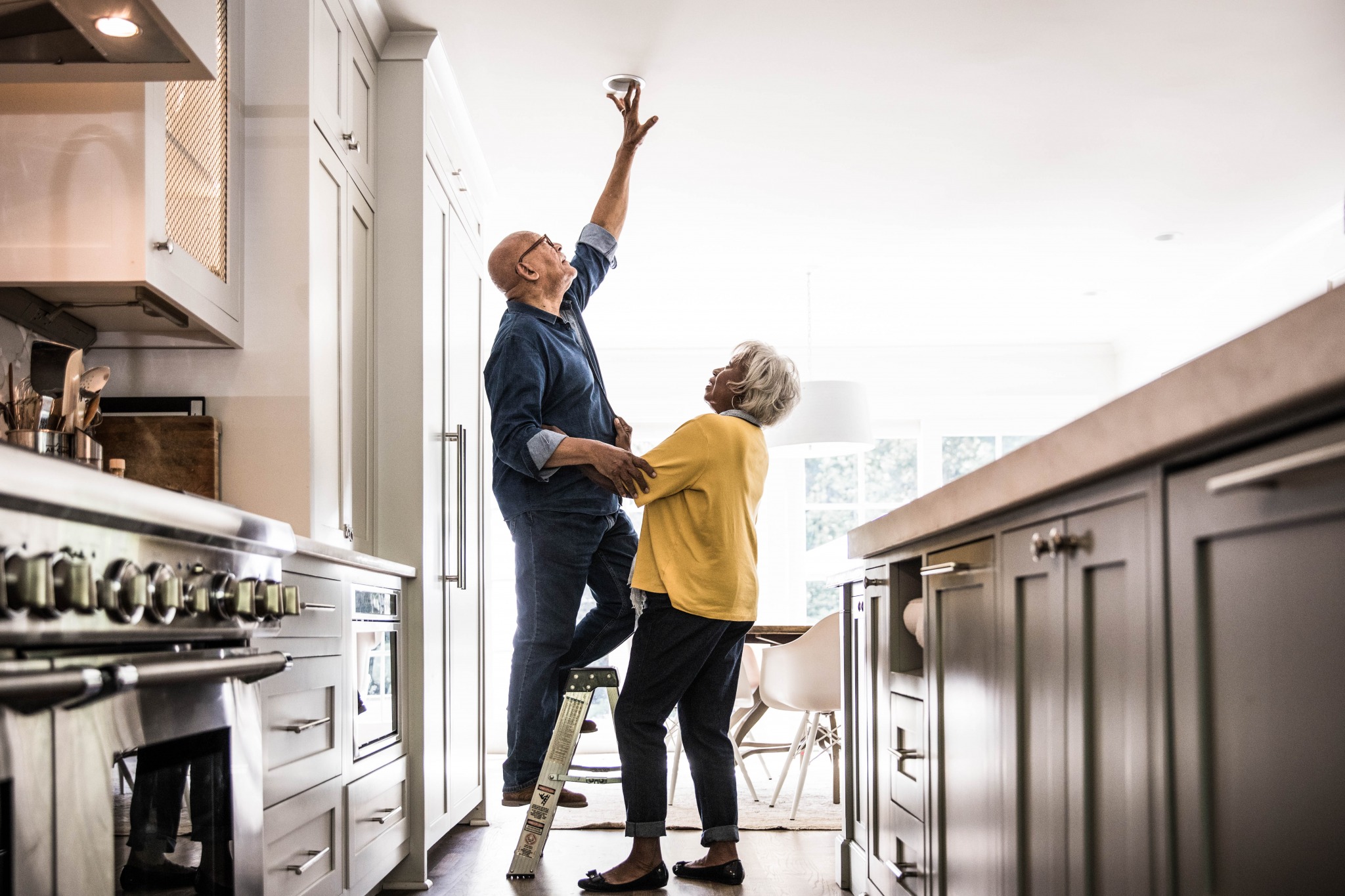
man and woman installing light bulb

Sep 15 2020

Courtesy of Zillow

Not surprisingly, a recent Zillow survey¹ found that most people — 81% — reported spending more time at home this year compared to the same time last year. Some of us might be feeling a little stir-crazy, but others are taking the opportunity to tackle home improvement projects. You may decide to change up your space for your personal enjoyment or comfort, but if you’re a homeowner looking to sell, it’s worth considering which projects will not only look good but offer the best return for your time and effort.

Zillow partnered with Thumbtack to determine the average costs of a few common improvements sellers make before listing their home for sale. By better understanding the costs, you can decide whether it’s worthwhile to DIY or call in a pro. 

Whatever route you take, a few well-chosen updates could improve your home’s appeal and value. Zillow data finds homeowners who make at least one improvement are more likely to sell their home above their list price than those who don’t make any improvements: 23% vs. 17%, respectively.² With sale prices climbing and homes selling at their fastest pace in more than two years, this may be a good time for would-be sellers to start prepping their homes for listing.  

“There are small things anyone can do to present their home in a better light,” said Sue Cohn Darmon, a Zillow Premier Agent in Connecticut with William Pitt Sotheby’s International Realty. “First impressions go a long way, especially since buyers are now spending more time searching online for homes. Listing photos are going to look better if the home appears well-maintained. If the small things are taken care of, the assumption is that the bigger things that aren’t visible have been taken care of too.”

Here are five DIY projects recommended by agents that could help increase your home’s value.

Upgrade your lights

Good lighting can bring out the best in your home. Updating old fixtures and adding dimmer switches are fairly simple upgrades. You could also consider replacing your fixtures with smart lights controlled by an app, which can help you save on your energy bill and sell your home faster. Zillow research finds homes mentioning smart lights in their listing description sold seven days faster than expected.

Here’s a DIY guide to changing a light fixture, or if you want a professional installer to do the job, Thumbtack finds the average cost is $380.

Replace your faucets

Whether your look is modern or traditional, a new faucet can enhance the style of your bathroom or kitchen. Make it a touchless faucet for added appeal, as COVID-era buyers increasingly look for smart features that will keep their homes germ-free.

With attention to detail and a tolerance for tight spaces, you can handle this job yourself, but if you’d rather leave the under-sink contortions to a pro, Thumbtack finds, on average, you can expect to pay $205 to replace bathroom fixtures.

Landscape smartly

A desire for more outdoor space is the top reason people say they would consider moving as a result of social distancing recommendations, according to a Harris Poll survey conducted for Zillow.³ There’s no better time to spruce up your yard and create the functional, beautiful outdoor space buyers want.

If you don’t like getting your hands dirty (literally), expect to pay $2,600 on average, according to Thumbtack, for a professional landscaping business to clean up your yard, which typically covers mowing, pruning, weeding, planting new flowers or shrubs, and adding new soil, mulch or bark dust. Zillow research found homes mentioning landscaping in their listing description can sell for 2.7 percent more than expected, so depending on the value of your home, it could be a worthwhile investment.

Add a fire pit

Now that you have a nicely landscaped yard, go one step further and install a fire pit to create a family-friendly backyard hangout. Listings mentioning a fire pit can sell for 2.8 percent more than similar homes, according to Zillow research. Interestingly, that sale premium is higher than homes mentioning an outdoor fireplace or a chimenea. An added bonus: This is a DIY the whole family can help with

Paint your front door (and more)

A freshly painted front door can boost your curb appeal, and if you’re thinking about selling, you may be surprised by the winning color when it comes to ROI: Homes with black front doors can sell for up to $6,000 more than similar homes, according to Zillow research.

If it’s in your budget, consider painting the whole exterior (probably not black, though!) to create a great first impression. In a survey of Zillow Premier Agents, 77% recommended sellers paint their home.4 Thumbtack finds the average cost of exterior painting is $2,535.


1. Zillow Group Population Science Survey on Time Spent at Home, conducted 7/16/2020 – 7/21/2020
2. Zillow Group Consumer Housing Trends Report 2019
3. This survey was conducted online within the United States by The Harris Poll on behalf of Zillow from May 4-6, 2020 among 2,065 U.S. adults ages 18 and older. This online survey is not based on a probability sample and therefore no estimate of theoretical sampling error can be calculated. For complete survey methodology, including weighting variables and subgroup sample sizes, please contact press@zillow.com.
4. Zillow Group partnered with independent market research and data analytics firm YouGov® to conduct a nationally representative, online quantitative survey that gathered information from 1000 sellers that sold a home in the past 6 months and 500 residential real estate agents. For more information visit zillow.com/report

 

4 Easy Ways to Save Energy and Money in Your Home

  • By
  • Posted

You have the necessary appliances like a refrigerator, stove, or microwave, and now you’re wondering what you can do to make your house more energy efficient. Here are some great pieces of technology that can make your house eco-friendly and even save you a few hundred dollars each year. Let’s take a look at a few of them!

led lights

By Jeremy Atkins, Rocket Homes Real Estate LLC


1. Smart Power Outlets

There are two main types of power outlets out there. One is a “connected” outlet and the other is an energy saving outlet. Connected outlets sync to your Wi-Fi network allowing you to control the power output to appliances remotely. Leave a fan on while at work? No need to let it run all day – just hop on your phone and turn it off. These are usually in the $25-$60 range depending on the unit.

Energy saving outlets go a step further by turning the outlet off completely. Kind of like flipping a switch on a circuit breaker. This saves you from the dreaded “vampire power” which is when a plugged-in device uses electricity, even when it’s turned off. These are a great way to keep your energy usage down and even save upwards of a $150-$400 per year. Energy saving outlets, like these, can be found for around $6-$25.

Energy saving outlets, like these, can be found for around $6-25.

2. Smart Thermostats

For someone like me who loves tech, smart thermostats are amazing. They connect to your Wi-Fi network and your furnace. Over the course of a week or two, they learn your schedule and heat up or cool your house down automatically right before you get home. They also adjust for when you leave. This is another boon for us forgetful folks. I can hear Ron Popeil now “Set it…and forget it!”

Most smart thermostats can be controlled remotely and allow for scheduling via an app or on the device. They’re easy to use and will help you save an average of $145 a year. The main players in this market are Ecobee, Nest, and Honeywell and they range from $170-$250.

3. LED & Smart Lights

Not as rare or expensive as they used to be, LED lights are a pretty amazing way to reduce your carbon footprint. A basic, 60-watt equivalent LED light bulb will use 10-15% of the energy needed of an incandescent bulb. They even give off less heat, which will help with your air conditioning bill in the summer too. You can find them for as little as $3 and they go up from there.

This wouldn’t be a “tech” article if I just talked about regular old LED lights. Good thing there are smart lights! I bought some Philips Hue lights a few months ago and they are awesome. I have them set to turn on at sunset because my wife is usually home then. Today, she has a meeting and isn’t home yet so I just went into to the app on my phone and turned them off. I even have them programmed to turn off at 8 am every morning just in case my wife or I forget to turn them off. Some versions can even allow you to adjust the color and sync them to music! Unfortunately, these can be pretty expensive at around $50 per bulb but could save you around $2-$4 per year.

4. Dual-Flush Toilet

Traditional toilets use more water than we usually need when we flush. That’s where dual-flush toilets come in. These unique thrones have a light flush option which, depending on the toilet/kit, uses a half-gallon less water per flush than a full-flush version. If you need more…ahem…flushing power, use the full flush mode and it’s business as usual. There are multiple manufacturers that sell toilets with this capability and you can even find kits online to convert your regular toilet to a dual flush. With these upgrades, you can save around $200 per year in water savings depending on the size of your household.

I’m always on the lookout for ways to help me save money and green tech has certainly helped. I’m thrilled to have made some of these energy efficient upgrades and I can’t wait to add more. Whether it’s a simple replacement LED light, new smart thermostat, or a dual flush toilet, you too can make your home more energy efficient and even save some cash.


Jeremy Atkins: Writer, Rocket Homes

Top Eco-Friendly Home Features Most Homeowners Want

  • By
  • Posted

With climate risks rising, an increasing number of homeowners are trying to do their part to improve the environment by investing in green and sustainable products and systems. Following are the top eco-friendly features most homeowners want in their homes.

Solar panels on roof

Content sponsor Quicken Loans for REALTOR Magazine reveals the energy-saving products most in demand right now.


By Rachel Burris

What Are Eco Homes?

Eco homes are designed to promote greener lifestyles by minimizing the greenhouse gases they emit into the atmosphere. These homes reduce their environmental impact by including sustainable materials and technologies that reduce homeowners' energy and water needs.

Each of the following eco-friendly home features helps limit the waste produced by households. 

energy star

  • Energy Star-rated appliances. Homes with high-efficiency appliances are in demand because they offer enhanced performance with reduced energy usage. Not only do Energy Star-rated appliances lower homeowners’ carbon footprint, but they also look good and reduce utility costs.

              Programmable thermostat

  • Programmable thermostats. Homes with older HVAC systems are wasteful and costly because they pump hot and cold air throughout the home without regard to when and where it’s needed. Conversely, programmable thermostats provide homeowners with increased control over their climates.

           Radiant floor heating

  • Radiant floor heating. With heat directly transferring from the ground to the individuals standing on it, radiant heating uses much less energy than traditional heating methods. Commonly found in luxury bathrooms, radiant heating requires electric coils or water tubing to be installed under the floors. It’s pricey to install, but this technology ultimately contributes to lower energy expenses.

           Man installing solar panels

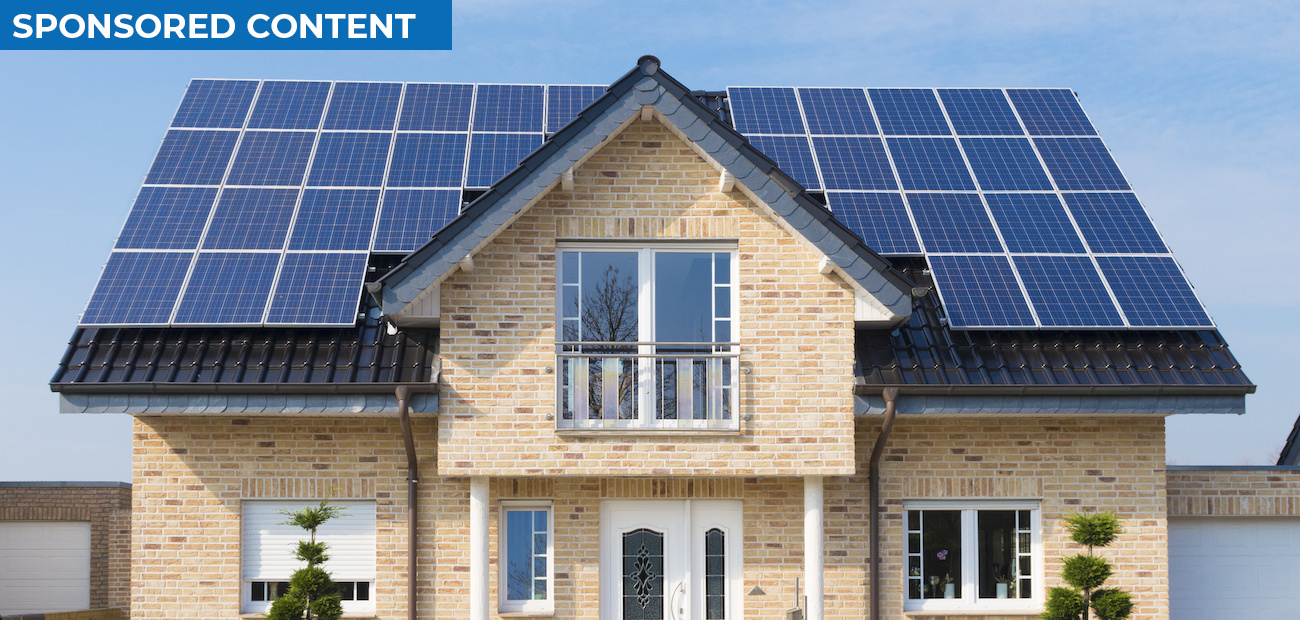
  • Solar panels. Instead of relying on the utility company to provide electricity, homeowners' are interested in generating clean energy themselves. Now that capturing the sun’s power is far more affordable, everyone's looking to deck their homes out with solar panels.

           Wood  Cermanic tile

  • Recycled materials. Building and finishing homes with recycled materials is a trend that’s on the rise. Producing new materials depletes many natural resources, so reusing them eliminates waste and diminishes the environmental impact. Reclaimed materials, like barn wood and recycled quartz, also are more affordable and can furnish homes with striking textures.

             Geothermal systems

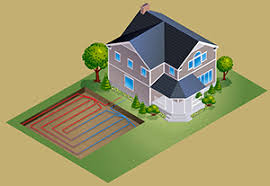
  • Geothermal systems. “Geothermal systems use the ground’s relatively cool temperature to cool a home in the summer and relatively warmer temperature to heat homes in the winter,” says Chris Fisher, manager of solar product development and marketing at CertainTeed. “They’re eco-friendly because they can displace heating loads, which currently rely on the burning of fossil fuels to produce heat.” While this method is more efficient than traditional HVAC systems, it’s also more expensive to install. Since it regulates temperatures by transferring heat from the earth into your home, installation requires extensive drilling.

The Benefits Of Eco Homes

With their environmental and financial advantages, it’s no wonder everyone's seeking eco homes. The benefit of homes with eco-friendly features are they're highly coveted, so they’re likely to sell faster and possess a higher resale value in the future.


Rachel Burris is a writer for Quicken Loans’ Publishing House, covering topics of interest to present and future homeowners, as well as industry insiders.


3 Ways to Build Home Equity

  • By
  • Posted

Buying a home is a big step for both your family and your financial wellbeing. As you pay off your mortgage, you begin to build equity in your home. Equity is the difference between the market value of your home and how much you still owe. If that number is positive, you’ve built equity, which can come in handy if you ever need to take out a loan or as a profit when you decide to sell your home. Here are some ways you can build equity in your home faster.

By Christopher Kelly, RE/MAX Bayside

Pay More

You have a certain amount that you’re required to pay on your mortgage each month, but you don’t have to stop at the minimum. A large portion of mortgage payments covers interest and insurance. Upping your payment to pay down your principal loan amount will speed up your payment schedule. Even an extra $50 a month can have a big impact.

Upgrade

The amount of equity you have in your home depends on what your home is worth, so making upgrades that increase the value of your home is another way to increase your equity. One of the most lucrative upgrades you can make is replacing old garage doors. Just be sure to do your research when upgrading your home to see which renovations offer the greatest return on investment.

Restructure Your Mortgage

If you initially signed up for a 30 year mortgage, but are now at a point where you want to pay your loan off faster, you may benefit from switching to a 15-year plan. You’ll pay more each month, but you’ll pay less interest over time and could pay off your mortgage years ahead of schedule.

5 Budget-Friendly Ideas to Transform a Home's Style

  • By
  • Posted

It can be an extremely expensive endeavor to redesign a home. If resources are limited, don’t be discouraged. Consider ways you can use what is already in the home to enhance the look and cut down on costs. Bringing in just a few essential items can change the tone of a space and have a big impact. Here are some ideas.

 Architect, Monica Gibson offers up tips to create a more inviting space.

1. Add indoor plants

Adding plants in your living space is one of the easiest and best ways to transform your home. Plants usher in natural beauty and color to any room in the most affordable way. Regardless of the space you have, growing indoor plants is ideal for any room.

Try different ways of placing them to change the look of rooms. If you have less space, hang plants or place them on floating shelves. You also can use plants on the floor where space is available.

Do not let lack of natural light keep you from transforming your home with indoor plants. Invest in reliable grow lights to provide lighting to your plants. You now have a solution for brightening that boring corner in your living room.

2. Repaint the walls

Photo credit: Dunn-Edwards (paint color: Minty Fresh)

Another way to instantly transform your home on a budget is by adding a fresh coat of paint to the walls. You can decide to use the existing hue, or you can change it to a different shade for a fresher look. The latter, however, would mean changing a few accessories in the home to create a balanced feeling. Need some color inspiration? Take a look at 2020’s hottest paint colors

3. Swap Out window treatments

Many people underestimate the effect window treatments can have on a room. The color, texture, and fabric—and even how treatments are placed—can have a huge impact on the overall look of any room. Therefore, changing window treatments can transform a space without having to spend a fortune.

Consider creating an illusion of a high ceiling by raising the window panels to the top of walls. Opt for materials such as cotton, linen, and silk to add greater elegance to the windows. If you prefer having blinds, wood and woven bamboo always make for a great choice.

4. Replace the pillows

Another underestimated way to greatly make your home more elegant: pillows—lots of them. Pillows can bring life to your living space. They also offer extra support on the sofa.

Consider replacing your old pillows and throw pillows for fuller ones. When it comes to throw pillows, experiment with colors and textures. If they are not worn out, just replace the covers with ones that have different colors and textures. Get more tips on using pillows in your staging.

5. Use wall hangings

A budget-friendly alternative to repainting the walls is to use wall hangings. Invest in unique art pieces, or have some customized. You can even add a painting that you made yourself to create a more personalized feel. Family portraits also make a great choice when it comes to wall hangings. But keep in mind that home stagers will often advise removing any personal photos prior to selling a home.

6. Get rid of old furniture

That old, ugly chair that you are holding on to for sentimental value is the undoing in your living room. You don’t want furniture that looks worn. Don’t worry about the cost of replacing it. Instead, take advantage of the empty space to rearrange the rest of the furniture for a fresh look.

Alternatively, find an affordable replacement in second-hand shops. You can always change the upholstery to have it match the rest of your furniture.

Take heart: There’s an endless list of design ideas to achieve a luxurious effect without breaking the bank. Keep in mind that labor costs are usually the biggest expense. If you eliminate that cost by doing more work yourself, you can find more savings. Also, be strategic by just replacing a few key items.

Avoid a complete redesign. Instead, change little pieces; it can go a long way.

ABOUT THE AUTHOR: Monica Gibson is an architect, with a degree in architecture. She has eight-plus years of experience in interior and exterior design. Her mission is to inspire others to live their dreams and create their perfect sweet home. Lena puts a big effort into working with her clients and tries to help them in the best way she can.


Home Sells in a Mere 12 Hours After Remote Staging

  • By
  • Posted

Remotely staging properties is a growing trend in the pandemic. And the service may stick around even after the health crisis is over, considering the success some stagers are having.

By Melissa Dittmann Tracey

Home stager Francesca Mahoney was able to transform a space without ever stepping foot inside. Francesca along with Creekhill Designs LLC in Holly Springs, NC, did a video staging consultation with sellers in April, and then the home went under contract in just 12 hours. The homeowner emailed pictures of the home to Mahoney, and they met over a FaceTime video call for two hours to stage the 3,000-square-foot property, inside and out.

In the family room, Mahoney honed in on the fireplace in the back corner. She had the sellers move the sofa and pare down the furniture and accessories, which drew eyes to the fireplace first. She also urged the sellers to remove distracting decorative items and accessories, limiting kitchen countertops to only three items.

On curb appeal, she guided them in showcasing the front porch, such as with the addition of rocking chairs, hanging baskets of flowers, a fresh coat of paint on the front door, and a new doormat. “Today’s buyers are very discerning due to HGTV and Pinterest,” Mahoney says. “Getting compelling and beautiful listing photos is always critical, but even more so in our current reality.”

Mahoney plans to continue offering remote staging consultations even after the pandemic. “I have been pleasantly surprised at how effective they are,” Mahoney says.

Before

After

Before

After

Before

After


Melissa Dittmann Tracey is a contributing editor for REALTOR® Magazine


Inventory on the Way: New Homes Post Big Gains

  • By
  • Posted

Housing is giving a boost to the economic recovery and housing inventories. Single-family and multifamily construction jumped nearly 23% last month, the Commerce Department reports. This marks the highest production rate since February.

Broken out, single-family construction jumped in July by 8.2% to a seasonally adjusted annual rate of 940,000. The multifamily sector, which encompasses apartment buildings and condos, rose 58.4% to a 556,000 pace, the Commerce Department reports.

“The market is being buoyed by historically low interest rates, a focus on the importance of housing, and a shift to the suburbs as more buyers are seeking homes in suburban communities, exurbs, and more affordable low-density markets,” says Robert Dietz, the NAHB’s chief economist.

New construction for single-family and multifamily units now nearly matches pre-pandemic activity from the first quarter. “Such growth is needed to steadily relieve the housing shortage,” says Lawrence Yun, chief economist of the National Association of REALTORS®. “This kind of growth is also a major contributor to local economic recovery.”

However, Yun cautions that the increase in multifamily units may lead to an oversupply of apartment buildings, notably in city centers where there has been some shift in consumer preference for single-family homes in the suburbs during the pandemic.

On new-home construction, buyers may face higher prices. Builders caution that an increase in lumber prices—by more than 110% since mid-April--is adding about $14,000 to the cost of building each new single-family home.

Nevertheless, high buyer demand is still increasing the construction of single-family units, a sign Yun says is “welcome.” Housing inventory nationwide for homes for sale is down by 19% from a year ago. “There is intense buyer competition in the market as a result,” he notes. In particular, the Western region of the U.S. is seeing competition, as new-home construction is not rising as much and the inventory shortage is most pronounced.

Combined single-family and multifamily starts saw the largest jump last month in the Northeast, increasing 9.3% annually, followed by a 5.9% increase in the Midwest and a 5.2% uptick in the South. The West saw the lowest increase but still rose 1.4% annually.

Despite the recent increases in new-home construction, Yun predicts inventory shortages will remain problematic for the remainder of the year but sees an opportunity for a more balanced market with housing supply in 2021.

Housing permits, a gauge for future construction, rose 18.8% to a 1.50 million unit annual rate in July, the Commerce Department reports. Single-family permits jumped 17% while multifamily permits increased 22.5%. Housing permits were highest in the South, up 5.4%, and the Midwest was up 3.2% annually, but permits were down 6.2% in the Northeast and by 1.6% in the West.

Source: National Association of REALTORS® and National Association of Home Builders


6 Home Trends Buyers Love

  • By
  • Posted

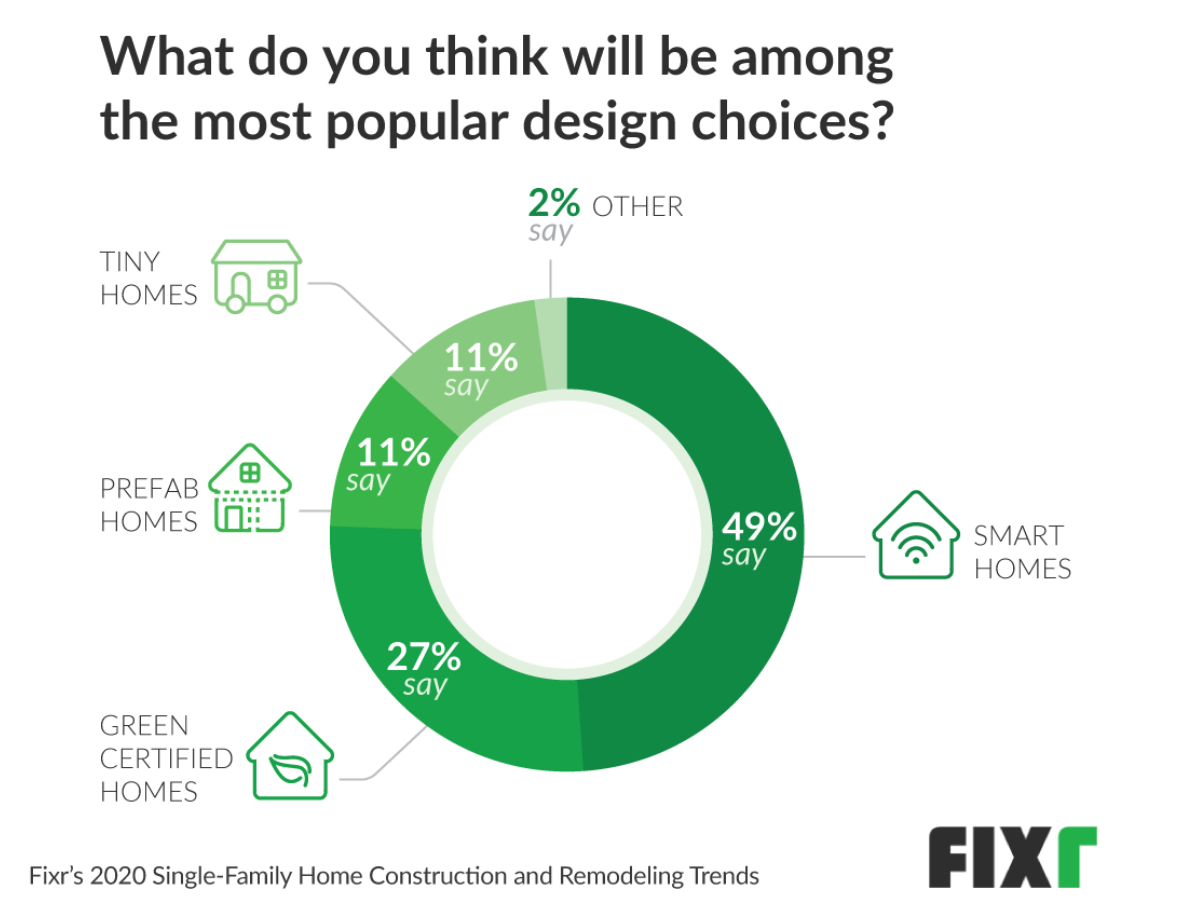
Open floor plans, smart homes, and outdoor areas are among the features in top demand for home shoppers this year. Home improvement website Fixr’s recent study, Single-Family Home Construction and Remodeling Trends 2020, highlights the renovation and construction choices of buyers and homeowners in 2020. The results reveal some key areas of interest in home design.

By Yuka Kato

1. Open floor plan and two-story homes represent the most popular layouts.

While there has been a trend toward open floor plans for the past few years, 2020 is seeing an overwhelming consensus: 90% of experts selected an open floor plan as the most popular single-family layout. And it’s likely to remain so in the future.

As quarantine periods and social distancing guidelines force families to spend more time together at home, large common areas command a premium value. Family rooms, dens, and open kitchen areas are acquiring new importance.

Another large percentage—77%—are favoring two-story houses in 2020. Compare this to the 29% who preferred single-story homes, or the 2% who favor split-level residences.

2. Smart homes rank first among design choices.

A growing trend in home design is the smart home, in which AI-based automation systems are seamlessly incorporated into electric circuits, heating/cooling systems, and entrances. Buyers this year are likely to appreciate homes in which smart thermostats, security cameras, and smart outlets are already installed.

3. Most homeowners make accessibility modifications to their home for future personal use.

Homeowners looking to age in place are exploring renovations that allow them to do so more easily. Homes with accessibility features likely will be more attractive to senior buyers as they look toward a future of independence, even as their physical abilities may decrease. This future need is a motivating factor behind such renovations (54%) than current personal use (11%) or current use for an aging relative (22%).

Buyers also are evaluating potential homes with accessibility modifications in mind. For instance, a front yard with space for a ramp will be more appealing than one with front steps leading directly to the street.

4. Energy efficient homes with tight building envelopes are among the top designs for green construction.

As Americans deal with furloughs, layoffs, and economic uncertainty, many are paying more attention to their energy bills. Energy efficient homes are suddenly much more attractive than conventional properties, and buyers who may not have ever considered green construction are making energy efficiency a priority.

Sixty-two percent of design experts say energy efficient homes are a top priority in 2020, according to Fixr’s study, far outweighing other options like cool roofs or solar panels.

Experts say a tight building envelope—more than exterior or interior insulation—is the most common way to prevent energy seepage. A tight building envelope minimizes air transfer and can be an important feature of an energy efficient and environmentally friendly home. A home with both effective insulation and a tight building envelope will provide the best value to a buyer who desires lower energy bills and minimal heating requirements.

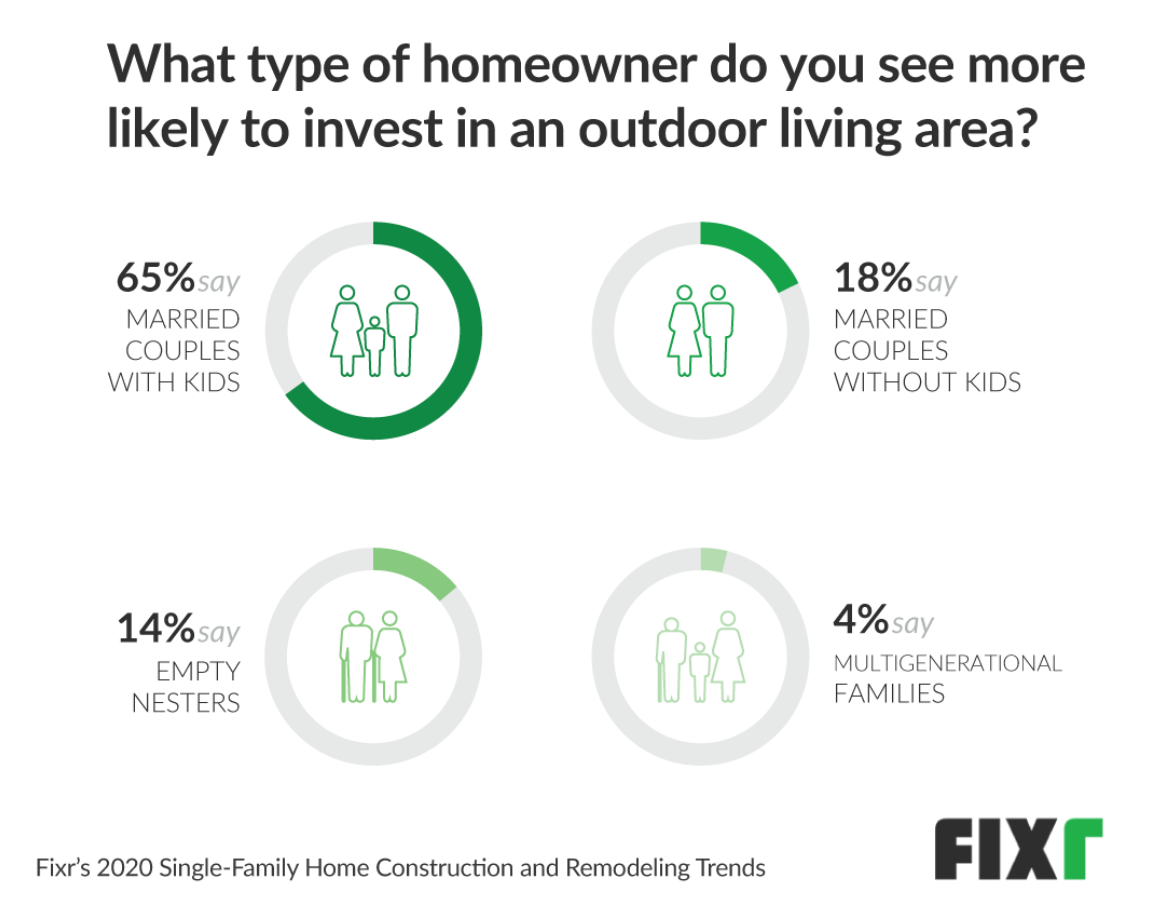
5. Family space and outdoor kitchens are trending in 2020.

Outdoor playsets, firepits, and recreation-oriented yards are seeing an uptick in popularity, especially among married couples with kids. 

This is a 2020 trend that has only been cemented by quarantine rules and social distancing regulations. As playgrounds, parks, and outdoor amusements became unavailable, families were forced to think in terms of what outdoor activities they could offer their children on their own property.

But outdoor living spaces aren’t limited to playgrounds, decks, and patios. Fixr’s research shows that outdoor kitchens were nearly twice as popular as a traditional patio. The outdoor kitchen is another trend that has been steadily increasing over the past few years, and it will be interesting to see how it continues to evolve in 2020 and 2021. New recommendations for socially distant entertaining, which may be better suited for meals and meetings with friends outside, may increase the number of homeowners wanting both outdoor kitchens and seating spaces.

6. Contemporary and modern will be the most common styles used in modular construction.

Modular and prefab construction continues to be widely used, and Millennials are most likely to build modular homes. As part of the Fixr survey, consumers were asked which style of prefab building would be most popular in 2020. A large majority (62%) indicated that a contemporary, modern style would be most commonly selected by home buyers. The runner-up choice was ranch-style—but it was only selected by 22% of respondents.

This year has been in many ways an uncharted year, full of unexpected surprises. But even as priorities have changed, many home buying and renovation trends have remained consistent. 


ABOUT THE AUTHOR: Yuka Kato is an industry analyst at fixr.com, a leading home improvement website dedicated to providing the most accurate cost guides and advice. She writes about interesting trends and insights in the construction and remodeling industry.

How to Move While Social Distancing

  • By
  • Posted

Are you getting ready to move to a new home or just looking for ways to help keep your family healthy as cold and flu season approaches? Find tips to help you manage your goals this summer in the article below.


By Christopher Kelly of RE/MAX

Summer is one of the most popular times to move, but how do you gather your friends, family, or hired movers together safely while practicing safe social distancing? Whoever you recruit to help move your belongings from point a to point b, here are some tips to help you and your family stay safe.

Provide Essentials 

Make sure you have soap, water, hand sanitizer, masks, gloves, and shoe covers available during your move. These items, when used correctly, can help prevent the spread of germs.

Set Some Ground Rules

Whether the people helping you move are there as volunteers or earning a living, you should take charge and outline basic precautions you want everyone to use. Ask your helpers to wear a mask, wash or sanitize their hands often, and stay 6 feet apart whenever possible.

Use New Boxes

Experts estimate that cardboard can carry COVID-19 for 24 hours, so it may be best to invest in new boxes instead of opting for used boxes for your next move. You can purchase moving boxes from most moving or storage companies.

Sanitize Before and After the Move

Sanitize your furniture, boxes, and household touch points before your moving help arrives to help create a safe moving environment. You should also sanitize these items after unloading them at your new house.


What Are The Five Biggest Money Mistakes Buyers Make?

  • By
  • Posted

Buying a home is one of the biggest purchases you'll ever make, so there's no question that you should make an effort to spend your money wisely. Especially when you're unfamiliar with the process, it's easy to make mistakes that can have a big impact on your wallet. With that in mind, here are some of the biggest money mistakes buyers make.


By Tara Mastroeni 

Forgetting to shop around for a lender:

Buyers need to remember to shop around when it comes to obtaining a mortgage. You might meet a lender who, on paper, offers the most competitive rate, but don't forget to take into account other factors as well. Some banks may have special programs for first-time home buyers, or they may put money toward closing costs, or toward your downpayment. Your goal should be to find the loan that makes the most sense for you, overall.

Not working with a lender before shopping for a home:

Some buyers fail to get their finances and credit score in order, work with a lender and get pre-approved before they start their home search. Ideally, buyers should make certain they are vetted with a lender and ready to go prior to their home search. This ensures that when they see a home they absolutely love, they can move on it quickly. There's nothing worse than seeing the hurt and disappointment in a buyer who has fallen in love with a home, but is not financially ready to make an offer.

Buying a home above your budget:

Don’t look for a home that's at the very top end of your monthly budget. You need to consider what you'll do if your income goes down or some other unexpected expenses suddenly come up. Also, when buying a home, you need to factor in added costs such as higher heating and cooling, property taxes, maintenance costs. You'll also want to leave room in the budget for other expenditures such as saving for things like retirement, college funds for your children, or vacations.

Skipping the home inspection:

A lot of buyers who are penny wise and pound foolish. They think they can save a few hundred dollars by skipping inspections. While this may be true, skipping inspections can lead to them spending thousands of dollars in necessary repairs down the road.

Opening new lines of credit during underwriting:

One of the biggest financial mistakes a buyer can make is opening new lines of credit during underwriting, Whether they purchase a car or open new credit cards to purchase furniture are huge mistakes because the underwriter has to include the new debt with their debt-to-income ratio.

Unfortunately, people believe if they have an approval or conditional approval from their lender it’s okay to open the new lines of credit, but what they fail to realize is that the underwriter has to pull a new credit report on the day of closing to ensure they haven’t obtained any new debt. Of course, if they have, then the lender has to recalculate the new debt-to-income ratio and may not be able to issue a new approval.

Contributor for Forbes Magazine: Tara Mastroeni 


1 in 5 Americans Have Moved During the Pandemic

  • By
  • Posted

Millions of Americans have relocated this year due to the COVID-19 outbreak, according to the Pew Research Center. New data released this week shows that 22% of Americans either moved or know of someone who did.

From Realtor Magazine

The reasons vary, researchers say, such as college students moving out of dorms as schools closed abruptly, homeowners and renters leaving communities perceived as unsafe, and people moving from housing they could no longer afford. The findings are based on a survey conducted in early June of nearly 10,000 people.


Infographic on moving during pandemic. Visit source link at the end of this article for more information.

© Pew 


Young adults have been the most likely to move. Thirty-seven percent of those ages 18 to 29 said they either moved, someone moved into their home, or they knew someone who moved because of the pandemic.

Overall, 28% of those who have moved during the pandemic say the most important reason was to reduce their risk of contracting the virus. An additional 23% say it was because their college campus closed, 20% said they wanted to be with family, and 18% said it was a financial decision driven by either a job loss or another money-related reason.


Source: “About a Fifth of U.S. Adults Moved Due to COVID-19 or Know Someone Who Did,” Pew Research Center (July 6, 2020)


What Greener Homes Are Made Of

  • By
  • Posted

TIMBER! Structures are being made from engineered wood known as mass timber. The wood is fire resistant and 80% lighter than concrete or steel but just as strong. 

What Greener Homes Are Made Of

By Joy Choquette

Tune in to the materials and practices fueling resilient, eco-friendly construction. “Being green” has become more than a catchphrase. It’s a filter through which some people, including real estate buyers, are making life choices.

As consumer interest grows in the benefits of eco-friendly, resilient commercial and residential properties, ­REALTORS® are getting the message. In the 2020 REALTORS® & Sustainability Report, 70% of residential agents and 74% of commercial practitioners found that promoting energy efficiency in their listings was somewhat or very valuable. Almost 60% of commercial pros said they are comfortable answering questions from clients about building performance.

In addition to finding properties that meet clients’ wants, savvy real estate pros are paying attention to construction practices and materials that are being used for sustainability features in both new and older structures.

Which green building practices should you showcase? Which cutting-edge and resilient materials are most popular now? And what’s the potential return on investment? As you share information with clients, consider three factors: location, consumer priorities, and building trends.

Know Your Area

While some things—like low-VOC paint and energy-efficient lighting—are important no matter where one is located, other aspects of green building are more location-specific. Considerations differ for building in, say, Alaska versus Alabama.

As an example, the majority of homes in Tennessee have ­below-ground crawl spaces rather than full basements, notes Alan Looney, president of Castle Homes in Brentwood, Tenn. They can be damp and musty despite vents to the outdoors.

To prevent moisture and increase efficiency, Looney says, owners should seal crawl spaces and floors and then place foam around the foundation. Likewise, it’s useful to bolster the insulation in attics. “By foaming the roof deck and having your mechanical systems in an air-conditioned space, the system doesn’t have to work as hard to cool the entire house,” Looney notes. The bottom line: When you’re serving green clients, you need expertise on the housing stock, as well as the green practices and materials, common in your area.

Priority Setting

Providing a cost-benefit analysis can help determine the payoff for homeowners keen on adapting efficient systems. Looney notes that while underground rain harvesting, geothermal, and solar systems are all options, it can take years to see a return on investment. For instance, a recent geothermal project cost approximately $85,000, Looney explains, whereas a standard air-source HVAC system would have been closer to $45,000. The EPA estimates that homeowners save 30% to 70% on heating bills and 20% to 50% on cooling costs by choosing geothermal over conventional systems. With a 30% tax rebate (a federal incentive that drops to 26% in 2020 and 22% in 2021), the system will take an estimated 12 years to see a financial benefit.

With so many environmental considerations, how do you help clients sort through competing priorities? Kate Stephenson, a partner at Helm Construction Solutions in Montpelier, Vt., believes the top concern for both residential and commercial ­clients should be air quality. Why? It affects all aspects of life, from the quality of sleep one gets at home to an employee’s ­ability to concentrate at work, says Stephenson, whose com­pany focuses on sustainable project management.

Air quality issues should be addressed when older buildings are retrofitted. “As air leakage is reduced to save energy and improve comfort, adding mechanical ventilation brings in fresh air,” Stephenson says. These systems are most important in kitchens and bathrooms, where air can be stale or moist.

Castle Homes targets another overlooked part of homes for air cleaning: closets. Installing exhaust fans in closets clears the air of chemicals used by dry cleaners.

Eyes on Mass Timber

An up-and-coming construction material with potential to reduce the industry’s carbon footprint is known as mass timber. This category of engineered wood is gaining attention in the U.S. for its resiliency and efficiency—so far, mostly for large-scale construction projects. Mass timber products consist of fibers, shavings, and other thin layers of wood bound together using resin or industrial glues to make large slabs that fit together easily. The layering process makes an engineered wood stronger than traditional wood, as well as fire- and earthquake-resistant.

Though mass timber, also known as cross-laminated timber, was introduced in Europe in the 1990s, the U.S. construction industry is still learning about it. Projects using the material are moving forward, especially in the multifamily sector, but building code and supply issues remain impediments to major expansion. At the start of 2020, the U.S. had 784 mass timber multifamily, commercial, or institutional projects constructed or in design, according to the Wood Products Council.

Industry observers say as familiarity increases and materials become more available, mass timber has the potential to replace masonry, concrete, and even steel as a go-to material for flooring, walls, or entire buildings. It’s also cost-effective, as large prefabricated panels can be assembled quickly at a building site. Akin to giant Lego pieces, the panels are constructed to fit the precise dimensions needed for a project.

“We had to find a way to build smarter with science and innovation to create engineered wood products,” says Scott McIntyre, North American business director for performance materials manufacturer Hexion. The company creates resins for engineered wood products that are environmentally responsible and thermally stable. “In building and construction, we manufacture resins that allow you to use a solid tree,” notes Sydney Lindquist, sustainability leader at Hexion. “Prior to engineered wood products, only about 60% of the tree was used and the rest would be waste.”

A common environmental question around mass timber is whether forests are being cleared to produce it. Lindquist says that’s not an issue. “Sustainably harvested wood is grown very quickly. It’s not a well-known fact that sustainable forestry helps increase new growth,” she says.


Joy Choquette is a freelance writer based in Swanton, Vt.


To buy or wait?

  • By
  • Posted

Whether you’re hearing about low interest rates or longing for more space, you might be wondering if this is a good time to buy. Here’s what you need to know.

From Zillow.com

Are You Missing Out if You Don't Buy Now?

Not necessarily. There are many factors to consider beyond the current shifts in the market.

Zillow economists predict that home prices will most likely decrease between 2-3% through the end of the year from pre-COVID levels and slowly recover by late 2021.

The predictions include two other possible scenarios: Prices decline as much as 4% and take longer to recover, or as little as 1% and recover more quickly. For example, a home priced at $250,000 in February 2020 could be priced between $2,500 and $10,000 lower, at least through the end of the year, according to the forecast.

Which scenario plays out depends on many things, including how quickly the market reopens and whether interested buyers can still afford to purchase a home.

What the forecast doesn’t change is whether buying now or in the foreseeable future is right for you. The decision to buy depends on your personal circumstances. Trying to time the market for the best deal is something even professional investors aren’t very good at.

According to Zillow economists, the current environment poses both opportunities and challenges.

New opportunities for buyers might be out there

If demand stays strong and the crisis passes relatively quickly — both big “ifs” at this moment — then we can probably expect price growth to accelerate like it was earlier this year. If that’s the case, it might be a good time for some buyers in some markets to get ahead of any growth in home prices. Other factors that could help buyers:

  • Mortgage interest rates are very low, which has the potential to significantly boost your buying power.

  • There could be less competition for the still-limited pool of homes for sale, with many people putting plans on hold and staying home.

  • Sellers may be more flexible on pricing and/or timing in order to close a sale, especially if letting their home stay on the market will cost them or delay their own plans.

But the challenges could be daunting

Even with the best forecasting, we can’t know for sure how things will unfold over the coming months. If the crisis persists and social-distancing and other behaviors last through the bulk of the year, home prices may fall somewhat in response to the lack of demand from buyers. It could make sense for some buyers to wait to see if the home they’re eyeing today is available at a lower price tomorrow. Additional considerations:

  • Inventory is already low, and it’s unlikely that many would-be sellers will list their homes right now. That could make it harder for you to find the right home.

  • Mortgage interest rates are low but volatile — and lenders are working through a flood of refinance applications. For would-be buyers who secured financing in early March, this may not be as big an issue. It’ll be a lot tougher if you have not yet started the mortgage process.

  • Logistical hurdles need to be addressed. It may be difficult to complete the sale on time if some of the connected businesses, such as appraisals, inspections and title services, are temporarily closed due to public health orders.

If you have the time and willingness to face the current challenges, now could present some interesting opportunities. But you should have a plan to ensure you can back off or reevaluate as the situation unfolds. If you’re risk-averse or don’t feel ready, you’re likely to be more comfortable waiting until the situation is more clear.

For the most up-to-date housing market analysis, data and commentary on how the market is responding to this situation, visit Zillow Research.

Thinking About Buying or Selling Your Home During This Pandemic?

  • By
  • Posted

Stop thinking and do it, it could be to your advantage! Here's why...

Courtesy of Keeping Current Matters

Every day that passes, people have a need to buy and sell homes. That doesn’t stop during the current pandemic. If you’ve had a major life change recently, whether with your job or your family situation, you may be in a position where you need to sell your home – and fast. While you probably feel like timing with the current pandemic isn’t on your side, making a move is still possible. Rest assured, with technology at your side and fewer sellers on the market in most areas, you can list your house and make it happen safely and effectively, especially when following the current COVID-19 guidelines set forth by the National Association of Realtors (NAR) and the Centers for Disease Control and Prevention (CDC).

You may have a new baby, a new employment situation, a parent who moved in with you, you just built a home that’s finally ready to move into, or some other major part of your life that has changed in recent weeks. Buyers have those needs too, so rest assured that someone is likely looking for a home just like yours. This year, delayed listings from the typically busy spring season will push into the summer months, so more competition will be coming to the market as the pandemic passes. Getting ahead of that wave now might be your biggest opportunity.

Bottom line, homes are still being bought and sold in the midst of this pandemic. If you need to sell your house and would like to know the current status in your local market, contact us to create a safe and effective plan that works for you and your family.

Check out our "Buyers & Sellers" tab at the top of this page for more information on how to go about it!


21-40 of 57 Posts

Get in touch!

Do not fill in this field:

I agree to receive marketing and customer service calls and text messages from Melanson Real Estate. To opt out, you can reply 'stop' at any time or click the unsubscribe link in the emails. Consent is not a condition of purchase. Msg/data rates may apply. Msg frequency varies. Privacy Policy.

This site is protected by reCAPTCHA and the Google Privacy Policy and Terms of Service apply.