Real Estate Market Statistics

Home sales slow in January, but median price still hovers near $400k

  • By
  • Posted

January is a slow time for real estate sales, but things were really slow last month. Only 870 homes were sold in New Hampshire, a 15.5 percent fewer Granite State homes were sold than January 2021, according to the latest data from the NH Realtors Association.

by Bob Sanders

Yet, prices rose 14.2 percent from a year ago, although the median price of a single-family home dipped to $399,700 from December 2021, only the second time since last May that the median has dipped below $400,000.

Condos? Pretty much the same thing. Sales went down 17.2 percent, but the median unit price rose 18.8 percent, to $300,000.

As usual, the problem was not the lack of buyers but a lack of sellers. Those homes that do go on sale are on the market for an average of 33 days. There were only 931 homes for sale in January, a 35.4 percent decrease from the previous year, and there were 706 new listings, a 25.3 percent decrease.

Homes were selling for 1.4 percent more than the asking price, the Realtors said.

Homes in Carrol County appreciated the most, at a median price of $445,000, a 33.9 percent increase from a year ago.  Rockingham County homes sold for a median $540,000, a 17.4 percent increase.  The biggest slowdown in sales came in Sullivan, where 28 homes were sold, – a 47.2 percent decrease from 2021.

-------------------

As inventory continues to sink, what next?

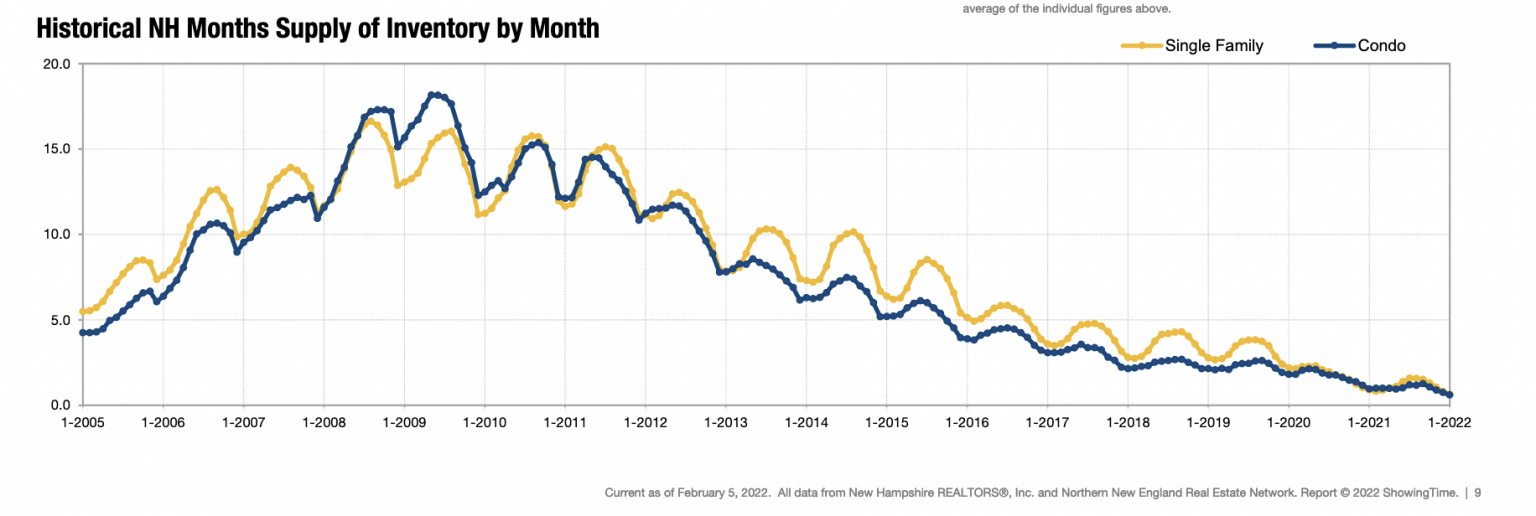
Housing remains scarce, and it continues to hit new lows. 

“In terms of inventory, it has been the lowest and it certainly feels that way,” said Adam Gaudet, president of the New Hampshire Association of Realtors board of directors and founder of 603 Birch Realty in Concord.

No crystal ball

Observers and stakeholders say the end of New Hampshire’s housing market spike is impossible to predict. 

The Realtors Association uses one metric above others when assessing the health of the housing market, Director of Communications Dave Cummings said. That measurement is the time it would take to sell all of New Hampshire’s housing inventory if no new houses came on the market. The hypothetical number – which factors in both inventory and demand – can speak volumes, Cummings said. A healthy market would take six months to sell all houses. Currently, New Hampshire sellers would take only 26 days. 

But Cummings argued it was only a matter of time before the pattern must reverse, if only because the state’s housing stock can’t get much lower.

“You know, we’re still just seeing it level, level, level out,” he said. “It can’t get too much lower, because essentially you’d have zero inventory.”

Contributor Ethan Dewitt , New Hampshire Bulletin


Attention Sellers!!!

When you list your property with our team of agents, you are provided with professional, courteous service from beginning to end. These services include, but are not limited to:

A free current market analysis: Determining the value of your property based on other properties, similar in nature that have sold or are currently on the market.

Listing your property: Entering the property in our MLS system, marketing through window displays, local and regional advertisements and various online media sources.

Representing your property personally: Having an agent from our office present at ALL showings.

Negotiating and closing the deal: Representing your requirements in the purchase and sale, while maintaining courteous representation throughout the closing.


So, if you're thinking about selling your home, give us a call at

603-569-4488

At Melanson Real Estate, we'll be happy to assist you with all your real estate needs.


The Middle Class Feels the Sting of the Housing Shortage and High Prices

  • By
  • Posted

The turbocharged housing market is hurting middle-class homebuyers stymied by a double whammy of fast-rising prices and a dearth of properties for sale.

(Getty Images)

By Clare Trapasso 

The analysis looked at how affordable homes listed for sale are for prospective buyers with different household incomes. It also looked at the number of homes for sale.

“In a highly competitive real estate market, the best areas for buyers are areas that have relatively more home available. But in order to truly be available, the home has to be for sale and affordable,” says Realtor.com Chief Economist Danielle Hale. “A homebuyer needs to ask themselves: ‘With my income and what’s on the market right now, where do I have the best shot from an availability perspective?'”

Buyers with a household income between $75,000 and $100,000 could afford only about 51% of the homes listed for sale. (Households include all adults living together, such as spouses and partners, extended families, and roommates.) That was compared with 58% in 2019. Those buyers are competing for just 245,300 homes nationally that are within their budgets.

Meanwhile, there were just 165,280 homes across the country that buyers could afford with household incomes between $50,000 and $75,000.

Even in the few places where housing became cheaper during the pandemic—such as the bigger, more expensive cities that became less desirable over the Past few years—the lack of homes for sale has made it harder for buyers to get an edge.

“Due to rising home prices and the ongoing inventory shortage, homeownership attainment will become especially challenging for middle-class buyers unless significantly more entry-level housing units become available,” Nadia Evangelou, NAR’s senior economist and director of forecasting, said in a statement. “Otherwise, the wealth gap between middle-income and upper-income households may grow even further.”

The 10 best metropolitan areas for buyers with household incomes between $75,000 and $100,000 were mostly in the South in less expensive areas that have had more new construction. These places all had more homes for sale at the right price for these buyers.

Deltona, FL, topped the list, followed by Des Moines, IA; Augusta, GA; Atlanta; McAllen, TX; Baton Rouge, LA; Miami; Virginia Beach, VA; Youngstown, OH; and Scranton, PA. (Metros include the main city and surrounding towns, suburbs, and smaller urban areas.)

“Homes are priced a bit lower so that your housing dollars stretch further,” says Hale. Also, “construction has done a better job of keeping up with demand.”


Clare Trapasso is the deputy news editor of Realtor.com where she writes and edits news and data stories. She previously wrote for a Financial Times publication, the New York Daily News, and the Associated Press. She also taught journalism courses at several New York City colleges.

Supply-Chain Issues Leave New Homes Without Garage Doors and Gutters

  • By
  • Posted

Pandemic-related factory closures, transportation delays and port-capacity limits have stymied the flow of many goods and materials critical for home building.
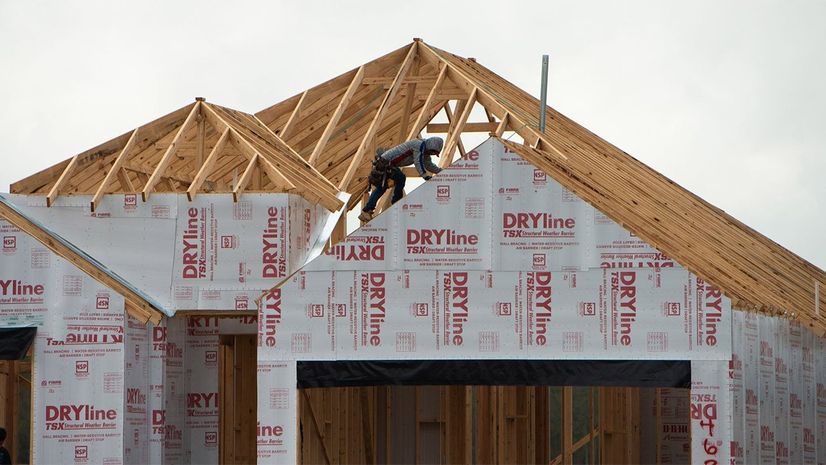
House under construction with home wrap

(Brandon Thibodeaux for The Wall Street Journal)

By Nicole Friedman

Supply-chain backlogs are roiling the new home market, upending efforts to accelerate construction, limiting home-buyer choices, and causing some new owners to move into unfinished homes.

Home builders have increased activity in the past year in response to robust home-buying demand and a shortage of homes in the existing-home market. In many cases, the surge in demand in late 2020 and early 2021 overwhelmed builders, forcing many to halt sales in some markets while they caught up.

Now the industry is struggling with global supply-chain woes. Pandemic-related factory closures, transportation delays and port-capacity limits have stymied the flow of many goods and materials critical for home building, including windows, garage doors, appliances and paint. Freezing weather and power outages in Texas in February led to a shortage of resin, which is used in many home-building products.

While supply-chain delays for some products showed signs of easing at the end of last year, builders say it is still taking weeks longer than normal to finish homes. About 90% of home builders surveyed by housing-market research firm Zonda in November said they were experiencing supply disruptions, up from 75% in January 2021.

Delivery delays can cause a domino effect of rescheduling work crews, which is worsened by a shortage of skilled tradespeople in many markets.

Many builders so far have been able to pass increased material costs along to home buyers. But with home prices higher than ever—the median price of a newly built home in November rose 18.8% from a year earlier to a record $416,900—some builders are concerned about pricing out potential buyers.
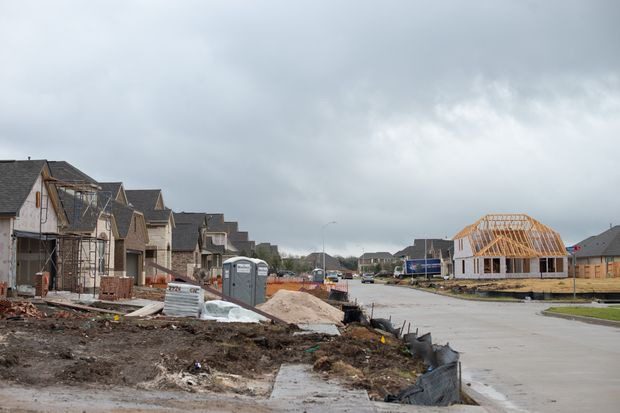
Housing development under construction

Coby and Tierrah Finger recently moved into a housing development in Fresno, Texas. (Brandon Thibodeaux for The Wall Street Journal)

Builders are scrambling to find new suppliers, stock up on building products and use substitute materials. Some are scouring retail big-box stores for products they can’t find through the normal supply channels.

That was the case with builder Epcon Communities in Dublin, Ohio, which bought metal shower grab bars online because they weren’t available through its typical commercial suppliers, said Stew Walker, Epcon’s vice president of construction. The company’s electrical subcontractor resorted to buying electrical boxes in hardware stores, he said.

“From one week to the next, the only thing we know is that we’re going to get notified of something else that is unavailable,” Mr. Walker said.

Epcon sold some homes last year without gutters and downspouts, then installed those features after buyers had already moved in, Mr. Walker said.

Homes by WestBay LLC in Riverview, Fla., has started ordering windows six months in advance, up from the typical 60 days of lead time, said President and CEO Willy Nunn. The company’s homes are 30 to 60 days behind their normal schedule.

“About the time we’re getting ready to pave streets in a new subdivision…we’re ordering windows for 100 homes,” Mr. Nunn said.
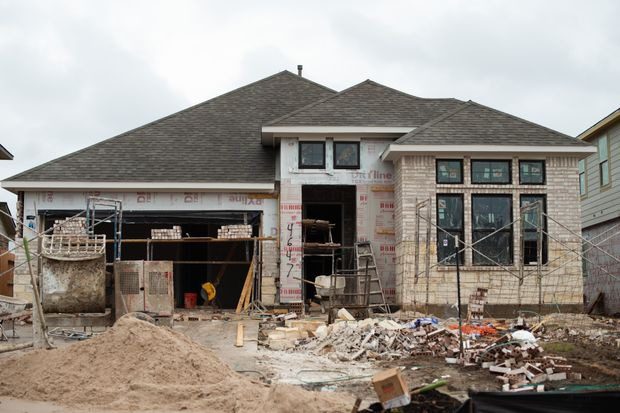
Unfinished home construction

The Fingers signed a contract with their builder in January 2021 but were unable to move in until December. Building-supply issues forced the couple to select brick three times. (Brandon Thibodeaux for The Wall Street Journal)

Many builders are selling houses later in the construction process, when they can better predict their costs and schedule, said Ali Wolf, chief economist at Zonda. Some are limiting options for floor plans or design features.

“In the home-building industry, timeline is king, because there are so many moving parts,” Ms. Wolf said.

California-based Williams Homes Inc. planned to build about 500 homes last year but only completed 400 due to supply-chain constraints, said Chief Executive Lance Williams.

“It was spotty and across the spectrum—just hiccups in the supply chain that we just historically haven’t seen,” he said. A shortage of garage doors, in particular, prompted the company to “scour the Western United States” to find more, he said.

Garage-door delays in Sacramento, Calif., prompted city officials in November to establish a provisional policy allowing builders to close homes with temporary garage doors.

The delays are causing havoc for buyers who are planning moves. And if mortgage-interest rates continue rising, buyers might face higher borrowing costs if their home closings are delayed.

Coby and Tierrah Finger signed a contract with M/I Homes Inc. to build a new home in the Houston suburbs in January 2021 and expected it to be completed by August or September. That was convenient because their apartment lease was up at the end of September, and Mrs. Finger was due with their second child in October.

But construction was delayed by city permits, freezing weather in Texas and materials shortages. M/I Homes asked the Fingers to choose new exterior bricks three times, because the options they had selected were no longer available. The family moved in with Mr. Finger’s parents after their lease ended and were living there when their baby was born.

“It was incredibly frustrating,” Mr. Finger said. They closed on their home purchase Nov. 29.

M/I Homes said it faced similar supply-chain issues to those of other builders in the Houston market, and it has been upfront with buyers about delays.

Home builders have built up a huge backlog of uncompleted homes. The number of single-family homes currently under construction surged 28.3% in November from a year earlier to the highest seasonally adjusted level since 2007, according to the Commerce Department.

Homes by WestBay’s Mr. Nunn expects demand in his market to stay robust as more remote workers relocate to Florida. “This is a terrific environment for us long-term, but we have to get through this supply chain unraveling,” he said.
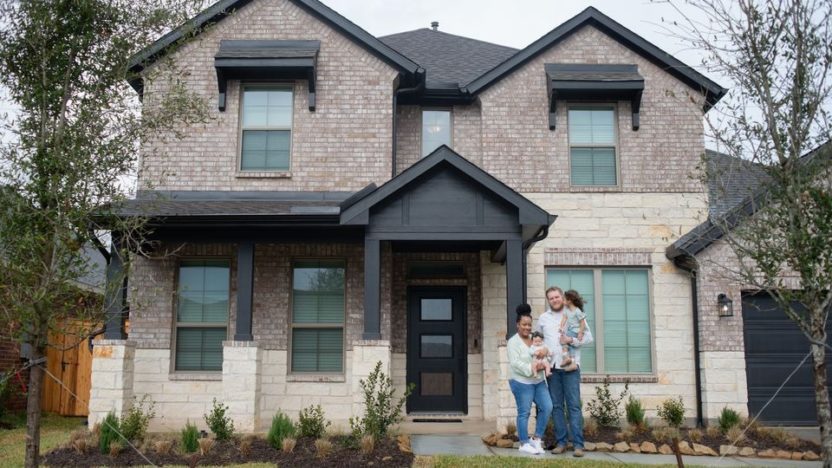
Finished home with family outside

“It was incredibly frustrating,” Coby Finger said of the construction delays on the family’s new home. (Brandon Thibodeaux for The Wall Street Journal)


By Nicole Friedman, writer for REALTOR.com®

 

Housing Market Predictions for 2022

  • By
  • Posted

Learn what factors are at play that will influence real estate sales in the year ahead.

2022 housing market predictions

©Urupong - Getty Images

by Rose Morrison

The housing market is a complicated machine with close connections to the U.S. economy. Changes in one will affect the other, and vice versa. Because these two entities are connected so closely, even the slightest shift can have far-reaching implications for home buyers and real estate agents.

Looking for patterns and understanding the relationships between different economic factors can help real estate professionals anticipate where the housing market may go next. As the new year approaches, here’s what experts are saying.

The Housing Market Now

Coinciding with the pandemic in early 2020, supply chain shortages and underbuilding across the nation made it increasingly difficult for Americans to find new homes. Underbuilding has been a growing problem for years, as construction companies have faced more restrictions and obstacles on how they can build.

COVID-19 has compounded this issue and impacted spending and production. Building materials were bought up early in the pandemic as eager homeowners used their extra time for home renovations. Meanwhile, new products could not reach stores—either because they weren’t being produced or because of backups in the supply chain. 

This lack of supply was exacerbated by a rise in demand for homes over 2020 and 2021. Many people changed their lifestyles and moved outside the city. Low supply and high demand created a strong seller's market, which led to higher prices. Even though houses cost more, bidding wars broke out as buyers tried to secure a residence.

High competition meant homes were selling in a matter of days or even hours, giving sellers the upper hand and reducing room for any negotiation from buyers. However, homebuyers kept engaging with the market since lower mortgage rates and remote work made homeownership a possibility for many.

The Future of the Housing Market

Experts agree that the housing market will continue to favor sellers for some time, possibly for years, but with slower growth in home prices and decelerating inflation. The large discrepancy between supply and demand for new homes will take a while to balance out, and the supply chain will need to work smoothly for some time before things can settle.

Market Competition

Although many other factors also create a seller’s market, the power dynamic between supply and demand is the main predictor of how things will turn out. Except in extreme cases, buyers and sellers can reach their goals regardless of who has the upper hand. However, sellers will get a better deal overall.

Seasonally, competition for homes and bidding wars tend to slow down in the winter. However, because competition has been so high overall, lowered levels this season are still high compared to years before the pandemic. Prices are expected to keep rising, so finding a home over the winter is probably wiser than waiting until spring.

Interest Rates

Another factor predicted to cause major shifts moving forward is the adjustment of interest rates by the Federal Reserve. The American housing market is sustained through a complex system of loans and interest rates, flowing down from the federal level. When inflation is high, the Federal Reserve raises interest rates, which affects loans like mortgages in an aim to prevent further growth.

Higher mortgage rates mean buyers will have to pay more for homes, which could slow down the housing boom by discouraging some people. However, investors will benefit from these higher rates since they’ll be making back larger amounts of money from banks and homeowners.

Financial Security

After the pandemic caused many people to lose their jobs and experience financial insecurity, the government and banks responded with loan forbearance programs to protect individuals from being evicted or going into foreclosure. However, most of these will come to an end in early 2022, so experts like National Association of REALTORS® Chief Economist Dr. Lawrence Yun predict some stimulation to the housing market as more homes come up for sale.

Consumer Confidence

Another factor that affects the housing market is consumer confidence. When people are optimistic about the future, they spend more and invest in long-term goals like houses. The early months of the pandemic caused a lot of uncertainty about the future and made many people question their goals and financial stability.

However, according to Kuba Jewgieniew, CEO of Realty ONE Group, consumer confidence and investments are growing as the pandemic era evolves. Looking forward, people will likely continue to move out of high-population areas because they’re seeking more space and homes with a smaller environmental impact.

Supply and Demand

Experts expect demand for homes to outpace supply for some time, so high competition and rising prices will continue to factor into buyers’ decisions. Rising interest rates may preclude some people from buying, which could tone down high competition rates. However, as incomes increase and employment rates move back to normal levels, the market should begin to balance out.

Changes in economic conditions are already affecting buyers. For instance, in 2021, lumber prices skyrocketed as demand for this building material outpaced supply. However, according to Kuba, lumber prices are expected to stabilize over the next year. This will make building new homes a more affordable option for many people. 

Zoom RVs

With the ability to work remotely, some would-be homeowners have decided to hit the road in their RVs, using Zoom to connect to work along the way. This trend could potentially continue due to a combination of the challenging housing market and remote work becoming normal for many people and industries, according to Kuba.

The COVID-19 pandemic has led to a seismic shift in how individuals relate to their jobs. It’s allowed many home buyers to move farther away from their offices. While some companies may decide to bring their employees back to the office, others will likely establish remote work as a permanent option.

Many people are thriving with the increased flexibility, lack of commute, and control over their work environment. The Zoom RV craze may eventually calm down, but working from home will continue to impact real estate in unprecedented ways for years to come.

The Housing Market in 2022 and Beyond

The housing market has been dynamic over the last two years. The pandemic highlighted how even small changes can have a ripple effect on the opportunities available to home buyers and investors.

However, the market’s close connection with the economy also offers hope as 2022 approaches. Over time, supply and demand will balance out, and the tides will eventually turn to favor buyers again in the future. In the meantime, sellers can make the most of this time in history.


Rose Morrison is the managing editor of Renovated, a home living site where she shares the latest home renovation news and market trends. Throughout her writing career, Rose has been a regular contributor to a number of sites, such as the National Center for Construction Education & Research, the American Society of Home Inspectors, and the International Code Council. 

The New Rules for Homebuyers and Sellers in the Age of Omicron: What To Expect in 2022

  • By
  • Posted

The homebuying and selling season typically kicks off right now. Will the newest stage of the COVID-19 pandemic wreck the market? Here’s the scoop.

Omicron and the housing market

(Realtor.com / Getty Images)

By Janet Siroto

Omicron has indisputably put a damper on early 2022 and as COVID-19 infection rates continue to climb, many may wonder whether we’re headed toward another nationwide shutdown of schools, businesses, and other #lifegoals that may have just begun sputtering back to life.

Meanwhile, homebuyers who’ve vowed that this is the year they’ll finally buy a house might feel as if a wrench the size of a Mack truck was thrown into their plans. Will open houses even be allowed? Will home sellers pull their listings, thinking it’s not worth the risk?

In an effort to shed some light on the year ahead, we surveyed real estate experts on what homebuyers and sellers should expect in the coming weeks and months.

How omicron will affect the housing market

Before the omicron variant of COVID-19 appeared on the scene, the 2021 housing market was rebounding healthily from previous waves of the pandemic and turned downright bullish as the end of the year approached. In spring 2021, a Realtor.com® survey found that only 10% of homeowners planned to sell within 12 months. By fall, that number had ballooned to 26%.

These factors had portended a tidal wave of home sales in the new year. And then the new omicron strain hit in November, followed by a December dip in new listings.

Was this sudden drop due to omicron, or just the typical holiday season lull?

George Ratiu, manager of economic research at Realtor.com, isn’t sure, but feels optimistic that omicron won’t halt the housing market’s momentum, particularly since this variant appears milder than its predecessors.

“We are not through it yet, but so far, this virus seems to be a lot more contagious, but also a lot less negatively impactful in terms of sickness and death,” Ratiu says. He also points out that data from epidemics in 1918 and the 1950s have also shown that viruses become more contagious but less severe over time.

Indeed, indications from South Africa, where the COVID-19 strain was first detected, showed a steep surge in cases followed by a rapid decline. So there’s some reason to expect that this latest wave of the pandemic in the U.S. will follow suit.

Omicron doesn’t seem to have hit the economy as hard as previous waves, either.

“The GDP and economy have survived fairly well,” Ratiu explains. “We’re seeing housing weather the variant so far. Retail sales, consumer confidence, and other indicators show guarded optimism in the road ahead.”

Bottom line: Even as COVID-19 infection rates climb, most experts aren’t bracing for a shutdown like we saw during the first wave of the pandemic in spring 2020.

“I do not believe that omicron will have much impact on the selling season,” says Cara Berkeley, a personal financial expert at Penny Polly. “The delta variant did not seem to slow things down here [in Tennessee], so omicron should not either. The number of homes sold in Nashville in November of this year was higher than the number sold in November of last year. The upwards trend both in sales and in the median price per home is continuing.”

Why omicron isn’t stopping home sellers from listing today

Even in the face of high COVID-19 infection rates, many home sellers are still eager to list in the new year because, frankly, they’ve been waiting long enough.

“My husband is already retired, and we’ve been dreaming of moving to Maine for a while,” says Meg Rooney, 63, of Fairfield, CT. “But we’ve felt paralyzed by the pandemic. The time didn’t feel right in the middle of the crisis. But I think omicron will be the last surge, and our real estate agent says people are ready to tour and buy despite this current uptick in cases. So we’ll finally put our house on the market.”

Most listing agents we spoke to see no shortage of buyers in their respective markets—particularly with more people taking on remote jobs than ever before.

“There continues to be huge pent-up demand,” says Tami Bonnell, co-chair of EXIT Realty Corporate International.

The take-home lesson for sellers: Those who list should expect plenty of offers—although only time will tell whether we’ll see a repeat of the frenzied bidding wars of 2021.

Why omicron isn’t scaring off homebuyers

Meanwhile, omicron doesn’t seem to be deterring homebuyers much.

“I will be hitting the open houses hard this month,” says Alison Levine, a mom of a toddler and a 6-year-old in Cleveland. “I know how high the infection rates are. But the pandemic has also shown me that our apartment is too small for remote learning plus working from home—and I need a backyard.”

Many of today’s homebuyers, much like Levine, have put their house hunts on hold for the past two years of the pandemic. By now, they’ve had it with their cramped quarters, and are willing to take a few calculated risks to upgrade to a place that better fits their lives today.

“Younger parents may be having a first or second child and need a bigger house, or a different school district,” explains Ratiu. “I see a bright future for the suburbs in 2022.”

In addition to outgrowing their homes, homebuyers have another urgent reason to hazard some home tours right now even with omicron lurking: Mortgage interest rates are expected to rise soon.

“Buyers are acutely aware that the current mortgage rates are just above 3%,” says Ratiu. “While they have been flat, rates are expected to rise, so people are in a hurry to capitalize on this.”

Homebuyers this year should brace themselves for plenty of competition.

“There is huge demand, [but] there’s still short inventory,” says Bonnell. “I believe the first half of the year will be tighter with more bidding wars than the second half.” 

One reason omicron likely won’t slow down homebuyers is that so much of home touring today is happening virtually rather than in person. In 2020 during the first wave of COVID-19, video and virtual tours were more of a novelty that certain buyers and sellers resorted to when in-person viewing wasn’t safe. By now, though, virtual tours have matured into a far more sophisticated and commonplace experience

“We’ve had a year and a half to practice virtual tours and marketing,” says Norman Miller, a real estate and finance professor at the University of San Diego. “We’ve taken some of the fear out of the process.”

To succeed in early 2022, buyers will need to bring their A-game and start preparing now. This means making sure you have a current mortgage pre-approval (they expire over time), watching interest rates closely, and getting ready to pounce once your dream house appears.

“My agent and I frequently text about what she’s seeing in the market, things like how quickly things are selling and where the winning bid is compared to the asking price,” says Levine. “That way, I know how high to bid.”

Real estate in the wake of omicron: What’s ahead?

While many experts anticipate that omicron will be more of a blip than a bomb on this year’s real estate forecast, the one real wild card is whether more variants are on the horizon.

“It’s hard to project, but on broad balance, we’re likely to see continued variants in 2022,” says Ratiu.

Yet putting our lives on hold forever just isn’t something humans are meant to do, a fact that homebuyer Levine keeps in mind as she forges ahead.

“Omicron isn’t softening things so far,” she says. “So I am getting my ducks in a row.”


Janet Siroto is a journalist, editor, and trend tracker. Her work has appeared in Cosmopolitan, Good Housekeeping, and other publications.

The New Normal of Selling a Home Today

  • By
  • Posted

If you’re selling your home right now—or thinking about doing it soon—you should know that today’s housing market is unlike anything we’ve seen or experienced lately, maybe ever.

Buying or selling your home sign

Getty Images

In the past, home sellers might have waited weeks or months to get an offer that might not be as high as they’d hoped. Buyers may have lowballed, or driven a hard bargain asking sellers to make certain repairs or other concessions before closing the deal.

Today, however, many of these realities are no more: In many areas of the country, homes are getting snapped up fast, sometimes within days of going on the market. Buyers mired in bidding wars are pushing their offers over asking price, and often waiving inspections and other demands to sweeten their offer.

In general, this is all good news for sellers—but it also means that it’s more important than ever to understand the market and play your cards carefully to fetch the best offer and terms for you. Here’s what sellers need to know about the real estate landscape today.

How the COVID-19 pandemic is affecting the housing market today

The COVID-19 pandemic has changed so much of our lives, and real estate is no exception.

“We’ve all been through a hopefully once-in-a-lifetime experience that dramatically changed the way we lived, worked, and went about our daily lives,” says Realtor.com Chief Economist Danielle Hale. “Even as we move forward and get back to living the way we used to, it’s likely that these experiences will stick with us and shape the way we make decisions for years into the future.”

For one, pandemic lockdowns made many people realize that their current living spaces just aren’t working for them anymore.

“One of the major motivations of homebuyers is the desire to have a larger, more functional home,” says Jason Gelios, a real estate agent with Community Choice Realty in Southeastern Michigan.

This is particularly true for people who started working remotely during the pandemic—who, after cramming their desks into dining rooms, “cloffices,” and other corners, are ready to upgrade to a bigger house so they can work at home with more privacy and comfort.

“This allows for people who are permanently remote-working to be more productive in their home,” explains Gelios.

And since remote workers may no longer need to commute to the office often or at all, many are now house hunting in areas that they hadn’t previously considered.

“With remote work flexibility becoming the new normal, buyers sought out areas like South Florida where they could enjoy the outdoors, extra space, and the tax benefits that come with living here,” says Chad Carroll with The Carroll Group at Compass, in South Florida.

Home inventory is low

Although buyers are out in droves, there are many fewer homes on the market than usual—which is creating a highly competitive market for buyers nationwide.

“Sellers are benefiting from the historically low inventory levels and record demand,” Carroll says. “This combination has fueled bidding wars and led to properties going under contract at an insane velocity.”

These low-inventory conditions may improve somewhat over the next year. But Hale warns, “the market is so out of balance that even with improvement, the number of homes for sale will remain low.”

Home prices are high

With fewer homes and high demand for them, many sellers are seeing multiple offers that, in turn, are driving up prices.

“The ongoing increase in housing prices makes it a great time for a home seller to cash out on their homes now,” says Beatrice de Jong, consumer trends expert at online real estate transaction company Opendoor.

Often, buyers are making offers above the listing price.

“Faced with few homes available for sale, buyers intent on owning are pulling out all the stops,” says Hale.

However, this highly beneficial market for sellers comes with a big caveat if selling means you’ll need to buy a new home yourself.

“Sellers searching for their next home will face the same fierce competition,” warns de Jong.

What’s more, home prices are seeing some early signs of leveling off—or at least not be rising at the breakneck pace of the past. So if you want to sell at the top of the market, it may pay to list sooner rather than later.

Interest rates are at record lows

Even though home prices are high, mortgage interest rates have hit record lows. And since even a 1% lower interest rate could lower monthly mortgage payments by up to 20%, it make homes more affordable for buyers, which is driving them into this competitive market.

“While the cost of a home is on the higher side, the cost to obtain the financing is much lower and oftentimes offsets the higher price, spurring a huge demand for buyers to go out and shop for homes,” Gelios says.

It’s a seller’s market

“There are many ways to define a seller’s market,” says Hale. “But a few key hallmarks are limited availability of homes for sale, fast-selling homes, rising home prices, and competitive buyer offers such as offers over asking price, waiving contingencies, and flexible closing terms.”

All that said, most buyers are looking for a new home because it’s the right time for them—not because of market conditions.

“They’re getting married, moving in with a partner, expanding their family or planning to do so,” Hale explains.

And the same wisdom applies to deciding whether to sell your house: Even though market conditions are in your favor, you should make sure it’s the right time to sell your house for you. Weigh your own personal circumstances, including any current or upcoming life changes such as a new job, retirement, the arrival or departure of family members within the home, and more.


Courtesy 


As Boomers Downsize, Competition Grows for Simpler-but Not Always Smaller-Homes

  • By
  • Posted

Older buyers seeking smaller or easier-to-maintain homes are crashing into younger buyers in a housing market where the competition is fierce.

Red, white and green shutter houses

(Getty Images / Realtor.com)

By Julia Carpenter | Nov 1, 2021

Soaring home prices and new construction favoring bigger builds have interrupted traditional patterns of homeownership for buyers across the country. Smaller houses, desired by aging seniors and young couples alike, are among the toughest to find. The supply of homes up to 1,400 square feet is near a five-decade low, according to data from Freddie Mac.

In 2020, about 28% of real-estate transactions could be characterized as downsizing, said Lawrence Yun, chief economist at the National Association of Realtors. The majority of these transactions are made by buyers 55 or older.

“We have a housing shortage,” Mr. Yun said. “Clearly from the age patterns, young people want to upsize, and the older generation is looking to downsize, but not greatly—only 100 or 200 square feet smaller than where they’d been living.”

The typical housing cycle for many families—kids go off to school, household sizes shrink, empty-nesters hand off their family homes to new households raising their own children—has been disrupted in recent years, said Len Kiefer, deputy chief economist at the mortgage giant Freddie Mac. The large baby boomer population outnumbers the rising Gen X-ers, who would be the ones to traditionally take over the family homes.

Many boomers want to “age in place,” meaning living in their original home independently into their later years. A 2018 survey of 2,287 adults from the AARP shows seniors would prefer to stay in the communities where they already live.

“They like their grocery store, they like their doctor, they like their local options,” said Karan Kaul, senior research associate at the Urban Institute.

Once they decide to move to a smaller home, they end up competing with first-time buyers and limited supply, Mr. Kiefer said. Price growth has been strongest for smaller, less-expensive homes. “That works against you in terms of what you can get for your buck,” Mr. Kiefer said.

If they haven’t paid off their mortgage, older buyers might find they could sell their current home at a high price but then pay more in mortgage payments on a smaller place. The share of older homeowners with debt has steadily increased over the past decade, rising to 55.4% in 2019 from 33.2% in 2007. This rise is driven in large part by mortgage debt, according to data from the Urban Institute.

After retiring from working at the New York Department of Education for 33 years, Enid Maldonado-Salgado started to make a plan to move from her current home in Flushing, in New York City’s Queens borough, to further east on Long Island, where she and her husband can be closer to family.

The 60-year-old worked with a Realtor for a year before retirement. Ms. Maldonado-Salgado said her goal was to find a home valued at 80% of her current home’s worth. She found the house-hunting process difficult, even with the money she had saved from refinancing her existing home and the substantial profit she expects from selling it.

For Ms. Maldonado-Salgado, downsizing meant finding an affordable home that wouldn’t require too much maintenance or upkeep. She wanted the freedom to travel and to be closer to her grandchildren.

Ms. Maldonado-Salgado is now in the process of closing on a new house in Smithtown. The new house is nearly equal in square footage to her house in Queens.

“It wasn’t about finding something smaller, it was about finding something that benefited my budget,” she said. “We wanted to make things simpler for ourselves.”


Courtesy: 

Will Rising Mortgage Rates Make Homebuying More Expensive-or Less?

  • By
  • Posted

It could become a lot more challenging to buy a home in the coming months—or it may have just gotten a whole lot easier.

(Getty / Realtor.com)

By Sharon Lurye for Realtor.com | Nov 3, 2021

After hitting historic lows, mortgage interest rates are creeping up. The U.S. Federal Reserve’s announcement on Wednesday that it will taper its purchases of bonds and mortgage-backed securities is expected to keep pushing mortgage rates higher.

Those higher rates could indeed make homebuying more expensive for many as their monthly mortgage payments get bigger. But in this paradigm-breaking market, higher rates could also prove to be a boon for buyers in some markets by keeping prices in check and lessening competition. That could make homebuying less expensive if buyers aren’t spending as much on their homes and engaging in crazy bidding wars—possibly a welcome lifeline for many first-time buyers who’ve been barred from homeownership by record-high prices.

Confused? Well, today’s COVID-19-fueled housing market is like nothing the U.S. has seen before. There is a dire housing shortage, builders haven’t been able to ramp up, and a massive generation of millennials is champing at the bit to become homeowners. And so depending on a variety of factors, these rising rates could be either a blessing or a curse for prospective homebuyers.

How can you tell which side of the equation you’ll wind up on?

Higher mortgage rates could hurt buyers struggling with high home prices

For some, higher interest rates are a double whammy of bad news. Home prices in most competitive housing markets will still remain high. And after buyers purchase homes, they will be paying more in interest. So buying a home will be more expensive all around.

“It’s going to be less affordable a year from now than where we are today,” warns Leonard Kiefer. He is the deputy chief economist at Freddie Mac, the government-backed organization that helps support the U.S. housing market.

His team forecasts that mortgage rates will reach 3.2% by the end of the year, and go up to 3.7% by the end of 2022 for 30-year fixed-rate loans. At the same time, housing prices will go up 7% in 2022, according to Freddie Mac’s price index—although that’s still better than the explosive 16.9% growth of 2021.

Low rates, which bottomed out at just 2.65% in the first week of January for 30-year fixed-rate loans, helped to fuel the explosion in home prices in the early days of the coronavirus pandemic. Homes could cost more, while monthly mortgage payments stay the same as they were a few years ago when rates were higher.

For example, the monthly mortgage payment on a median-priced home of $380,000 with a 2.65% mortgage rate would be $1,225 a month on a 30-year loan. That payment goes up about $80 a month with a 3.14% rate. Over 30 years, that can equal nearly $29,000. (This is for buyers who have a 20% down payment. It does not include property taxes, home insurance, or homeowners association fees.)

Rates averaged 3.14% in the week ending Oct. 28, according to Freddie Mac data.

But, historically speaking, rates even in the 3% range are still very low. It’s less than the current rate of inflation (5.4% in September, according to the Consumer Price Index). This means that banks aren’t even charging enough in interest to make up for the value that money loses over time due to inflation. With such low rates, there will still be plenty of buyers who want to jump in on a mortgage.

Plus, the majority of millennials are now in their 30s, the prime age to buy a first home. And they are the largest demographic group in the country. But instead of more housing going up to accommodate them, the number of available homes has shrunk with construction declining and investors turning single-family homes into rentals.

That will keep competition high as will the dearth of homes for sale.

“We are living in an unprecedented housing market,” says Jodi Hall, president of Nationwide Mortgage Bankers, a lender. “Housing prices will continue to rise because of the shortage of housing, specifically homes for first-time homebuyers.”

Higher mortgage rates could keep rising home prices in check

Other experts take a sunnier view. They argue that higher mortgage rates will finally cool down some of the cutthroat competition over housing and—eventually—help push down sale prices.

“Prospective homebuyers should actually be praying for rates to start creeping up,” says Katie Gatti, a personal finance consultant and founder of the Money with Katie blog.

The big picture suggests price increases will at least have to slow down. Median incomes have barely grown since 2000—while housing prices have skyrocketed. That means “price growth will almost certainly have to slow,” says Gatti. There just aren’t enough people who can afford current prices.

“As the prices get higher, that potential buyer pool shrinks,” says Gatti. “Simply put, our economy—and the average income— can’t support the cost of a home in most cities.”

Ultimately, homebuyers may still be out of luck if they want to see home prices actually go down.

“With how hot the market is, the rising rates will only slightly affect housing prices,” says Khari Washington, owner of 1st United Realty and Mortgage in Riverside, CA.

Price growth may slow down, meaning prices are still increasing, but at a more gradual, manageable pace. Offers over asking could also decrease, which would help buyers’ bottom lines.

Why mortgage rates matter to homebuyers

Mortgage rates aren’t just an esoteric statistic about the real estate industry. For most Americans, they determine how much it costs to own a home. Rates have been falling in the U.S. since the1980s. But when the pandemic hit, they became almost absurdly low thanks, in part, to the Federal Reserve’s purchases of mortgage-backed securities.

When lenders make mortgages, they typically bundle up the loans into these securities, otherwise known as mortgage bonds, and sell them on the secondary market to investors. This frees up money to make new loans.

When the pandemic struck the nation in March 2020, the Fed announced it would buy bonds to help stabilize the economy and the housing market. That led to a surge in demand, which pushed mortgage interest rates down to record lows. When the bond market is strong, mortgage rates fall.

As a result of these early pandemic moves, the average interest rate for a 30-year fixed-rate mortgage fell below 3% for the first time in July 2020.

Now that the economy has rebounded and unemployment has dropped, the Fed is diminishing its bond purchases. This weakening bond market should lead to rising mortgage rates.

Mortgage rates aren’t the only big factor driving the housing market. The main problem is a lack of homes for sale. Historically low rates encouraged more people to go out and buy a house. But the number of homes for sale, already well below what was needed, dried up even further. And the residential construction industry hasn’t caught up.

Freddie Mac estimates the U.S. needs 3.8 million more homes to fix this shortage. While an average of 418,000 new starter homes a year went up in the 1970s, that number plummeted to just 65,000 in 2020.

“Is there going to be relief? Probably not for some time,” says Freddie Mac’s Kiefer. “Fundamentally, the issue for the housing market is lack of supply. We just haven’t built a lot.”


Sharon Lurye is a freelance journalist based in New Orleans. She graduated from Columbia Journalism School in 2018.


Is Your Home (and Home Insurance) Ready for Extreme Weather?

  • By
  • Posted

Hurricanes. Heat waves. Earthquakes. Tornadoes. Today’s headlines are awash in extreme weather, and whether you blame climate change or just plain bad luck, the simple truth is that the damage from these disasters is impossible to ignore.

Getty Images

By Margaret Heidenry

More trouble may be brewing, as our country’s six-month hurricane season peaks in September, followed by winter’s plummeting temperatures leading to blizzards, hail, and other dangers. Even Southern areas are no longer immune, as was made clear in February 2021 when Winter Storm Uri overwhelmed Texas power grids and inflicted losses estimated at $10 billion to $20 billion. Then, the wrath of Hurricane Ida's fury last month.

While no climate expert or weather forecast can divine exactly what will unfold in the coming months, one thing all Americans can do to protect themselves and their home is have a solid homeowners insurance policy. But how prepared are we on this front?

To find out, Realtor.com® teamed up with HarrisX to conduct a poll of 3,026 adults on their extreme weather concerns and homeowners insurance know-how—and the results suggest that many Americans may be more vulnerable than we think.

Here are some of the key highlights:

  • The natural disasters homeowners are most worried about are tornadoes (39%), severe winter storms and cold weather (38%), floods (35%), and hurricanes (29%). To a lesser degree, they’re also concerned with earthquakes (21%), wildfires (17%), and droughts (11%).

  • All that said, only 52% of American homeowners took natural disasters into account when choosing the location of their current home.

  • Just over half (56%) of homeowners knew what to look for in their homeowners insurance policy when buying their home, with 15% admitting they had no clue what to check. Meanwhile, almost one-third (29%) said they thought they knew what to look for, but learned a lot they didn’t know while buying insurance.

  • The youngest generation is the least likely to understand homeowners insurance: only 39% of Gen Z said they knew what to look for in their policy when buying a home, compared with 58% of Millennials, 58% of Gen X, and 57% of baby boomers.

In short, these survey results suggest that while many Americans might assume their home insurance will foot the bill for any extreme weather–related damages that come their way, they could be in for a rude awakening if disaster strikes.

To help clear up some common misconceptions about homeowners insurance, here’s a rundown of some extreme weather occurrences and what most home insurance policies will cover—and won’t cover—so homeowners are truly prepared for whatever happens.

Does home insurance cover floods?

Flooding is the most common natural disaster in the United States, according to CoreLogic. And if you think you don’t need flood insurance, keep in mind that more than 20% of insurance claims happen in non-flood zones.

Yet currently, only 12% of Americans have flood insurance. And while you might assume your standard home insurance policy covers floods, the reality is that it doesn’t. Instead, you’ll have to obtain separate flood coverage.

“Flood insurance must be purchased separately through the National Flood Insurance Program, or through a private flood insurer,” says Ted Olsen, managing director at New York’s Goosehead Insurance. (The program defines flooding as “an excess of water on land that is normally dry, affecting two or more acres of land or two or more properties.”)

Since flooding is not typically covered, it’s essential to know a home’s flood risk to weigh whether purchasing additional insurance is merited.

Coverage will also hinge on you doing your own due diligence to keep your house from flooding—namely by maintaining proper grading, where the ground around your house slopes downward and away from your foundation to keep water seeping outward rather than in.

“A flood insurance policy won’t cover you if your home floods due to improper grading around the home,” adds Olsen.

You can hire a landscaper to regrade your land, which usually costs between $969 and $3,000, according to HomeAdvisor. It’s a small price to pay to keep your house high and dry.

Does home insurance cover wind damage and tornadoes?

If a tornado, hurricane, or windstorm tears through your area, any wind-related damage to your home (e.g., ripped off shingles and siding) is typically covered under a standard insurance policy. But there are exceptions.

“In tornado-prone areas, there is often a separate higher deductible for wind damage,” says Olsen. And if you live in “tornado alley” (which includes parts of Texas, Oklahoma, Iowa, Kansas, and Nebraska) or another area that consistently experiences frequent tornadoes, you may need additional coverage for high wind damage. Some insurers even require an additional windstorm rider and separate deductible if you live near coastal areas that are vulnerable to tropical storms.

The goal of your homeowners insurance policy and additional coverage is to make sure you’re covered not only for minor damage, but also in case your home is completely destroyed and needs to be rebuilt. This is known as “actual total loss” or “total loss.”

Total loss coverage varies from area to area as well as from home to home, but it basically boils down to an estimate of how much it would cost to rebuild your home.

That could cost more than you paid for your house, or less—it all depends on the construction costs in your area. Be sure to check your policy to see what’s covered. Total loss coverage is pricier, but if you don’t have it, you’ll be on the hook for all the building costs not covered by your policy.

Does home insurance cover hurricanes?

Hurricanes inflict damage in one of two ways: wind and water. Damage from wind is typically covered in standard policies, although your insurer may put in place a separate higher deductible for hurricane-related wind damage.

Meanwhile, flooding caused by hurricanes is typically not covered by a standard homeowners insurance policy (as noted above), so if your property is at risk for flooding, you’ll have to purchase additional flood insurance.

Does home insurance cover wildfires?

In 2020, a large chunk of the damage coming from weather was due to a record-breaking U.S. wildfire season that burned more than 10.2 million acres. And this year is already looking worse. Twelve of the most destructive wildfires in California history took place in September and October, according to the California Department of Forestry & Fire Protection.

The good news to all this bad?

“All home insurance policies include fire as a covered peril,” says Alan Umaly, president of California’s Westwood Insurance Agency. “This means your home and belongings that are damaged in a wildfire will be covered.”

However, if you live in an area with a particularly high risk for wildfires, be warned that the increase of wildfires has prompted some insurance companies to forgo renewing even loyal policyholders because of the risk. Even if your insurer does offer wildfire coverage, it may not cover the total cost of rebuilding a home. Instead, it may cover just the loss of your personal property, some of the costs of rebuilding a home, and living expenses while your home is being repaired.

Read your insurance policy closely, and see if you need to secure additional coverage with wildfire-specific insurance policies.

Does home insurance cover damage from cold weather and snow?

Most home policies include coverage for a frozen pipe that breaks due to a snowstorm, as long as you maintain proper temperatures in the home. In other words, if you leave for a monthlong winter vacation and turn off your heat, a pipe that freezes and bursts as a result of this negligence is on you to fix.

And if ice or snow causes a tree to fall on your home, most insurance companies will pay to have the tree moved from the house and for home repair, says Josh Thorner, agency manager with Country Financial in Portland, OR.

This falls under a “covered peril,” which is standard in most home insurance policies, and typically includes fire, lightning, wind, and ice.

Does home insurance cover damage from hail?

Yes, but “in areas where hail damage is prevalent, you will typically see some larger deductibles,” says Olsen.

So keep an eye out for home policies that are less expensive, but only because the wind and hail deductible is high—and consider purchasing higher-priced insurance with a lower deductible for hail if it’s common in your area.

Also note that a home’s roof, in particular, is the most susceptible to hail damage, and frequent roof replacements in hail-prone areas are what causes higher premiums.

Does home insurance cover earthquakes?

Standard home insurance policies not only don’t include coverage for earthquakes, they also specifically exclude them from coverage.

“The only way to protect against this natural disaster is to secure a specialty earthquake insurance policy,” says Umaly.

If you live in California, your insurance company is required under law to sell you earthquake insurance. But even if you have earthquake coverage, there are limits on what it pays out.

Most earthquake insurance covers only some of the losses and damage that earthquakes might cause to your home and belongings. For instance, if you would want to rebuild a damaged home to current earthquake building codes, you’d have to upgrade your earthquake coverage with an additional optional rider.


Margaret Heidenry is a writer living in Brooklyn, NY. Her work has appeared in the New York Times Magazine, Vanity Fair, and Boston Magazine.

Homeowners Have Gotten Lazy About Security

  • By
  • Posted

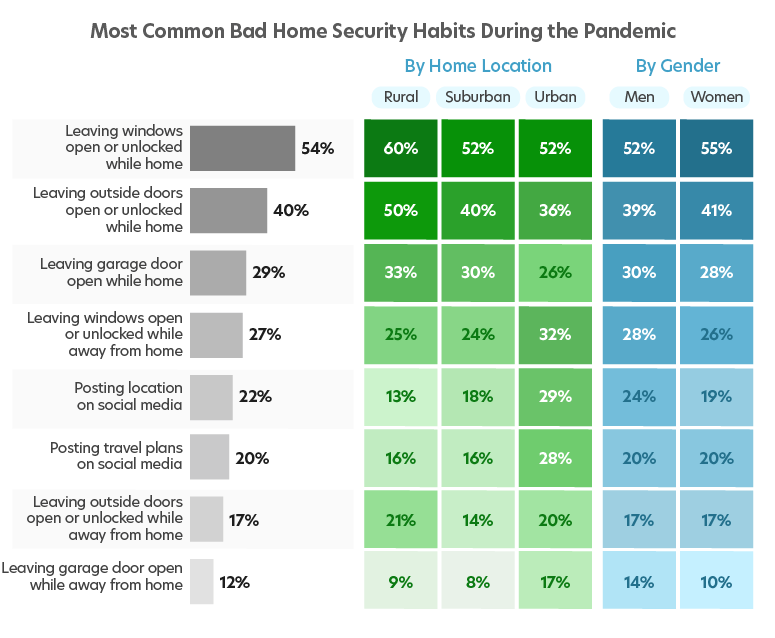
Homeowners may have developed some bad home security habits during the pandemic.

Homeowners are realizing it, according to a new survey of 1,000 U.S. consumers from Vivint, a smart home and security company.

Forty-two percent of respondents say that their home’s security while away was one of the leading reasons why they’re anxious about leaving home to travel. That is even higher than the 39% who expressed anxiety about getting COVID-19 while traveling, the survey finds. Younger Americans are more likely to feel this way than those who are in their 30s or 40s. Also, people living in urban areas showed more concern about their home’s safety while traveling.

The most common bad home security habits that respondents reported they’ve taken since the pandemic are leaving windows open and unlocked while home and leaving outside doors open or unlocked while still at home.

A separate survey found that 26% of people don’t lock their doors when they were at home, despite findings that shown most burglaries occur when someone is around, Vivint researchers note. The average cost of a home burglary is $2,661.

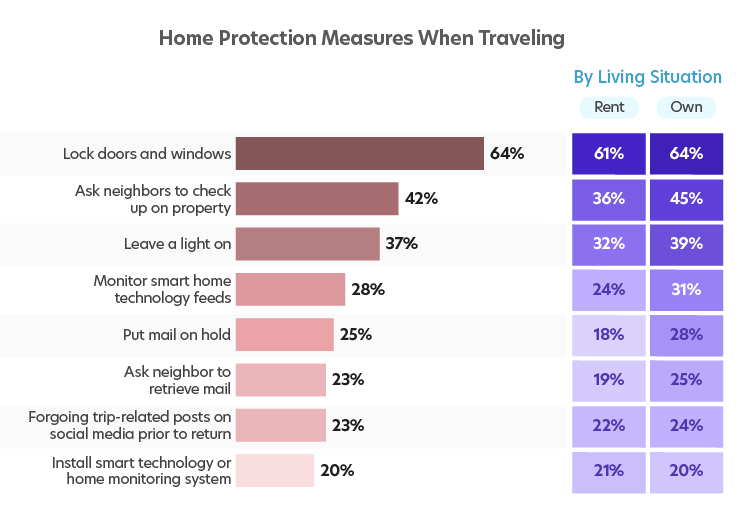
About 40% of Americans admitted to not doing their proper due diligence when it comes to protecting their homes before heading off on vacation, the survey found.  

Vivint highlights some of the most popular home safety practices while away.


Source: "Protecting the Home While You're Away," Vivint.com (July 2021)

The Housing Market Continues To Cool. What Will This Fall Be Like?

  • By
  • Posted

The forecast for the coming months is lower temperatures—and a cooler real estate market, if only by a few degrees.

By Clare Trapasso

The housing market is expected to shift to something closer to normal this fall, real estate experts say. They anticipate more homes will go up for sale, helping to slow down the unparalleled price increases and bidding wars of the past year.

But the market is likely to remain highly competitive, as there will still be many more buyers than homes to go around.

“We’re going to exhaust the pool of buyers who are still sitting on a lot of cash looking to buy their next home,” says Realtor.com® Senior Economist George Ratiu. “The market does not have a magical way of sustaining this pace [of price growth], because you’re going to run out of people who can afford it.”

However, that doesn’t mean that home prices, whose national median hit an all-time high of $385,000 in the week ending Aug. 14, will fall. In fact, prices increased 8.6% year over year that week. But that’s significantly less than the 17.2% annual rise in April. Going into the end of the year, prices may rise a more modest 5% to 6%, says Ratiu.

“The shift in the housing market will make shopping for a home a lot more tolerable than it has been, because consumers will actually have time to properly think through their decision and won’t be in as fierce of bidding wars,” says Ali Wolf, chief economist of building consultancy Zonda. “Going into fall, buyers may not need to pull out all the stops to win a house, like removing the inspection contingency or waiving the appraisal contingency.”

More homes are expected to go up for sale in the second half of the year. The influx won’t be nearly enough to put a dent in the dire housing shortage that’s the main reason for the record prices, but it may help curb the wild price growth.

“It’s still going to be a very strong housing market. Demand is still going to be well in excess of supply,” says Greg McBride, chief financial analyst at Bankrate.com. “It just won’t be as frenetic as what had been experienced earlier in the year.”

In June, there were 2.6 months of housing inventory for sale, according to the National Association of Realtors®. That’s an improvement from 1.9 months in January. However, a balanced real estate market has between 5.5 months and six months of homes for sale.

“We’re seeing the gap narrowing between demand and supply,” says NAR’s director of housing and commercial research, Gay Cororaton. But it isn’t going to even out anytime soon. “There’s still a huge, huge gap.”

The fall homebuying season is likely to be busier than usual

One thing that won’t return to usual is the pace of sales. Usually, the market begins slowing down and prices even dip in the fall; families typically prefer to get settled before the school year begins. But this year, the COVID-19 pandemic threw off the normal timing, and activity is expected to stay brisk after summer’s end.

“I expect an unusually busy fall season,” says Ratiu. After all, more homeowners are vaccinated and feel comfortable holding open houses, although the delta variant of the coronavirus could change this, or they just can’t delay their move. “Sellers are putting homes on the market. Normally this activity happens early in the spring.”

Demand is likely to stay strong as well—even though many buyers are frustrated or simply priced out. More millennials are hitting their prime homebuying years, and builders have been unable to ramp up construction to keep up with the growing population. With rental prices also hitting new heights, many people are seeing that it’s cheaper to buy than to continue to lease a home.

Plus, mortgage interest rates are still hovering around record lows. The fear of missing out on what could be a once-in-a-lifetime deal will likely entice additional buyers. (Rates averaged 2.87% for 30-year fixed-rate mortgages in the week ending Aug. 12, according to Freddie Mac data.)

And not every home will be affected by a slowdown.

“Don’t expect deals in the fall if you are house hunting in the most desirable part of a market or competing for a particularly nice house,” says Zonda’s Wolf. “Homes that stand out for one reason or another are still flying off the shelf.”

But overall, most buyers may not be as willing to pay top dollar and waive inspections and contingencies for less-than-spectacular homes that would have sold for $100,000 less just a year ago. There aren’t many regular people (as opposed to investors) who can pay all cash for a home. And there likely aren’t as many remote workers fleeing expensive cities and heading for cheaper parts of the country at this point in the pandemic as there were in the beginning.

“We are definitely shifting from an extreme excess of demand to a more moderate excess of demand,” says Ken Rosen, chair of the Fisher Center for Real Estate and Urban Economics at the University of California, Berkeley. But “it’s still going to be a seller’s market.”

In addition, many first-time buyers can’t afford to pay over the list price of a home if it doesn’t appraise for that much, says mortgage broker Rocke Andrews, of Lending Arizona in Tucson. They don’t have the extra cash to make up the difference.

The emergence of the delta variant is also spooking some buyers who worry about the stability of their jobs.

This could help to explain why the number of purchase mortgages (which don’t include refinances) dropped 18.7% year over year in the week ending Aug. 13, according to the most recent Mortgage Bankers Association data.

The market “will be nothing like the panic we saw” going into the fall, says Rosen. “It already is more orderly in many, many markets.”

Foreclosures likely won’t play a big part in the cooling market

Many folks have been anticipating a wave of foreclosures to sweep the country as moratoriums to protect struggling homeowners expire. However, it’s not expected to be nearly as severe as what happened during the Great Recession, or lead to an influx of homes going on the market.

Homeowners who haven’t made mortgage payments during the pandemic make up just a fraction of the housing stock—just 3.26% of mortgages were in forbearance as of Aug. 8, according to the most recent data from the Mortgage Bankers Association. Many of these folks will resume payments or work something out with their lenders. But at least some of these 1.6 million homes will hit the market.

Those homeowners who can’t resume their monthly payments and have enough equity in their properties can avoid foreclosure by putting their homes on the market. With prices at these levels, they may even walk away with a profit, and it won’t damage their credit.

“The middle-class and the upper-income groups won’t even notice the wave of foreclosures because it won’t be in their neighborhoods,” says Norm Miller, a real estate economics professor at the University of San Diego.

Lower-income homeowners who lost their jobs during the pandemic and don’t have much equity will likely be the ones who go into foreclosure. Their homes are expected to be in the lower-third price tier.

The number of foreclosures and how quickly they go up for sale are expected to vary from state to state. Some states have protections in place for homeowners that can delay proceedings significantly.

Some first-time buyers will scoop up these properties as the previous owners are forced back into the rental market. But the bulk are expected to go to investors, says Miller.

Investors are expected to keep home prices strong. During the pandemic, more institutional investors, such as pension funds and financial firms, have bought up single-family homes to turn them into rentals. Many can buy in bulk and pay in cash. That’s likely to continue.

“This is going to lower the homeownership rate a little as [these residences] become rental units,” says Miller.

Clare Trapasso is the deputy news editor of Realtor.com. 

 Thinking about selling or buying your home?
                                 Then look no further!

We’re here to service ALL your real estate needs. We have over 30 years of experience, you can trust. We are an extraordinary real estate company located in downtown Wolfeboro in the heart of the Lakes Region.

Feel free to peruse our website to find out more!


Mortgage Costs Grow 20 Times Faster Than Incomes

  • By
  • Posted

Housing affordability continues to decline as the hot real estate market fuels skyrocketing prices. Incomes aren’t keeping pace with the higher prices.

© malerapaso - iStock/Getty Images Plus

The median family income rose by 1.2% in May while the monthly mortgage payment jumped by 20%, according to the National Association of REALTORS®’ Housing Affordability Index.

Even as mortgage rates are down compared to a year ago—which has helped buyers save on borrowing costs—the median existing-home price has jumped 24.4% compared to the same period.

Monthly mortgage payments increased to $1,204 in May, a 20% jump compared to a year earlier. NAR’s analysis notes the annual mortgage payment—as a percentage of income—increased to 16.5% over the past year due to higher home prices and a decline in median family incomes.

Homeowners in the West have the highest mortgage payments to income share at 22.1% of income. Home prices in the West have climbed to a record high of $513,700.

The most affordable region of the U.S. in housing continues to be the Midwest, in which the median family income is $86,440. NAR’s index calculates a qualifying income as the income required to afford a mortgage so that payments are no more than 25% of a family’s income. The Midwest had a qualifying income of $44,016.


Source: “Housing Affordability Falls in May as Home Prices Rise Faster Than Income,” National Association of REALTORS® Economists’ Outlook blog (July 9, 2021)

5 Mortgage Trends To Watch

  • By
  • Posted

Understanding key financing issues affecting homebuyers in their purchasing decision.

by Melissa Dittmann Tracey

Buyers have fueled a red-hot housing market over the last year as they rushed to secure record-low mortgage rates. But shifts are underway, which may affect borrowers planning for their next home.

  1. Rising rates. “Interest rates below 3% on a 30-year fixed-rate mortgage aren’t likely to be around long,” says Lawrence Yun, chief economist of the National Association of REALTORS®. Rising inflation and a strengthening economy are expected to push rates up. Yun predicts that by as early as year’s end—but likely by next spring—30-year fixed-rate loans will average 3.5%. Higher rates and home prices could push some would-be buyers out of the market.

  2. Strict qualifications. Lending standards tightened during the COVID-19 pandemic as lenders looked to avert risk, notes Tendayi Kapfidze, chief economist at LendingTree. Standards could ease a bit as the economy keeps improving and refinancings become a smaller share of total mortgage lending, says Guy Cecala, publisher of Inside Mortgage Finance. Still, the most favorable rates will go to borrowers with stellar credit histories—scores of 750 and above—and large down payments. Lending criteria in the hot vacation and second-home market could be a different story. Due to tightened underwriting criteria, second-home buyers could face steeper rates.

  3. Larger mortgages. Higher home prices are leading to larger loan amounts. In March, the average mortgage taken out on a new-home purchase reached a record-setting $374,000, up from about $332,000, two years earlier, according to the Mortgage Bankers Association. As more people upsized their space in the pandemic, sales in upper price brackets outpaced those at lower price points. Applications for mortgages larger than $766,000 jumped 55% year over year in February, the largest jump in any price range, according to the Mortgage Bankers Association. By contrast, mortgages in the $150,000–$300,000 range decreased by 2%.

  4. More nonbank lending. Borrowers have more options as nonbank lenders gain market share. “Nonbanks are competing more on rates and underwriting than banks have been, and that’s particularly been true over the past year,” Cecala says. “That likely will continue. As of now, banks appear to be content competing from the sidelines.” The top five U.S. banks—Wells Fargo, Bank of America, JPMorgan Chase, US Bancorp, and Citigroup—comprised only 21% of total mortgage originations last year, a decline from their 50% combined market share in 2011, according to Business Insider Intelligence’s Online Mortgage Lending Report. Alternative lenders are offering traditional financial products often at lower costs, with more relaxed eligibility criteria, and expanded digital options in loan processing. Quicken Loans (now known as Rocket Mortgage) issued the highest dollar amount of single-family loans in 2020, according to an analysis of 2020 Home Mortgage Disclosure Act data.

  5. Rate lock-in effect. Some owners aren’t selling because they don’t want to give up their existing ultra-low interest rate, thus squeezing supply and placing upward pressure on home pricing, Kapfidze says, adding “this could be a challenge to the housing market going forward.” But Yun offers a broader view, noting that mortgage rates aren’t the only factor potential sellers consider. Some seek more space or the new flexibility to work remotely and live anywhere.


Melissa Dittmann Tracey is a contributing editor for REALTOR® Magazine. 

Top 10 Issues Affecting Real Estate in 2021

  • By
  • Posted

Remote work and mobility are expected to have the most significant impact on real estate over the next year, according to The Counselors of Real Estate’s list. The group identified current and emerging issues expected to have an influence over real estate in the 2021-2022 cycle. Remote work and mobility and its influence over commercial buildings globally was named as the top issue, followed by technology and ESG (Environment, Social, and Governance).

“The pandemic was a stress test, revealing vulnerabilities, appetites, and new and increased risks,” says Michel Couillard, global chair of The Counselors of Real Estate. “These themes present themselves in the 2021-2022 Top Ten Issues, which are highly interconnected and indicative of a newly changed and further evolving real estate environment. We have been awakened to some familiar but nascent areas of importance, namely cybersecurity, supply chain, and price instability. None of these are new concepts, but in a span of months or even just weeks, we saw high profile hacks, shortages of resources like microchips, lumber and labor, and rising prices across the board.”

Here’s a closer look at the top 10 issues on CRE’s list for 2021-2022:

1. Remote work and mobility

The pandemic greatly disrupted the workplace as many employees began to work remotely—and still are more than a year later. Commercial properties may need to be repositioned as the workplace adapts to more flexible and even shareable spaces.

“As we emerge from COVID-19 into a new world replete with local and global disruptions alike, our industry has been forced to recognize that adaptability and resiliency are paramount in real estate markets,” says Couillard. “It is undeniable that the pandemic’s disruption significantly impacted human behavior in how and where people have chosen to work. Now, with an escalating return to ‘business as usual,’ and workers beginning to return to offices, landlords, and companies nevertheless are facing repositioning of the workspace and the benefit of easily adaptable and shareable spaces. …. Property owners and managers should be flexible in order to accommodate these demand-driven changes in the desired use and location of space."

2. Technology acceleration and innovation

The Counselors of Real Estate also ranked the acceleration and adoption of technology as having the second greatest impact on the real estate industry. “The stressors were not about new tech, but about the acceptance of it,” Coulliard says. “Lockdown-driven changes in our work, the economy, in social structures, and in our personal behavior forced the industry to put any earlier reluctance aside.” Growing technology themes include artificial intelligence, machine learning, the Internet of Things, and cybersecurity, the report notes.

3. ESG at a tipping point

Environmental, social, and governance (ESG) initiatives are growing. In 2020, ESG funds more than doubled net new money intakes. “The growth in recent years is fueled by multiple drivers, including consumer shifts, regulatory requirements, trillions of dollars of wealth transferring to generation Z and millennials committed to philanthropic living, a blurring of work and societal expectations, and a full sprint to attract and retain top talent,” the report notes.

4. Logistics

“Whether it’s a port, rail line, pipeline … manufacturing facility, warehouse, farm, ranch, or grocery store, all these real estate assets are a critical segment in the supply-chain funnel that is logistics,” the report notes. “How logistics is functioning impacts the utilization of commercial real estate. Redundancy and the ability to process disruption are two key elements required to support the fast-moving, high-volume requirements of modern-day logistics in the ‘shop-online-and-deliver-to-me’ era in which we find ourselves.”

5. Infrastructure

The Civil Engineers estimates the U.S. infrastructure funding gap in 2021 to be $2.6 trillion, a 24% increase compared to 2017. “The COVID-19 pandemic, climate change, and heightened societal interest in social and economic equity have redefined infrastructure imperatives beyond the significant ongoing necessity for improved roads, bridges, airports, ports, mass transit, and other traditional infrastructure needs,” the report notes. A proposal on Capitol Hill sets out to allocate $110 billion in new spending to bridges and roads, $65 billion to expanding access to broadband, and $48.5 billion to public transit, and more.

6. Housing supply and affordability

The National Association of REALTORS® and the Rosen Consulting Group released a report last week calling for a “once-in-a-generation” response to address decades of underinvestment and underbuilding in the housing market. The nation has faced a shortfall of 5.5 million to 6.8 million housing units since 2001, according to the report. Housing groups are calling on lawmakers to expand access to resources, remove barriers to incentivize new development, and more. 

7. Political polarization

“Political friction is holding back America’s economic productivity,” the report notes. “We are squandering resources as we try to address problems that arise from the partisan divide rather than problems confronting us as common issues …. And the real estate industry’s well-being is a function of our economic growth.”

8. Economic structural change

Economic growth is mostly an unknown. As the report notes, how do we assess the real potential of the economy for sustainable growth? What numbers indicate a true trend and which are merely adjustments from the low bottom of the second quarter of 2020? Which behavioral changes made by U.S. households in the pandemic will persist? The ability for businesses to anticipate what’s next is met with challenges. For example, “even though real estate investors may reasonably expect an uptick in demand in the coming year, the ability to anticipate when occupancy and rent will rise frustrates underwriting,” the report notes. “We are observing many investors increasing their focus on property management aimed at retaining tenants and defending cash flow, while selectively seeking ‘value-add’ properties amenable to active asset management. The thinking is ‘focus on what you can control’ during this period where macro-level uncertainty is the governing headwind at the policy level in terms of the structural problems in this economy.”

9. Adaptive Reuse 2.0

The term is not new but the focus is getting bigger. CRE refers to Adaptive Reuse 2.0 as “The Neighborhood Approach.” It aims to address the challenges of what to do with defunct suburban malls and thousands of empty big-box retail stores that are surrounded by desirable and affordable neighborhoods. It requires a re-examination of suburban communities in repositioning and transforming areas that could be at risk for blight. A number of projects have been completed or are underway to help reconnect communities, prevent blight, and restore green space.

10. Bifurcation of capital markets

Debt capital markets have been volatile since the pandemic, namely public markets like commercial mortgage-backed securities, mortgage REITs, and agencies such as Freddie Mac and Fannie Mae. “Mortgage REITs took a significant hit early in the pandemic, with some recent recovery driven by restructuring credit lines and paying down credit facilities that experienced margin calls,” the report notes. Still, the “market continues to be flush with debt capital liquidity, despite property type and market uncertainty. Looking out to the remainder of 2021 and into 2022, performance will dictate the amount of distress and losses, and risk management should dictate markets, property types, leverage, loan structure, and pricing for mortgage debt. The next year should also tell us if commercial real estate debt was too rich and whether perceived risk underestimated where pricing should have been.”


Source: The Counselors of Real Estate

Mortgage Rates Rise Above 3%

  • By
  • Posted

For the first time in 10 weeks, mortgage rates inched above 3%—and the era of 2% rates may be over. “As the economy progresses and inflation remains elevated, we expect that rates will continue to gradually rise in the second half of the year,” said Sam Khater, Freddie Mac’s chief economist. “For those homeowners who have not yet refinanced—and there remain many borrowers who could benefit from doing so—now is the time.”

© ATU Images - The Image Bank/Getty Images

The National Association of REALTORS® has predicted that mortgage rates will average 3.2% by the end of the year.

Freddie Mac reports the following national averages with mortgage rates for the week ending June 24:

  • 30-year fixed-rate mortgages: averaged 3.02%, with an average 0.7 point, rising from last week’s 2.93% average. A year ago, 30-year rates averaged 3.13%.

  • 15-year fixed-rate mortgages: averaged 2.34%, with an average 0.7 point, increasing from last week’s 2.24% average. A year ago, 15-year rates averaged 2.59%.

  • 5-year hybrid adjustable-rate mortgages: averaged 2.53%, with an average 0.3 point, up slightly from last week’s 2.52% average. Last year at this time, 5-year ARMs averaged 3.08%.

Freddie Mac reports average commitment rates along with points to better reflect the total upfront cost of obtaining a mortgage.

Source: Freddie Mac


Is the Housing Market Going to Crash in 2021?

  • By
  • Posted

The housing market is red-hot right now, but if you're waiting for a massive market correction, don't count on it. Real estate industry experts weigh in with predictions for home buying and selling trends.

for sale sign in yard outside home in the USA

CREDIT: SAUL LOEB/AFP/GETTY IMAGES

By Mia Taylor

It's hardly a secret that real estate prices across the country have been skyrocketing. Recent data from Redfin, a real estate brokerage, shows that median home prices are up 20% year-over-year. At the same time, many properties are under contract for purchase within a mere one to two weeks of hitting the market and it's not unusual for prospective buyers to offer 10% or even 20% over the asking price. In fact, Redfin reports that 46% of homes sold for more than their list price. As if that's not enough, many buyers are paying cash for homes. Yes, cash. You read that right.

"We are in a record-breaking housing market with asking prices at an all-time high ($357,200), median sale prices at an all-time high ($347,500), the share of homes selling over list price at an all-time high (46%), and homes selling faster than ever before: 58% under contract within two weeks of listing and 46% within one week of listing," says Redfin Chief Economist Daryl Fairweather. "Ask just about any real estate agent, and they'll tell you they've never seen a market this hot."

All of which has left many watchers and potential buyers scratching their heads and wondering if we're due for a market crash similar to the housing market burst that brought on the Great Recession in 2007. The short answer to that question? No, a similar crash is not likely. And there are many reasons for that. 

Here's a closer look at some of the most obvious factors contributing to widespread confidence that there will be no real estate market crash in 2021 (or anytime soon), as well as insight into what real estate and industry experts do see happening in the market over the coming months—and what it all means for potential buyers.

Factors Contributing to the Overheated Housing Market 

First, it's important to understand that there are numerous elements driving the current housing market and they differ from what was taking place before the Great Recession.

"Those of us who experienced the housing crash really don't want to go back to the days of underwater sellers and houses sitting on the market for months at a time without a single offer. The good news is that this isn't 2008 and 2021 has a few things going for it that the sub-prime market could only dream about back when 'short sale' became a household word," explains Debra Remington, managing broker for Texas-based Remington Team Realty.

1. Lack of Inventory 

One of the biggest contributors to the current red-hot market and sky-high prices is a dearth of inventory. This is an explanation you'll hear from experts far and wide. 

The shortage of inventory is caused by a few factors, including owners not wanting strangers (potential buyers) traipsing through their living quarters amid a global pandemic, thus far fewer homes being put on the market for sale.

The second issue is the pace of new construction, which has been slower than normal. Years of sluggish new construction in the United States has finally caught up, and many builders went under during the Great Recession.

"Not enough people are listing their homes for sale, and new construction isn't keeping pace with demand," says Fairweather. "America built fewer homes in the 2010s compared to any decade going back to the 1960s."

In other words, one of the primary drivers behind the current overheated housing market is very different than what set the stage for the 2007 crash. Today's boom is not due to loose lending practices flooding the market with unqualified buyers.

"What caused the market to crash was related to real estate and the lending practices that were happening. People were buying homes that shouldn't have been buying homes," says Dave Nations, founder of The Nations Network. "They couldn't actually afford the house they were buying but the loan product allowed them to at least get in the house short-term."

Experts predict that the current record low inventory will keep demand at record levels. But in the run-up to the Great Recession, the market was characterized by limiteddemand and too much inventory, says Remington.

2. Historic Low Interest Rates 

Historic low interest rates are also contributing to current conditions, encouraging a steady stream of buyers to enter the market. The Federal Reserve repeatedly lowered interest rates amid the economic downturn caused by the COVID-19 pandemic. And it doesn't appear that those rock-bottom rates will disappear anytime soon, yet another reason buyer demand is likely to remain strong and thus no market crash.

"The Federal Reserve has no immediate plans to change interest rate strategy. If they stay low, buyers will continue to purchase as even if they are paying a premium, they are locking in really great rates for the next 30 years," says San Francisco-based realtor Julie Upton. 

3. Millennial Buyers Entering the Market 

Millennials are also entering the market like never before, which is playing a role in market conditions. According to the 2021 NAR Buyer and Seller Report, the median age of first-time homebuyers is now 33, which is coincidentally also the average age Millennials turn this year.

"Millennials buying homes have already significantly impacted the market," says Grace Keister of California-based First Team Real Estate. "At First Team, we've seen a big uptick in Millennial clients. I've personally referred two friends in the last year to buyers' agents; [I] know about two other friends who are casually searching, and another couple who just purchased after six months of searching. We also had a new agent who closed 15 transactions in her first year, all buyers that she met through her TikTok presence."

4. Lending Practices Tightened 

Perhaps one of the most meaningful indicators that a real estate market crash is unlikely in 2021 can be found in today's lending environment, which is far stricter than it was prior to 2007. As Upton likes to say, the days of NINJA loans (no income, no job, no assets) are long gone. 

"These risky loans were common prior to the market crash," explains Upton. "These days, lenders are very strict when qualifying buyers, and changes to appraisal laws have also tightened up the appraisal practices. Taken together, there are fewer risky mortgages in the financial system."

Why a 2021 Market Crash is Unlikely 

Market crashes generally take place when there's a serious breakdown somewhere in the system. But as outlined by so many experts, that's not currently a problem.  

"Absent a catastrophe in the financial markets or in the political arena, we fully expect demand for housing to remain strong," says Michael Shapot, a New York based real estate broker with The Shapot Team.

Upton supports Shapot's assessment. "While anything can happen that might impact the housing market, there are no key indicators right now to suggest that there will be a crash in 2021," she says.  

Bankrate Chief Financial Analyst Greg McBride says that while the recent pace of home price appreciation isn't sustainable over the long-run, that doesn't mean prices are at risk of some sort of sharp drop or correction. It would likely take a return to the questionable lending practices of the early 2000s to trigger such a collapse.

"If lending standards loosen and we go back to the wild, wild west days of 2004 to 2006, then that is a whole different animal," McBride explains. "If we start to see prices being bid up by the artificial buying power of loose lending standards, that's when we worry about a crash."

What Is Likely to Happen with the Housing Market? 

As the vaccine rate of Americans continues to increase and more homeowners feel comfortable listing properties and having strangers walk through their homes, market conditions will likely become more balanced. There will be more supply and prices should adjust somewhat.

"The gradual increase in inventory will begin to slowly alleviate the demand created by the inventory shortage," says Colby Hager of Texas-based Capstone Homebuyers. "This rather gradual return to normal will create a larger pool of options for buyers which will lead to more days on market for houses. The bidding wars seen today that are a big factor of price increases will begin to die out because buyers will have more housing options to choose from and there will be a drop in competition between buyers for any one house."

Indeed, Zillow data supports the projections of Hager and other industry professionals; while the early weeks of 2021 were marked by a scarcity of new home listings as sellers stayed on the sidelines in the face of an uptick in COVID-19 cases, data indicates sellers are starting to come back. New listings nationwide rose by 30% in the four weeks between late February and late March.

What Does It All Mean? 

So what do all of these insights and predictions add up to? Is it good news for homebuyers? In many ways, that depends on your buying timeline.

"Homebuyers who have the ability to wait for the bidding wars to disappear, prices to stagnate, and listings to stay on the market longer will get more house for their dollar," says Hager. "Homebuyers who can afford to sit on the sidelines during this overheated housing market will definitely be rewarded."

And if you're in the market to buy right now and can't wait it out? "Remain patient. Exercise caution. Don't ever pay more than you can comfortably afford," says Shapot. "Consider other options, perhaps in different neighborhoods or off market properties that haven't yet been listed. Look at properties that have been on the market a while and appear overpriced; there is less likelihood that there will be a bidding war and perhaps the homeowner will be sensible and consider reasonable offers."


Mia Taylor is an award-winning journalist who's passionate about making personal finance coverage accessible and engaging. News organizations she has worked for as a staff member or contributor include The Atlanta Journal-Constitution, the San Diego Union-Tribune, The Boston Globe, TheStreet, Bankrate, MSN, and Cheapism. In 2011, she was a member of a team of KPBS reporters who received a Walter Cronkite Award for Excellence in Journalism. Follow her coverage on Twitter and Instagram.

Is the new Workweek 3 Days In, 2 Days Out?

  • By
  • Posted

Many workers want to continue to work from home, even when the pandemic is over. A new survey from JLL of 2,000 employees globally found that 72% want to be able to work from home more during the workweek, up considerably from 34% before the pandemic. Sixty-six percent are in favor of a hybrid model that mixes in office, home, and a co-working facility.

office space and cubicles

The idea of a 3-2-2 model is gaining popularity with workers. LinkedIn’s year-end roundup of 2020’s workplace trends called it a one to watch in the new year. The model would allow employees to work three days in the office, two days remotely, and two days off.

While many workers don’t want to return full-time to the office, they are missing the workplace. Fifty-two percent of professionals say they do not feel as productive at home, and 58% miss working at an office, according to a separate JLL survey. The 3-2-2 model could allow workers to balance remote and in-office work.

“The emergence of this new framework for the workweek confirms that people don’t just want to go back to the office—for many, they need to,” writes Kenny Kane, chief operating officer at Firmspace, for Forbes.com. “And commercial real estate agents will see this reflected in their quarterly reports as soon as the pandemic turns around.”

Still, a CBRE analysis cautions that the growth in remote work could cut the overall need for office space by 15% after the pandemic ends. As workplaces consider new leases, they’re demanding more flexible space options, shared meeting spaces, better indoor air quality, connected building apps, and touchless technology, CBRE notes. Also, about 50% of the workers surveyed by JLL consider socialization spaces crucial to their experiences in the office in the future. These spaces could include coffee and tea areas, lounges, terraces that offer more connection with nature, and more.

Peter Miscovich, managing director of strategy and innovation at JLL, told the Commercial Observer that some clients are wanting to decrease their office portfolios, open up satellite spaces in the suburbs, or retool their existing spaces to fit a new hybid workplace model.

Co-working spaces are increasingly being viewed as an alluring option to more workers. The JLL survey finds that 40% of workers would like to be able to work at a co-working space in the future.

Regardless, the office will remain a key role for companies as a collaboration space, Miscovich says. Only 10% of survey respondents said they would want to work from home exclusively. Seventy-four percent said they would be willing to return to the office at least part time; 24% would be willing to return on a full-time basis.


Courtesy Realtor Magazine

Source: "72% of Workers Don't Want to Return to Office Full Time. Report Finds," Commercial Observer (March 5, 2021); "Shaping Human Experience," JLL (Feb 22, 2021); and "What the New 3-2-2 Work Week Will Mean for Commercial Real Estate," Forbes.com (March 2, 2021)

Co-Working Spaces May Soon See a Surge in Activity

  • By
  • Posted

Co-working and flexible workspace providers saw business quickly dwindle as the COVID-19 pandemic struck last spring and the shift to remote work began. These businesses sublet space on short-term contracts, which allowed tenants to leave quickly as employees moved to working from home.

Co-Working Spaces and flexible work week

However, investors and analysts are turning bullish that co-working and flexible office providers such as WeWork and IWG could soon see a boom in business as workers return to offices.

Still, there’s a lot of catching up to do. WeWork’s occupancy rate globally plunged to 47% at the end of 2020. It lost $3.2 billion last year, The Wall Street Journal reports. Before the pandemic, co-working spaces were the fastest-growing type of office space in commercial real estate, according to JLL. But the pandemic struck the sector particularly hard.

On the other hand, traditional property service providers have been more protected in the pandemic since their tenants sign long-term leases. Even as offices have remained mostly empty, building owners could still collect rent.

But moving forward, property providers may be more drawn to shorter-term leases. As such, investors are seeing signs that co-working spaces could hold a special attraction to offices moving forward.

Flexible leases could grow from less than 5% of the market today to as much as 30% by 2030, the real estate firm JLL forecasts.

Co-working spaces could grow as an option as companies may be reluctant to sign a 10-year lease until they better understand what the future of work will look like and how employees will divide their time between home and office. “Some may turn to looser office arrangements longer term, accelerating a trend already building before the pandemic,” says reporter Carol Ryan for The Wall Street Journal.

Companies that press forward with a remote office likely will still find they need a space to meet in-person at times. Also, some offices may decide on a hybrid workweek approach—splitting time between the office and home—which could also cause companies to look at flexible office space as an option.

“Co-working spaces have the potential to provide vital business services to support the remote workforce closer to where they are, especially as residual anxieties linger over taking public transit,” Brent Capron, design director of interiors at architecture firm Perkins and Will’s New York studio, told CNBC in an article on co-working spaces.


Courtesy Realtor Magazine

Source: "Flexible Offices Will Be Crowded After COVID-19," The Wall Street Journal (March 23, 2021) and "How Co-Working Spaces Could Succeed in the Post-Pandemic World," CNBC (Jan 12, 2021)

Luck, Superstition May Influence Real Estate Decisions

  • By
  • Posted

Many Americans admit to being superstitious when it comes to choosing what home to buy—in fact, they say if a home feels unlucky, they aren’t buying it. More than a third—or 38%—of Americans have decided against buying a home because of superstition, according to a newly released survey from LendingTree of about 1,500 Americans. And consumers who find their self-described lucky house are willing to pay even more for it.

4 leaf clover, influence real estate decisions


Reasons some consumers reconsidered a home purchase due to luck or superstition


Source: LendingTree survey of 1,550 consumers conducted Feb. 19-22, 2021. Only those who chose not to buy a certain home due to luck or superstition answered this question. 

Homes a buyer perceives as lucky can nab more at resale. Nearly 47% of survey respondents say they would blow their budget for a lucky house—and are willing to go an average of $38,000 above their range for the home, the LendingTree survey shows. What qualifies as a lucky home? More than a third of buyers say they’d pay extra for a home whose street number was their lucky number.

The younger generations appear to be the most superstitious in real estate—55% of Gen Z and 50% of millennials said they’ve bypassed a home because of something related to luck or superstition. Overall, men are more likely than women to decide against buying a particular home because of superstition, at 51% of men and 37% of women.

Here are some additional findings from the LendingTree survey:

  • 39% of homeowners refuse to live next to a cemetery.

  • 32% would not buy a home with an unlucky street number. (On the other hand, the majority of respondents did say they’d buy a house with an unlucky street number like 13 or 666, but 20% would prefer to pay less because of it.)

  • 30% say they would not buy a home where the previous owners experienced a tragedy inside the home, like death.

  • 43% say they have at least one deal breaker related to the home’s feng shui, with the most cited reasons being a staircase that faces the front door, back and front doors in the same path, or a bathroom door that faces the front door.

  • 43% of survey respondents who reported being previous home sellers said they’ve had difficulties selling their home due to superstitious buyers.


Source: "Nearly Half of Americans Would Burst Their Budget for a "Lucky" Home," LendingTree (March 16, 2021)

The Top Green Features Buyers Seek in New Homes

  • By
  • Posted

Energy efficiency is on many buyers’ minds when they shop for new-home construction, according to a consumer survey from the National Association of Home Buyers. The NAHB surveyed more than 3,000 home buyers—both recent and prospective—on the features they most desire in their new home.

Many buyers said they’d go with the more sustainable option, such as the use of more durable materials in their home, when presented the option.

When the cost savings of these features are pointed out, they may be even more tempted—and they say they are willing to pay up front to help lower their utility bills. On average, buyers would pay up to $9,292 more for a home in order to save $1,000 annually on utility costs, according to the NAHB’s study.

“We’re doing a lot more in our homes now,” Brandon Bryant, founder of Red Tree Builders, a green home building company in Asheville, N.C., said during February’s virtual 2021 International Builders’ Show. But he added education is key. “We’ve got to teach people how to live in green homes, how these homes operate, and even before we build to let them know what we could do because a lot of times we could do so much more for their life.”

The top eco-friendly components and designs consumers said they desired:

  • Energy Star–rated windows and appliances

  • Efficient lighting that uses less energy than traditional bulbs

  • Energy Star rating for the whole house

Other trending features center around health and wellness, such as zone heating, purified air appliances (like UVC fans), indoor air quality sensors, and connections to the outdoors, the NAHB said.

"There are a wide range of green features that buyers feel are desirable," said Paul Emrath, vice president of surveys and housing policy research at the NAHB. "Energy efficiency, though, tops the list of what they most want."


Source: National Association of Home Builders

1-20 of 40 Posts

Get in touch!

Do not fill in this field:

I agree to receive marketing and customer service calls and text messages from Melanson Real Estate. To opt out, you can reply 'stop' at any time or click the unsubscribe link in the emails. Consent is not a condition of purchase. Msg/data rates may apply. Msg frequency varies. Privacy Policy.

This site is protected by reCAPTCHA and the Google Privacy Policy and Terms of Service apply.