Real Estate Buyers

Home sales slow in January, but median price still hovers near $400k

  • By
  • Posted

January is a slow time for real estate sales, but things were really slow last month. Only 870 homes were sold in New Hampshire, a 15.5 percent fewer Granite State homes were sold than January 2021, according to the latest data from the NH Realtors Association.

by Bob Sanders

Yet, prices rose 14.2 percent from a year ago, although the median price of a single-family home dipped to $399,700 from December 2021, only the second time since last May that the median has dipped below $400,000.

Condos? Pretty much the same thing. Sales went down 17.2 percent, but the median unit price rose 18.8 percent, to $300,000.

As usual, the problem was not the lack of buyers but a lack of sellers. Those homes that do go on sale are on the market for an average of 33 days. There were only 931 homes for sale in January, a 35.4 percent decrease from the previous year, and there were 706 new listings, a 25.3 percent decrease.

Homes were selling for 1.4 percent more than the asking price, the Realtors said.

Homes in Carrol County appreciated the most, at a median price of $445,000, a 33.9 percent increase from a year ago.  Rockingham County homes sold for a median $540,000, a 17.4 percent increase.  The biggest slowdown in sales came in Sullivan, where 28 homes were sold, – a 47.2 percent decrease from 2021.

-------------------

As inventory continues to sink, what next?

Housing remains scarce, and it continues to hit new lows. 

“In terms of inventory, it has been the lowest and it certainly feels that way,” said Adam Gaudet, president of the New Hampshire Association of Realtors board of directors and founder of 603 Birch Realty in Concord.

No crystal ball

Observers and stakeholders say the end of New Hampshire’s housing market spike is impossible to predict. 

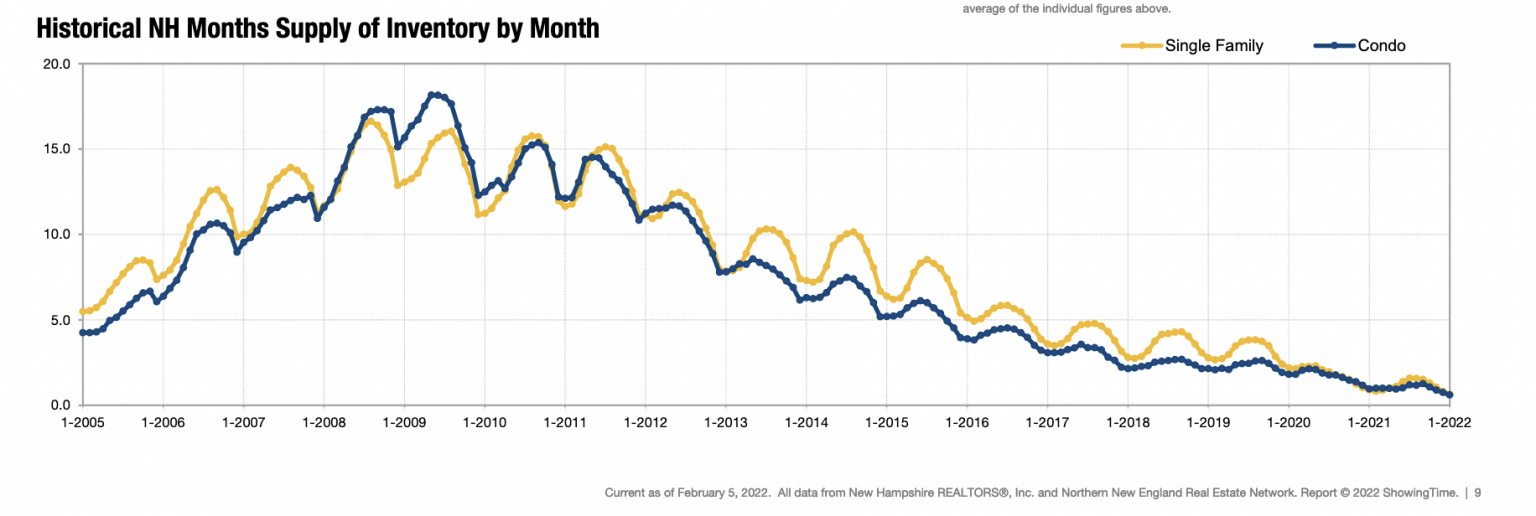
The Realtors Association uses one metric above others when assessing the health of the housing market, Director of Communications Dave Cummings said. That measurement is the time it would take to sell all of New Hampshire’s housing inventory if no new houses came on the market. The hypothetical number – which factors in both inventory and demand – can speak volumes, Cummings said. A healthy market would take six months to sell all houses. Currently, New Hampshire sellers would take only 26 days. 

But Cummings argued it was only a matter of time before the pattern must reverse, if only because the state’s housing stock can’t get much lower.

“You know, we’re still just seeing it level, level, level out,” he said. “It can’t get too much lower, because essentially you’d have zero inventory.”

Contributor Ethan Dewitt , New Hampshire Bulletin


Attention Sellers!!!

When you list your property with our team of agents, you are provided with professional, courteous service from beginning to end. These services include, but are not limited to:

A free current market analysis: Determining the value of your property based on other properties, similar in nature that have sold or are currently on the market.

Listing your property: Entering the property in our MLS system, marketing through window displays, local and regional advertisements and various online media sources.

Representing your property personally: Having an agent from our office present at ALL showings.

Negotiating and closing the deal: Representing your requirements in the purchase and sale, while maintaining courteous representation throughout the closing.


So, if you're thinking about selling your home, give us a call at

603-569-4488

At Melanson Real Estate, we'll be happy to assist you with all your real estate needs.


The Middle Class Feels the Sting of the Housing Shortage and High Prices

  • By
  • Posted

The turbocharged housing market is hurting middle-class homebuyers stymied by a double whammy of fast-rising prices and a dearth of properties for sale.

(Getty Images)

By Clare Trapasso 

The analysis looked at how affordable homes listed for sale are for prospective buyers with different household incomes. It also looked at the number of homes for sale.

“In a highly competitive real estate market, the best areas for buyers are areas that have relatively more home available. But in order to truly be available, the home has to be for sale and affordable,” says Realtor.com Chief Economist Danielle Hale. “A homebuyer needs to ask themselves: ‘With my income and what’s on the market right now, where do I have the best shot from an availability perspective?'”

Buyers with a household income between $75,000 and $100,000 could afford only about 51% of the homes listed for sale. (Households include all adults living together, such as spouses and partners, extended families, and roommates.) That was compared with 58% in 2019. Those buyers are competing for just 245,300 homes nationally that are within their budgets.

Meanwhile, there were just 165,280 homes across the country that buyers could afford with household incomes between $50,000 and $75,000.

Even in the few places where housing became cheaper during the pandemic—such as the bigger, more expensive cities that became less desirable over the Past few years—the lack of homes for sale has made it harder for buyers to get an edge.

“Due to rising home prices and the ongoing inventory shortage, homeownership attainment will become especially challenging for middle-class buyers unless significantly more entry-level housing units become available,” Nadia Evangelou, NAR’s senior economist and director of forecasting, said in a statement. “Otherwise, the wealth gap between middle-income and upper-income households may grow even further.”

The 10 best metropolitan areas for buyers with household incomes between $75,000 and $100,000 were mostly in the South in less expensive areas that have had more new construction. These places all had more homes for sale at the right price for these buyers.

Deltona, FL, topped the list, followed by Des Moines, IA; Augusta, GA; Atlanta; McAllen, TX; Baton Rouge, LA; Miami; Virginia Beach, VA; Youngstown, OH; and Scranton, PA. (Metros include the main city and surrounding towns, suburbs, and smaller urban areas.)

“Homes are priced a bit lower so that your housing dollars stretch further,” says Hale. Also, “construction has done a better job of keeping up with demand.”


Clare Trapasso is the deputy news editor of Realtor.com where she writes and edits news and data stories. She previously wrote for a Financial Times publication, the New York Daily News, and the Associated Press. She also taught journalism courses at several New York City colleges.

Housing Market Predictions for 2022

  • By
  • Posted

Learn what factors are at play that will influence real estate sales in the year ahead.

2022 housing market predictions

©Urupong - Getty Images

by Rose Morrison

The housing market is a complicated machine with close connections to the U.S. economy. Changes in one will affect the other, and vice versa. Because these two entities are connected so closely, even the slightest shift can have far-reaching implications for home buyers and real estate agents.

Looking for patterns and understanding the relationships between different economic factors can help real estate professionals anticipate where the housing market may go next. As the new year approaches, here’s what experts are saying.

The Housing Market Now

Coinciding with the pandemic in early 2020, supply chain shortages and underbuilding across the nation made it increasingly difficult for Americans to find new homes. Underbuilding has been a growing problem for years, as construction companies have faced more restrictions and obstacles on how they can build.

COVID-19 has compounded this issue and impacted spending and production. Building materials were bought up early in the pandemic as eager homeowners used their extra time for home renovations. Meanwhile, new products could not reach stores—either because they weren’t being produced or because of backups in the supply chain. 

This lack of supply was exacerbated by a rise in demand for homes over 2020 and 2021. Many people changed their lifestyles and moved outside the city. Low supply and high demand created a strong seller's market, which led to higher prices. Even though houses cost more, bidding wars broke out as buyers tried to secure a residence.

High competition meant homes were selling in a matter of days or even hours, giving sellers the upper hand and reducing room for any negotiation from buyers. However, homebuyers kept engaging with the market since lower mortgage rates and remote work made homeownership a possibility for many.

The Future of the Housing Market

Experts agree that the housing market will continue to favor sellers for some time, possibly for years, but with slower growth in home prices and decelerating inflation. The large discrepancy between supply and demand for new homes will take a while to balance out, and the supply chain will need to work smoothly for some time before things can settle.

Market Competition

Although many other factors also create a seller’s market, the power dynamic between supply and demand is the main predictor of how things will turn out. Except in extreme cases, buyers and sellers can reach their goals regardless of who has the upper hand. However, sellers will get a better deal overall.

Seasonally, competition for homes and bidding wars tend to slow down in the winter. However, because competition has been so high overall, lowered levels this season are still high compared to years before the pandemic. Prices are expected to keep rising, so finding a home over the winter is probably wiser than waiting until spring.

Interest Rates

Another factor predicted to cause major shifts moving forward is the adjustment of interest rates by the Federal Reserve. The American housing market is sustained through a complex system of loans and interest rates, flowing down from the federal level. When inflation is high, the Federal Reserve raises interest rates, which affects loans like mortgages in an aim to prevent further growth.

Higher mortgage rates mean buyers will have to pay more for homes, which could slow down the housing boom by discouraging some people. However, investors will benefit from these higher rates since they’ll be making back larger amounts of money from banks and homeowners.

Financial Security

After the pandemic caused many people to lose their jobs and experience financial insecurity, the government and banks responded with loan forbearance programs to protect individuals from being evicted or going into foreclosure. However, most of these will come to an end in early 2022, so experts like National Association of REALTORS® Chief Economist Dr. Lawrence Yun predict some stimulation to the housing market as more homes come up for sale.

Consumer Confidence

Another factor that affects the housing market is consumer confidence. When people are optimistic about the future, they spend more and invest in long-term goals like houses. The early months of the pandemic caused a lot of uncertainty about the future and made many people question their goals and financial stability.

However, according to Kuba Jewgieniew, CEO of Realty ONE Group, consumer confidence and investments are growing as the pandemic era evolves. Looking forward, people will likely continue to move out of high-population areas because they’re seeking more space and homes with a smaller environmental impact.

Supply and Demand

Experts expect demand for homes to outpace supply for some time, so high competition and rising prices will continue to factor into buyers’ decisions. Rising interest rates may preclude some people from buying, which could tone down high competition rates. However, as incomes increase and employment rates move back to normal levels, the market should begin to balance out.

Changes in economic conditions are already affecting buyers. For instance, in 2021, lumber prices skyrocketed as demand for this building material outpaced supply. However, according to Kuba, lumber prices are expected to stabilize over the next year. This will make building new homes a more affordable option for many people. 

Zoom RVs

With the ability to work remotely, some would-be homeowners have decided to hit the road in their RVs, using Zoom to connect to work along the way. This trend could potentially continue due to a combination of the challenging housing market and remote work becoming normal for many people and industries, according to Kuba.

The COVID-19 pandemic has led to a seismic shift in how individuals relate to their jobs. It’s allowed many home buyers to move farther away from their offices. While some companies may decide to bring their employees back to the office, others will likely establish remote work as a permanent option.

Many people are thriving with the increased flexibility, lack of commute, and control over their work environment. The Zoom RV craze may eventually calm down, but working from home will continue to impact real estate in unprecedented ways for years to come.

The Housing Market in 2022 and Beyond

The housing market has been dynamic over the last two years. The pandemic highlighted how even small changes can have a ripple effect on the opportunities available to home buyers and investors.

However, the market’s close connection with the economy also offers hope as 2022 approaches. Over time, supply and demand will balance out, and the tides will eventually turn to favor buyers again in the future. In the meantime, sellers can make the most of this time in history.


Rose Morrison is the managing editor of Renovated, a home living site where she shares the latest home renovation news and market trends. Throughout her writing career, Rose has been a regular contributor to a number of sites, such as the National Center for Construction Education & Research, the American Society of Home Inspectors, and the International Code Council. 

The New Rules for Homebuyers and Sellers in the Age of Omicron: What To Expect in 2022

  • By
  • Posted

The homebuying and selling season typically kicks off right now. Will the newest stage of the COVID-19 pandemic wreck the market? Here’s the scoop.

Omicron and the housing market

(Realtor.com / Getty Images)

By Janet Siroto

Omicron has indisputably put a damper on early 2022 and as COVID-19 infection rates continue to climb, many may wonder whether we’re headed toward another nationwide shutdown of schools, businesses, and other #lifegoals that may have just begun sputtering back to life.

Meanwhile, homebuyers who’ve vowed that this is the year they’ll finally buy a house might feel as if a wrench the size of a Mack truck was thrown into their plans. Will open houses even be allowed? Will home sellers pull their listings, thinking it’s not worth the risk?

In an effort to shed some light on the year ahead, we surveyed real estate experts on what homebuyers and sellers should expect in the coming weeks and months.

How omicron will affect the housing market

Before the omicron variant of COVID-19 appeared on the scene, the 2021 housing market was rebounding healthily from previous waves of the pandemic and turned downright bullish as the end of the year approached. In spring 2021, a Realtor.com® survey found that only 10% of homeowners planned to sell within 12 months. By fall, that number had ballooned to 26%.

These factors had portended a tidal wave of home sales in the new year. And then the new omicron strain hit in November, followed by a December dip in new listings.

Was this sudden drop due to omicron, or just the typical holiday season lull?

George Ratiu, manager of economic research at Realtor.com, isn’t sure, but feels optimistic that omicron won’t halt the housing market’s momentum, particularly since this variant appears milder than its predecessors.

“We are not through it yet, but so far, this virus seems to be a lot more contagious, but also a lot less negatively impactful in terms of sickness and death,” Ratiu says. He also points out that data from epidemics in 1918 and the 1950s have also shown that viruses become more contagious but less severe over time.

Indeed, indications from South Africa, where the COVID-19 strain was first detected, showed a steep surge in cases followed by a rapid decline. So there’s some reason to expect that this latest wave of the pandemic in the U.S. will follow suit.

Omicron doesn’t seem to have hit the economy as hard as previous waves, either.

“The GDP and economy have survived fairly well,” Ratiu explains. “We’re seeing housing weather the variant so far. Retail sales, consumer confidence, and other indicators show guarded optimism in the road ahead.”

Bottom line: Even as COVID-19 infection rates climb, most experts aren’t bracing for a shutdown like we saw during the first wave of the pandemic in spring 2020.

“I do not believe that omicron will have much impact on the selling season,” says Cara Berkeley, a personal financial expert at Penny Polly. “The delta variant did not seem to slow things down here [in Tennessee], so omicron should not either. The number of homes sold in Nashville in November of this year was higher than the number sold in November of last year. The upwards trend both in sales and in the median price per home is continuing.”

Why omicron isn’t stopping home sellers from listing today

Even in the face of high COVID-19 infection rates, many home sellers are still eager to list in the new year because, frankly, they’ve been waiting long enough.

“My husband is already retired, and we’ve been dreaming of moving to Maine for a while,” says Meg Rooney, 63, of Fairfield, CT. “But we’ve felt paralyzed by the pandemic. The time didn’t feel right in the middle of the crisis. But I think omicron will be the last surge, and our real estate agent says people are ready to tour and buy despite this current uptick in cases. So we’ll finally put our house on the market.”

Most listing agents we spoke to see no shortage of buyers in their respective markets—particularly with more people taking on remote jobs than ever before.

“There continues to be huge pent-up demand,” says Tami Bonnell, co-chair of EXIT Realty Corporate International.

The take-home lesson for sellers: Those who list should expect plenty of offers—although only time will tell whether we’ll see a repeat of the frenzied bidding wars of 2021.

Why omicron isn’t scaring off homebuyers

Meanwhile, omicron doesn’t seem to be deterring homebuyers much.

“I will be hitting the open houses hard this month,” says Alison Levine, a mom of a toddler and a 6-year-old in Cleveland. “I know how high the infection rates are. But the pandemic has also shown me that our apartment is too small for remote learning plus working from home—and I need a backyard.”

Many of today’s homebuyers, much like Levine, have put their house hunts on hold for the past two years of the pandemic. By now, they’ve had it with their cramped quarters, and are willing to take a few calculated risks to upgrade to a place that better fits their lives today.

“Younger parents may be having a first or second child and need a bigger house, or a different school district,” explains Ratiu. “I see a bright future for the suburbs in 2022.”

In addition to outgrowing their homes, homebuyers have another urgent reason to hazard some home tours right now even with omicron lurking: Mortgage interest rates are expected to rise soon.

“Buyers are acutely aware that the current mortgage rates are just above 3%,” says Ratiu. “While they have been flat, rates are expected to rise, so people are in a hurry to capitalize on this.”

Homebuyers this year should brace themselves for plenty of competition.

“There is huge demand, [but] there’s still short inventory,” says Bonnell. “I believe the first half of the year will be tighter with more bidding wars than the second half.” 

One reason omicron likely won’t slow down homebuyers is that so much of home touring today is happening virtually rather than in person. In 2020 during the first wave of COVID-19, video and virtual tours were more of a novelty that certain buyers and sellers resorted to when in-person viewing wasn’t safe. By now, though, virtual tours have matured into a far more sophisticated and commonplace experience

“We’ve had a year and a half to practice virtual tours and marketing,” says Norman Miller, a real estate and finance professor at the University of San Diego. “We’ve taken some of the fear out of the process.”

To succeed in early 2022, buyers will need to bring their A-game and start preparing now. This means making sure you have a current mortgage pre-approval (they expire over time), watching interest rates closely, and getting ready to pounce once your dream house appears.

“My agent and I frequently text about what she’s seeing in the market, things like how quickly things are selling and where the winning bid is compared to the asking price,” says Levine. “That way, I know how high to bid.”

Real estate in the wake of omicron: What’s ahead?

While many experts anticipate that omicron will be more of a blip than a bomb on this year’s real estate forecast, the one real wild card is whether more variants are on the horizon.

“It’s hard to project, but on broad balance, we’re likely to see continued variants in 2022,” says Ratiu.

Yet putting our lives on hold forever just isn’t something humans are meant to do, a fact that homebuyer Levine keeps in mind as she forges ahead.

“Omicron isn’t softening things so far,” she says. “So I am getting my ducks in a row.”


Janet Siroto is a journalist, editor, and trend tracker. Her work has appeared in Cosmopolitan, Good Housekeeping, and other publications.

The New Normal of Selling a Home Today

  • By
  • Posted

If you’re selling your home right now—or thinking about doing it soon—you should know that today’s housing market is unlike anything we’ve seen or experienced lately, maybe ever.

Buying or selling your home sign

Getty Images

In the past, home sellers might have waited weeks or months to get an offer that might not be as high as they’d hoped. Buyers may have lowballed, or driven a hard bargain asking sellers to make certain repairs or other concessions before closing the deal.

Today, however, many of these realities are no more: In many areas of the country, homes are getting snapped up fast, sometimes within days of going on the market. Buyers mired in bidding wars are pushing their offers over asking price, and often waiving inspections and other demands to sweeten their offer.

In general, this is all good news for sellers—but it also means that it’s more important than ever to understand the market and play your cards carefully to fetch the best offer and terms for you. Here’s what sellers need to know about the real estate landscape today.

How the COVID-19 pandemic is affecting the housing market today

The COVID-19 pandemic has changed so much of our lives, and real estate is no exception.

“We’ve all been through a hopefully once-in-a-lifetime experience that dramatically changed the way we lived, worked, and went about our daily lives,” says Realtor.com Chief Economist Danielle Hale. “Even as we move forward and get back to living the way we used to, it’s likely that these experiences will stick with us and shape the way we make decisions for years into the future.”

For one, pandemic lockdowns made many people realize that their current living spaces just aren’t working for them anymore.

“One of the major motivations of homebuyers is the desire to have a larger, more functional home,” says Jason Gelios, a real estate agent with Community Choice Realty in Southeastern Michigan.

This is particularly true for people who started working remotely during the pandemic—who, after cramming their desks into dining rooms, “cloffices,” and other corners, are ready to upgrade to a bigger house so they can work at home with more privacy and comfort.

“This allows for people who are permanently remote-working to be more productive in their home,” explains Gelios.

And since remote workers may no longer need to commute to the office often or at all, many are now house hunting in areas that they hadn’t previously considered.

“With remote work flexibility becoming the new normal, buyers sought out areas like South Florida where they could enjoy the outdoors, extra space, and the tax benefits that come with living here,” says Chad Carroll with The Carroll Group at Compass, in South Florida.

Home inventory is low

Although buyers are out in droves, there are many fewer homes on the market than usual—which is creating a highly competitive market for buyers nationwide.

“Sellers are benefiting from the historically low inventory levels and record demand,” Carroll says. “This combination has fueled bidding wars and led to properties going under contract at an insane velocity.”

These low-inventory conditions may improve somewhat over the next year. But Hale warns, “the market is so out of balance that even with improvement, the number of homes for sale will remain low.”

Home prices are high

With fewer homes and high demand for them, many sellers are seeing multiple offers that, in turn, are driving up prices.

“The ongoing increase in housing prices makes it a great time for a home seller to cash out on their homes now,” says Beatrice de Jong, consumer trends expert at online real estate transaction company Opendoor.

Often, buyers are making offers above the listing price.

“Faced with few homes available for sale, buyers intent on owning are pulling out all the stops,” says Hale.

However, this highly beneficial market for sellers comes with a big caveat if selling means you’ll need to buy a new home yourself.

“Sellers searching for their next home will face the same fierce competition,” warns de Jong.

What’s more, home prices are seeing some early signs of leveling off—or at least not be rising at the breakneck pace of the past. So if you want to sell at the top of the market, it may pay to list sooner rather than later.

Interest rates are at record lows

Even though home prices are high, mortgage interest rates have hit record lows. And since even a 1% lower interest rate could lower monthly mortgage payments by up to 20%, it make homes more affordable for buyers, which is driving them into this competitive market.

“While the cost of a home is on the higher side, the cost to obtain the financing is much lower and oftentimes offsets the higher price, spurring a huge demand for buyers to go out and shop for homes,” Gelios says.

It’s a seller’s market

“There are many ways to define a seller’s market,” says Hale. “But a few key hallmarks are limited availability of homes for sale, fast-selling homes, rising home prices, and competitive buyer offers such as offers over asking price, waiving contingencies, and flexible closing terms.”

All that said, most buyers are looking for a new home because it’s the right time for them—not because of market conditions.

“They’re getting married, moving in with a partner, expanding their family or planning to do so,” Hale explains.

And the same wisdom applies to deciding whether to sell your house: Even though market conditions are in your favor, you should make sure it’s the right time to sell your house for you. Weigh your own personal circumstances, including any current or upcoming life changes such as a new job, retirement, the arrival or departure of family members within the home, and more.


Courtesy 


7 Credit-Building Myths First-Time Homebuyers May Hear (and Believe) Today

  • By
  • Posted

People love to dole out unsolicited advice. Some of it is actually useful. Other tips you hear, though, may do more harm than good—particularly when it comes to your credit score.

Young girl on cell phone examining her credit score

(Getty Images)

By Erica Sweeney | Nov 16, 2021

Establishing credit and maintaining a good credit score (also known as a FICO score) is essential if you hope to get a mortgage to buy a home someday.

“Good credit proves to lenders that you’re a reliable and trustworthy person who will pay back the money you owe,” says Ace Watanasuparp, national director of strategic sales at Citizens Home Mortgage.

Having good credit helps you not only get a mortgage, but one with a low interest rate, which will lower your monthly payments and the overall amount you pay for the home. And even if your credit score isn’t stellar right now, Watanasuparp says it’s never too late to start repairing it.

Yet this is where bad advice from uninformed yet well-meaning friends and family could lead you astray. Want some guidance separating fact from fiction? Here’s a look at some of the worst credit-building advice floating around out there that actually isn’t true.

1. To build credit, you’ve got to use credit—lots of it!

Many may insist that the only way to establish good credit is to use it—liberally. While it’s true that utilizing some level of credit is important, more is definitely not better.

“Carrying a high balance on your credit card has the potential to hurt your score,” says Stephen Rosen, head of sales at the mortgage company Better. “And on top of that, you will end up paying more each month, due to interest.”

Credit utilization, or the amount of credit you’re using, makes up 30% of your FICO score. The higher your credit card balance, the higher your utilization rate, which hurts your credit score. So pay as much as you can on your credit card bill each month.

That said, keeping a modest credit card balance can help, Watanasuparp says. A good rule is to use only 30% to 40% of your maximum credit line. So, for a credit card with a $10,000 limit, keep the balance to no more than $3,000 or $4,000.

2. Close your credit cards once you pay them off

Closing a credit card once you’ve paid it off may seem like a logical thing to do—that way, no more debt! Yet in reality, closing cards is a bad idea.

“Closing recently paid off accounts can shorten your credit history, especially if it’s one of your oldest accounts to date,” Rosen says.

Credit history, or how long you’ve had credit accounts, makes up about 15% of your credit score.

Instead of closing the cards, Watanasuparp suggests keeping them open and using them from time to time—and always paying off the balance whenever possible.

3. The occasional late or missed payment is no big deal

Late or missing bill payments happen to just about everyone, and therefore may seem like NBD. On the contrary! Paying your bills on time has a huge effect on your credit, accounting for 35% of your FICO score.

It doesn’t matter how much credit you have, as long as you can manage it, meaning you have enough money to pay your bills and that you’re paying them on time, Watanasuparp says.

“It becomes a problem when you are not able to responsibly manage these lines of credit, and you start falling behind on payments, and you no longer have the funds to back your credit,” he says.

Consistently paying late or not at all suggests that you might not be able to make your mortgage payments either, so it could be tough to get a home loan. Setting up automatic payments or calendar reminders will help you avoid missing payments.

4. You can boost your credit score by adding your spouse to your accounts

If your spouse has excellent credit—but yours is subpar—you may have heard that adding your upstanding partner to your own credit accounts will help raise your own score. Sorry, but it’s not that simple.

Credit scores are unique to each individual, Rosen says, so merging accounts won’t boost your credit. However, there isone way a high-scoring partner does work in your favor.

“When it comes to applying for new credit with your partner, such as filling out a joint application for a mortgage, each partner’s credit score is taken into consideration by the lenders,” he says.

Lenders will often average out a couple’s scores to determine your overall creditworthiness as a team. So in this sense, your partner could help you get a loan with good terms.

Once you’ve got a loan together—and if it gets paid on time—this will start reflecting positively on both your credit reports. This takes time, however, so don’t expect any miracles overnight.

5. You should constantly check your credit report

These days, sites like CreditKarma.com make it easy (and free) to check your credit score and report on a daily basis. But that doesn’t mean you should.

Watanasuparp says you only need to check your credit score and report once a year—or every three to six months before getting a mortgage—to make sure there are no errors or late payments that you’re not aware of.

6. Getting a credit report will lower your score

The good news is that checking your credit yourself through an official report from one of the primary reporting agencies is a soft inquiry, which won’t affect your credit score.

However, loan applications for new credit cards or mortgages are considered hard inquiries, and will show up and stay on the report for up to two years, briefly lowering your score.

“My advice is to avoid loan applications for at least six months before you apply for a mortgage. This will ensure your best possible credit score is on file,” Rosen says.

Then, you can shop around with multiple lenders to find the one offering the best rate.

7. You need to hire a credit repair agency to clean up your credit

Credit repair agencies promise to repair your credit for a fee, by checking your credit report for errors and disputing them for you. However, it’s usually unnecessary.

You can dispute information on your credit report yourself for free, using AnnualCreditReport.com, a federally authorized site.

Furthermore, no one can remove accurate information, such as a history of late payments, from the report, Rosen says.

“There’s nothing that a credit repair company can do for you that you can’t do yourself,” he says. “The only legitimate way to enhance your credit score is to practice good credit management.”


Erica Sweeney is a writer whose work has appeared in the New York Times, Parade, HuffPost, Business Insider, Money, and other publications.

Will Rising Mortgage Rates Make Homebuying More Expensive-or Less?

  • By
  • Posted

It could become a lot more challenging to buy a home in the coming months—or it may have just gotten a whole lot easier.

(Getty / Realtor.com)

By Sharon Lurye for Realtor.com | Nov 3, 2021

After hitting historic lows, mortgage interest rates are creeping up. The U.S. Federal Reserve’s announcement on Wednesday that it will taper its purchases of bonds and mortgage-backed securities is expected to keep pushing mortgage rates higher.

Those higher rates could indeed make homebuying more expensive for many as their monthly mortgage payments get bigger. But in this paradigm-breaking market, higher rates could also prove to be a boon for buyers in some markets by keeping prices in check and lessening competition. That could make homebuying less expensive if buyers aren’t spending as much on their homes and engaging in crazy bidding wars—possibly a welcome lifeline for many first-time buyers who’ve been barred from homeownership by record-high prices.

Confused? Well, today’s COVID-19-fueled housing market is like nothing the U.S. has seen before. There is a dire housing shortage, builders haven’t been able to ramp up, and a massive generation of millennials is champing at the bit to become homeowners. And so depending on a variety of factors, these rising rates could be either a blessing or a curse for prospective homebuyers.

How can you tell which side of the equation you’ll wind up on?

Higher mortgage rates could hurt buyers struggling with high home prices

For some, higher interest rates are a double whammy of bad news. Home prices in most competitive housing markets will still remain high. And after buyers purchase homes, they will be paying more in interest. So buying a home will be more expensive all around.

“It’s going to be less affordable a year from now than where we are today,” warns Leonard Kiefer. He is the deputy chief economist at Freddie Mac, the government-backed organization that helps support the U.S. housing market.

His team forecasts that mortgage rates will reach 3.2% by the end of the year, and go up to 3.7% by the end of 2022 for 30-year fixed-rate loans. At the same time, housing prices will go up 7% in 2022, according to Freddie Mac’s price index—although that’s still better than the explosive 16.9% growth of 2021.

Low rates, which bottomed out at just 2.65% in the first week of January for 30-year fixed-rate loans, helped to fuel the explosion in home prices in the early days of the coronavirus pandemic. Homes could cost more, while monthly mortgage payments stay the same as they were a few years ago when rates were higher.

For example, the monthly mortgage payment on a median-priced home of $380,000 with a 2.65% mortgage rate would be $1,225 a month on a 30-year loan. That payment goes up about $80 a month with a 3.14% rate. Over 30 years, that can equal nearly $29,000. (This is for buyers who have a 20% down payment. It does not include property taxes, home insurance, or homeowners association fees.)

Rates averaged 3.14% in the week ending Oct. 28, according to Freddie Mac data.

But, historically speaking, rates even in the 3% range are still very low. It’s less than the current rate of inflation (5.4% in September, according to the Consumer Price Index). This means that banks aren’t even charging enough in interest to make up for the value that money loses over time due to inflation. With such low rates, there will still be plenty of buyers who want to jump in on a mortgage.

Plus, the majority of millennials are now in their 30s, the prime age to buy a first home. And they are the largest demographic group in the country. But instead of more housing going up to accommodate them, the number of available homes has shrunk with construction declining and investors turning single-family homes into rentals.

That will keep competition high as will the dearth of homes for sale.

“We are living in an unprecedented housing market,” says Jodi Hall, president of Nationwide Mortgage Bankers, a lender. “Housing prices will continue to rise because of the shortage of housing, specifically homes for first-time homebuyers.”

Higher mortgage rates could keep rising home prices in check

Other experts take a sunnier view. They argue that higher mortgage rates will finally cool down some of the cutthroat competition over housing and—eventually—help push down sale prices.

“Prospective homebuyers should actually be praying for rates to start creeping up,” says Katie Gatti, a personal finance consultant and founder of the Money with Katie blog.

The big picture suggests price increases will at least have to slow down. Median incomes have barely grown since 2000—while housing prices have skyrocketed. That means “price growth will almost certainly have to slow,” says Gatti. There just aren’t enough people who can afford current prices.

“As the prices get higher, that potential buyer pool shrinks,” says Gatti. “Simply put, our economy—and the average income— can’t support the cost of a home in most cities.”

Ultimately, homebuyers may still be out of luck if they want to see home prices actually go down.

“With how hot the market is, the rising rates will only slightly affect housing prices,” says Khari Washington, owner of 1st United Realty and Mortgage in Riverside, CA.

Price growth may slow down, meaning prices are still increasing, but at a more gradual, manageable pace. Offers over asking could also decrease, which would help buyers’ bottom lines.

Why mortgage rates matter to homebuyers

Mortgage rates aren’t just an esoteric statistic about the real estate industry. For most Americans, they determine how much it costs to own a home. Rates have been falling in the U.S. since the1980s. But when the pandemic hit, they became almost absurdly low thanks, in part, to the Federal Reserve’s purchases of mortgage-backed securities.

When lenders make mortgages, they typically bundle up the loans into these securities, otherwise known as mortgage bonds, and sell them on the secondary market to investors. This frees up money to make new loans.

When the pandemic struck the nation in March 2020, the Fed announced it would buy bonds to help stabilize the economy and the housing market. That led to a surge in demand, which pushed mortgage interest rates down to record lows. When the bond market is strong, mortgage rates fall.

As a result of these early pandemic moves, the average interest rate for a 30-year fixed-rate mortgage fell below 3% for the first time in July 2020.

Now that the economy has rebounded and unemployment has dropped, the Fed is diminishing its bond purchases. This weakening bond market should lead to rising mortgage rates.

Mortgage rates aren’t the only big factor driving the housing market. The main problem is a lack of homes for sale. Historically low rates encouraged more people to go out and buy a house. But the number of homes for sale, already well below what was needed, dried up even further. And the residential construction industry hasn’t caught up.

Freddie Mac estimates the U.S. needs 3.8 million more homes to fix this shortage. While an average of 418,000 new starter homes a year went up in the 1970s, that number plummeted to just 65,000 in 2020.

“Is there going to be relief? Probably not for some time,” says Freddie Mac’s Kiefer. “Fundamentally, the issue for the housing market is lack of supply. We just haven’t built a lot.”


Sharon Lurye is a freelance journalist based in New Orleans. She graduated from Columbia Journalism School in 2018.


Lenders Shift Focus to Home Buyers as Refinances Slow

  • By
  • Posted

Refinancings have kept lenders busy as homeowners have arranged lower mortgage rates to lessen their monthly mortgage payments. But as the 30-year fixed-rate mortgage rises above 3%, lenders are shifting their focus to compete for more home buyers as refinancings slow down.

© Vertigo3d - E+/Getty Images

October 20, 2021

In the third quarter, purchase mortgages comprised nearly half of the loans packaged into government-backed securities and sold to investors, the highest share since prior to the pandemic, according to Inside Mortgage Finance, as reported by The Wall Street Journal.

The refinance surge has largely ended as mortgage rates have increased. Applications to refinance a home loan fell by 7% last week and are 22% lower than a year ago, the Mortgage Bankers Association reported Wednesday.

“Refinance applications declined for the fourth week as rates increased, bringing the refinance index to its lowest level since July 2021,” says Joel Kan, the MBA’s associate vice president of economic and industry forecasting.

But the home purchase market remains hot, even as rates have inched up. The 30-year fixed-rate mortgage averaged 3.05% last week, according to Freddie Mac.

As refinancing activity declines, home buyers may find themselves better positioned to negotiate a lower interest rate, Sam Polland, a loan officer at Intercoastal Mortgage LLC in Potomac, Md., told The Wall Street Journal.

Lenders refocusing on the home purchase market are thriving. U.S. Bancorp says that in the first half of 2021, about half of its mortgages went to buyers. It originated more than $28 billion in the third quarter, up 11% from a year ago, according to Inside Mortgage Finance data.


Source: “Rising Mortgage Rates Shift Lenders' Focus to Home Buyers,” The Wall Street Journal (Oct. 17, 2021) [Log-in required.] and “Weekly Mortgage Demand Drops Over 6% After Interest Rates Move Even Higher,” CNBC (Oct. 20, 2021)

6 Ways Home Buyers Mess Up Getting a Mortgage

  • By
  • Posted

If you’re out to buy a home, you have to be vigilant. To clue you into the pitfalls, here are six of the most common ways people mess up getting a mortgage.

(FabioBalbi/iStock)

By Daniel Bortz - Realtor.com Magazine

Waiting until you can make a 20% down payment

A 20% down payment is the golden number when applying for a conventional home loan, since it enables you to avoid paying private mortgage insurance (PMI), an extra monthly fee of 0.3% to 1.15% of your total loan amount. But with mortgage rates where they are today—in a word, low—waiting for that magic 20% could be a huge mistake, since the more time passes, the higher mortgage rates and home prices may go!

All of which means it may be worth discussing your home-buying prospects with lenders right now. To get a ballpark figure of what you can afford and how your down payment affects your finances, punch your salary and other numbers into a home affordability calculator.

Meeting with only one mortgage lender

According to the Consumer Financial Protection Bureau, about half of U.S. home buyers only meet with one mortgage lender before signing up for a home loan. But these borrowers could be missing out in a big way. Why? Because lenders’ offers and interest rates vary, and even nabbing a slightly lower interest rate can save you big bucks over the long haul.

In fact, a borrower taking out a 30-year fixed rate conventional loan can get rates that vary by more than half a percent, the CFPB has found. So, getting an interest rate of 4.0% instead of 4.5% on a $200,000, 30-year fixed mortgage translates into savings of approximately $60 per month, or $3,500 over the first five years.

So to make sure you’re getting the best deal possible, meet with at least three mortgage lenders. You’ll want to start your search early (ideally, at least 60 days before you start seriously looking at homes). When you meet with each lender, get what’s called a good-faith estimate, which breaks down the terms of the mortgage, including the interest rate and fees, so that you can make an apples-to-apples comparison between offers.

Getting pre-qualified rather than pre-approved

Mortgage pre-qualification and mortgage pre-approval may sound alike, but they’re completely different. Pre-qualification entails a basic overview of a borrower’s ability to get a loan. You provide a mortgage lender with information—about your income, assets, debts, and credit—but you don’t need to produce any paperwork to back it up. In return, you’ll get a rough estimate of what size loan you can afford, but it’s by no means a guarantee that you’ll actually get approved for the loan when you go to buy a home.

Mortgage pre-approval, meanwhile, is an in-depth process that involves a lender running a credit check and verifying your income and assets. Then an underwriter does a preliminary review of your financial portfolio and, if all goes well, issues a letter of pre-approval—a written commitment for financing up to a certain loan amount.

Bottom line? If you’re serious about buying a house, you need to be pre-approved, since many sellers will accept offers only from pre-approved buyers, says Ray Rodriguez, New York City regional mortgage sales manager at TD Bank. Here’s how to start the process of mortgage pre-approval.

Moving money around

To get pre-approved, you have to show you have enough cash in reserves to afford the down payment. (Presenting your mortgage lender with bank statements is the easiest way to do this.) Nonetheless, your loan still needs to go through underwriting while you’re under contract for your loan to be approved. Because the underwriter will check to see that your finances have remained the same, the last thing you want to do is move money around while you’re in the process of buying a house. Shifting large amounts of money out or even into your accounts is a huge red flag, says Casey Fleming, mortgage adviser and author of “The Loan Guide: How to Get the Best Possible Mortgage.”

So if you’re in contract for a home, your money should stay put.

Applying for new lines of credit

If you apply for a new credit card or request a credit limit increase a few months before closing, watch out: Credit inquiries ding your credit score by up to five points. So, don’t let the credit inquiries add up.

“Worse than the actual hit on your credit score is any pattern of trying to borrow more money all at once,” says Glenn Phillips, CEO of Lake Homes Realty. Translation: Applying for multiple lines of credit while you’re buying a house can make your mortgage lender think that you’re desperate for money—a signal that could change your mortgage terms or even get you denied altogether, even if you’ve got a closing date on the books.

Changing jobs

Mortgage lenders like to see at least two years of consistent income history when pre-approving a loan. Consequently, changing jobs while you’re under contract on a property can create a big issue in the eyes of an underwriter.

Your best bet? Try to wait until after you’ve closed on your house to change jobs. If you’re forced to switch before closing, you should alert your loan officer immediately. Depending on the lender, you may simply need to provide a written verification of employment from your new employer that states your job status and income, says Shashank Shekhar, the founder and CEO of Arcus Lending in San Jose, CA.


Daniel Bortz has written for the New York Times, Washington Post, Money magazine, Consumer Reports, Entrepreneur magazine, and more. He is also a Realtor in Virginia.

Vaccines, Stimulus Are Fueling Seller Optimism

  • By
  • Posted

Americans are more upbeat about the idea of selling, particularly as the vaccine rollout continues and latest round of stimulus checks are distributed. That could come as hopeful news as many markets face severe housing shortages and buyers are increasingly being left with few choices of homes for sale.

Vaccines, stimulus are fueling seller optimism

Fannie Mae’s Home Purchase Sentiment Index rose by 5.2 points in March to a reading of 81.7. The components on the index that increased the most last month related to home selling and buying, household income, and home prices.

“The significant increase in the HPSI in March reflects consumer optimism toward the housing market and larger economy as vaccinations continue to roll out, a third round of stimulus checks was distributed, and this spring home buying season began—perhaps with even more intensity this year, since 2020’s spring homebuying season was limited by virus-related lockdowns,” says Doug Duncan, Fannie Mae’s senior vice president and chief economist.

The measure over home-selling sentiment moved higher across most consumer segments and reached nearly pre-pandemic levels, Duncan notes. That is “generally indicative of a strong seller’s market,” he notes. “Consumers once again cited high home prices and tight inventory as primary reasons why it’s a good time to sell.”

More Americans also reported it’s a “good time to buy” in the March survey compared to February, likely still being drawn to historically low mortgage rates despite recent upticks. However, that measure on home-buying sentiment still lags behind pre-pandemic levels. The home-buying experience is proving difficult due to rapidly rising home prices and a lack of housing supply, Duncan adds.

Here’s a closer look at indicators from March’s Fannie Mae’s Home Purchase Sentiment Index, reflecting responses from nearly 1,000 consumers over the housing market:

  • 61% of consumers said it’s a good time to sell, up from 55% in February.

  • 53% of consumers said it’s a good time to buy a home, up from 48% in February.

  • 50% of Americans surveyed believe home prices will go up over the next 12 months, up from 47% the month prior.

  • 54% of consumers expect mortgage rates to increase over the next year, up from 47% a month earlier.

  • 82% of Americans say they are not concerned about losing their job over the next 12 months, unchanged from February.

  • 25% of respondents said their household income is significantly higher than it was 12 months ago, up from 17% in February.


Source: “Home Purchase Sentiment Index,” Fannie Mae (April 7, 2021)

Luck, Superstition May Influence Real Estate Decisions

  • By
  • Posted

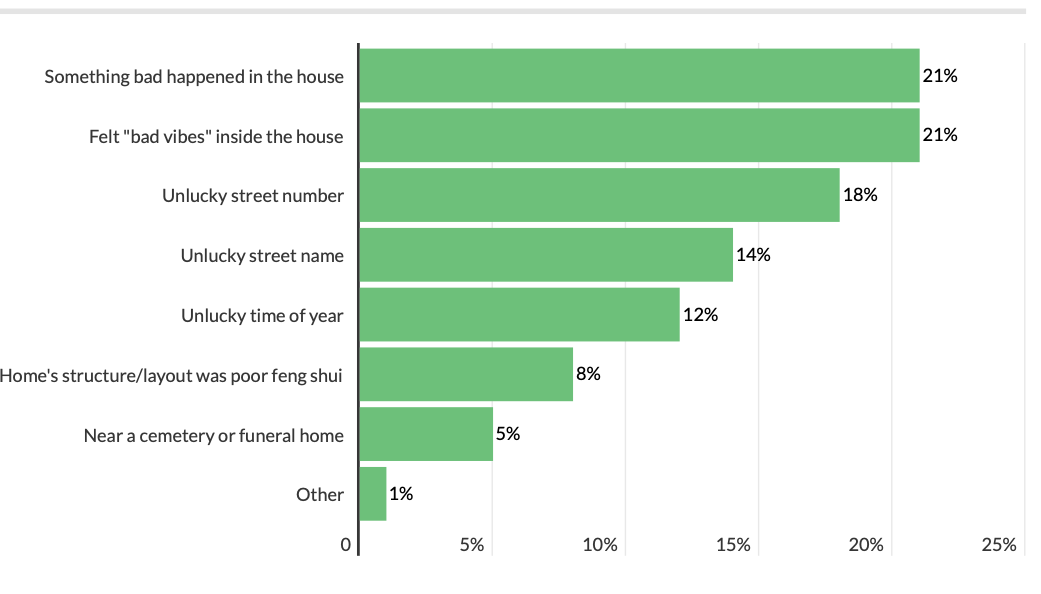
Many Americans admit to being superstitious when it comes to choosing what home to buy—in fact, they say if a home feels unlucky, they aren’t buying it. More than a third—or 38%—of Americans have decided against buying a home because of superstition, according to a newly released survey from LendingTree of about 1,500 Americans. And consumers who find their self-described lucky house are willing to pay even more for it.

4 leaf clover, influence real estate decisions


Reasons some consumers reconsidered a home purchase due to luck or superstition


Source: LendingTree survey of 1,550 consumers conducted Feb. 19-22, 2021. Only those who chose not to buy a certain home due to luck or superstition answered this question. 

Homes a buyer perceives as lucky can nab more at resale. Nearly 47% of survey respondents say they would blow their budget for a lucky house—and are willing to go an average of $38,000 above their range for the home, the LendingTree survey shows. What qualifies as a lucky home? More than a third of buyers say they’d pay extra for a home whose street number was their lucky number.

The younger generations appear to be the most superstitious in real estate—55% of Gen Z and 50% of millennials said they’ve bypassed a home because of something related to luck or superstition. Overall, men are more likely than women to decide against buying a particular home because of superstition, at 51% of men and 37% of women.

Here are some additional findings from the LendingTree survey:

  • 39% of homeowners refuse to live next to a cemetery.

  • 32% would not buy a home with an unlucky street number. (On the other hand, the majority of respondents did say they’d buy a house with an unlucky street number like 13 or 666, but 20% would prefer to pay less because of it.)

  • 30% say they would not buy a home where the previous owners experienced a tragedy inside the home, like death.

  • 43% say they have at least one deal breaker related to the home’s feng shui, with the most cited reasons being a staircase that faces the front door, back and front doors in the same path, or a bathroom door that faces the front door.

  • 43% of survey respondents who reported being previous home sellers said they’ve had difficulties selling their home due to superstitious buyers.


Source: "Nearly Half of Americans Would Burst Their Budget for a "Lucky" Home," LendingTree (March 16, 2021)

The Top Green Features Buyers Seek in New Homes

  • By
  • Posted

Energy efficiency is on many buyers’ minds when they shop for new-home construction, according to a consumer survey from the National Association of Home Buyers. The NAHB surveyed more than 3,000 home buyers—both recent and prospective—on the features they most desire in their new home.

Many buyers said they’d go with the more sustainable option, such as the use of more durable materials in their home, when presented the option.

When the cost savings of these features are pointed out, they may be even more tempted—and they say they are willing to pay up front to help lower their utility bills. On average, buyers would pay up to $9,292 more for a home in order to save $1,000 annually on utility costs, according to the NAHB’s study.

“We’re doing a lot more in our homes now,” Brandon Bryant, founder of Red Tree Builders, a green home building company in Asheville, N.C., said during February’s virtual 2021 International Builders’ Show. But he added education is key. “We’ve got to teach people how to live in green homes, how these homes operate, and even before we build to let them know what we could do because a lot of times we could do so much more for their life.”

The top eco-friendly components and designs consumers said they desired:

  • Energy Star–rated windows and appliances

  • Efficient lighting that uses less energy than traditional bulbs

  • Energy Star rating for the whole house

Other trending features center around health and wellness, such as zone heating, purified air appliances (like UVC fans), indoor air quality sensors, and connections to the outdoors, the NAHB said.

"There are a wide range of green features that buyers feel are desirable," said Paul Emrath, vice president of surveys and housing policy research at the NAHB. "Energy efficiency, though, tops the list of what they most want."


Source: National Association of Home Builders

The Brighter Path Ahead

  • By
  • Posted

More inventory and better access to vaccines are welcome news.

family in front of home for sale

Courtesy of Lawrence Yun

The 2020 pandemic-induced recession was unique in terms of the sudden and massive slashing of jobs. It was also the first recession during which overall income grew. No doubt there are families struggling paycheck to paycheck, but due to the massive stimulus packages—including the initial deposit of $1,200 and enhanced unemployment benefits—the financial condition of many families was better in a recession than before the pandemic.

Total income for the country in late 2020 was 4% higher than a year earlier. This was the figure reported just before the second stimulus checks of $600 per person went out in late December. It also does not include wealth accumulation from the record-high stock market or rising home prices. Also not reflected in the totals are the proceeds from mortgage refinances last year or the relief expected from a new stimulus. Still consumers remain cautious, as spending opportunities have been restricted by COVID-19. For the year, consumer spending fell by 2%. And the savings rate consequently rose to twice the pre-pandemic levels.

The situation translates into the potential for a great unleashing of spending in 2021. The positive impact will be increasingly felt as jobs come around. The full effect will be evident once herd immunity is established with the vaccine, likely in autumn. That is to say, 2021 is a growth year that will take us out of the recession.

The housing market continues to shine brightly. The main frustration is for buyers who find themselves outbid during multiple offer situations. More inventory is needed to give buyers more options and lessen the heat.

It's encouraging to see that builders are ramping up production of homes with backyards, which are now at their highest level in 13 years. Activity has been particularly robust in Southern states where land is more plentiful and building regulations are less onerous.

Moreover, with the wider availability of COVID-19 vaccines, homeowners, especially older Americans, who have been more hesitant about strangers visiting their homes, now may be more ready to list. Many seniors own their homes outright and have sizable housing equity for their next home purchase. They may even need to buy a larger place to accommodate more family visitors. After all, in the new economy, remote-work flexibility may mean more days working from grandma’s house.


Lawrence Yun, Chief Economist and Senior Vice President of Research at the National Association of REALTORS®


Mortgage Rates Rise But Stay Near Historic Lows

  • By
  • Posted

The 30-year fixed-rate mortgage came off its recent all-time lows to average near 3% last week. The 10-year Treasury yield, which mortgage rates closely follow, hit its highest level in the past year, prompting the increase in rates.

calculator, home and keys mortgage rates

“As the economic recovery progresses, mortgage rates are expected to rise further in the upcoming months,” writes Nadia Evangelou, senior economist and director of forecasting at the National Association of REALTORS®, for the association’s Economists’ Outlook blog. “Nevertheless, the upcoming rise in mortgage rates should not be alarming to would-be home buyers. The Federal Reserve recently assured that it would keep interest rates unchanged for a long time.”

Rates continue to remain near historic lows, said Sam Khater, Freddie Mac’s chief economist. The all-time low for the 30-year fixed-rate mortgage was set in January, averaging 2.65%.

Freddie Mac reports the following national averages with mortgage rates for the week ending Feb. 25:

  • 30-year fixed-rate mortgages: averaged 2.97%, with an average 0.6 point, up from last week’s 2.81% average. Last year at this time, 30-year rates averaged 3.45%.

  • 15-year fixed-rate mortgages: averaged 2.34%, with an average 0.6 point, rising from last week’s 2.21% average. A year ago, 15-year rates averaged 2.95%.

  • 5-year hybrid adjustable-rate mortgages: averaged 2.99%, with an average 0.1 point, rising from last week’s 2.77% average. A year ago, 5-year ARMs averaged 3.20%.

Freddie Mac reports average points along with average commitment rates to better reflect the total upfront cost of obtaining the mortgage.

Source: Freddie Mac and "Instant Reaction: Mortgage Rates, February 25, 2021," National Association of REALTORS® Economists’ Outlook blog (Feb. 25, 2021)

 

Want To Build Your Own House? The Pros, Cons, and Costs

  • By
  • Posted

Building a brand-new home may sound like a dream come true. You get to choose the ideal layout for your family’s needs, and have a say in each and every design element. However, the process may also be daunting if you’ve never done it before.

To help you through it, we’ve created this Guide To Building Your Own Home. It will provide all the detailed information you need at each stage of the home-building process so that everything goes as smoothly as possible.home under construction

By Erica Sweeney, realtor.com 

In this first article, we’ll offer a glimpse into the pros and cons of building a house, including how much it costs, how long it takes, how it's financed, and much more that will help you decide if this option is right for you.

Pro: You can get exactly what you want

Building a home is a popular option these days. Construction on single-family homes was up 10% in November 2020 compared with the previous year, according to the National Association of Home Builders. And, it makes sense: When you build your own home, you get exactly what you want: an in-law suite for when the grandparents visit, a decked-out office for working from home, midcentury modern style, and more. Anything is possible.

“You get a blank slate,” says Marc Rousso, CEO of JayMarc Homes in Seattle. “The fun part about building a custom home is that it can be whatever you want.”

That might sound overwhelming, so Rousso suggests starting with a vision board. Check out websites like Houzz or Pinterest, and drive around snapping photos of homes you like. Then think through how big you want the home to be, how many bedrooms and bathrooms you need, and the bonus spaces you want to live as comfortably as possible.

The best way to make sure you get what you want (and that it fits within your budget): Hire a great builder from the start. This crucial step sets the best possible foundation (in every sense of the word) for your new home. Builders help you select others on your team (such as an architect, interior designer, and landscaper) and serve as your point person throughout the process.

Not sure how find a homebuilder? NAHB offers an online directory, and its members are committed to ongoing education and ethical standards. Hiring builders who have been in business for several years is also a plus, as they’ve proven they can weather both the highs and lows of economic cycles.

Pro: You can build just about anywhere you want

Have you always dreamed of living by the water or having a mountain view? Or maybe you want no neighbors in sight? Building a home lets you set up your residence just about anywhere you want.

Talk to your builder before making a land purchase, though, Rousso urges. The builder will need to do a feasibility study on the land to make sure it’s a suitable place for the home you want to build.

“We've talked more people out of buying land than into buying land, because there are so many pitfalls,” he explains.

Builders help make sure the land is zoned for residential development and identify any issues with building on the site, such as connecting to utilities or developing the land before building can start.

Another thing to note: Land development can be costly. HomeAdvisor estimates it to be $1.30 to $2 per square foot of land, including surveying, drainage plans, utility and septic mapping, permits, soil testing, land clearing, excavation, and demolishing any existing structures.

Pro: New homes typically come with less maintenance

An obvious advantage of building a home is that everything is brand-new. That means maintenance and repairs will be minimal or even nonexistent for a while, saving you plenty of headaches and thousands of dollars a year. According to HomeAdvisor, in 2020, homeowners spent an average of about $3,200 on home maintenance.

Nonetheless, a new house isn't entirely maintenance-free. You’ll probably still need to do yardwork to keep up your newly installed landscaping. And you may want to pay for some preventive upkeep, such as a maintenance contract on your HVAC system, costing $150 to $500 a year. But that could save you money in the long run.

Con: Building usually costs more than buying an existing home

Building a house is an expensive enterprise, and typically costs more than buying a preexisting home. As such, you'll need to have some in-depth discussions with your builder on what you want, and whether it's affordable for you.

“A builder can help guide the design process starting with schematic design to give the prospective client an idea of the budget,” says Tim Benkowski, senior project manager at Balsitis Contracting in Lake Geneva, WI. “That way, design revisions can be made early without the owner falling in love with a home design only to find out they need to cut out their favorite parts or reduce the project scope.”

Several factors determine how much your newly constructed home will cost: location, size, complexity, and design elements.

The NAHB estimates that the median price of constructing a single-family home is $289,415, or $103 per square foot. Labor typically constitutes about 40% of the cost, followed by permits, design fees, and materials.

Con: Getting a construction loan can be complicated

To finance building a home, you’ll need a construction loan, which is a little more involved than getting a traditional mortgage to buy a preexisting house, says Steve Kaminski, head of residential lending at TD Bank.

For starters, you’ll likely need a 20% down payment since construction loans are considered higher-risk. Along with the usual financial documents needed for your loan application, you need to provide project plans, costs, and land value. You also need a signed contract or purchase contract with the project’s plans, specs, and budget details, and a timeline for the construction.

“The lender is not only evaluating the borrower, but also the project plans and oftentimes the builder to ensure they will be financially solvent throughout construction,” Kaminski explains.

Construction loans are usually shorter-term, covering just the duration of the build, and may have higher interest rates, usually about 1% higher than conventional mortgages, according to the Consumer Financial Protection Bureau.

Once the home is completed, you can pay off the balance or convert the loan to a conventional mortgage. The interest rate and the type and terms of the mortgage will depend on your credit history and lender.

When shopping around for a mortgage for a new home build, Kaminski urges borrowers to go with a lender experienced in working with construction loans.

Con: Building a home takes a while

Generally, it takes a bare minimum of three months to build a simple house, and it can take much longer. But it’s a “sliding scale,” says Benkowski. “A 2,500-square-foot and under [home] can typically be completed in seven to nine months with proper planning. A 7,500-square-foot home and up would likely take 12 to 30 months.”

Planning as much as you can will keep the project on track. Still, delays do happen. Weather is the biggest one, with temperature shifts and rain or snow postponing work. Your own choices could also be to blame. If you’re taking too long to choose your favorite flooring or windows, it could make it all take a little longer.

Erica Sweeney is a writer whose work has appeared in the New York Times, Parade, HuffPost, and other publications.


Happy Valentine's Day!

From all of us at Melanson Real Estate

Happy Valentine's Day!

What's Your Home Worth?

We can assist you with your no-cost, personalized, current market analysis!

Our Agents have the knowledge and experience of our service area and are happy to assist you with all your real estate needs.


Improvements First-Time Homeowners Should Tackle First

  • By
  • Posted

While low mortgage rates and the COVID-19 pandemic continue to motivate first-time buyers, other factors need to figure into their financial planning. Tight inventory markets mean many home shoppers will end up purchasing a house that requires repairs to its structure and mechanical systems, which will take a big bite out of their budget.

By Barbara Ballinger

Owning a home is a significant financial investment. These 10 tips will help you prepare for maintenance and repair costs, too.

3 Takeaways: 

  • First-time buyers should look beyond the shiny new kitchen and consider problematic signs in a listing.

  • Chimney inspections can point out crumbling mortar and problems with flashings, flue liners, and the flue itself.

  • Homes without good gutters and downspouts may have problems with interior leaks.

First-time buyers may want to look beyond the shiny new kitchen and sizable outdoor space and consider problematic signs, such as a leaky roof, cracked pipes, or inefficient air leaks. A thorough home inspection is good a start, yet, some buyers are willing to waive the inspection to make their offer more appealing to sellers in today’s competitive market. Although, they should know the risks involved when purchasing without an inspection.

All too often, homeowners—especially those buying a fixer-upper—focus on aesthetics, like gleaming subway tiles they plan to install along a kitchen backsplash or how they’ll transform a yard into a mediation retreat. They can’t forget about the issues that must take priority. Houses age just as people do, and they require regular checkups, repairs, and new parts, akin to our doctor visits, medications, and surgeries.

“So many homeowners buy a house for a lifestyle rather than for economic reasons, so they tend to think about the glitzy stuff rather than what’s behind the walls and sometimes not visible,” says Jennifer Ames, a salesperson with Engel and Volkers' Chicago office.

While it’s less joyful to spend money on replacing a furnace or roof than updating an old bathroom or porch, it’s critical to do so to protect an investment. Due diligence can also help lower heating and cooling bills and pare down other costs. Homebuyers should have specialists perform ongoing maintenance and to not put off repairs that may become more expensive if left untended. Some might even lead to health issues, such as mold.

1. Keep away rain. Climate changes have brought heavy rains and storms to more parts of the country, and homes without good gutters and downspouts may have problems with interior leaks and standing water in the yard.

A home’s gutters should be pitched away from the house and be wide enough to carry water without leaves getting clogged—ideally 6 inches rather than the traditional 4 inches.

Downspouts should extend 5 feet from the home’s foundation so water won’t collect near the home and leak inside, potentially causing mold.

Gutters should be cleared annually or semi-annually. An expert should periodically check wood fascia boards behind gutters, which may rot over time. Also, installing a drip edge to the roof’s plywood decking to keep water from getting underneath. In addition, the landscape should be regraded if the yard slants downward toward the house.

2. Tighten the envelope. Homes that are not well sealed allow warm air to escape in winter and cool air in summer. It also makes it easier for bugs and rodents to find their way inside. Hire an expert to perform an assessment. The assessment provides a number that indicates how leaky a house is, and directs a homeowner to undertake changes, such as using caulk to seal around windows, air ducts, and areas where the walls meet the foundation. In addition to lowering energy costs, this also prevents pollutants and humidity from entering the home.

Historically, most homeowners who add insulation choose foam or mineral wool, but many building codes now require tighter envelopes, so the industry is moving toward blown-in rockwool, fiberglass, and cellulose.

Another way to keep out insects and rodents is to use inert pesticides like boric acid.

3. Maintain a stable foundation. Cracks in a foundation require prompt attention so they don’t spread and cause more severe problems. Cracks develop for all sorts of reasons, from climate fluctuations to age to land sloping toward the house. A structural engineer should be hired to do an assessment and help the homeowners develop a solution, such as waterproofing a basement and foundation down to the footings or installing a sump pump and battery backup system to remove future water. Telltale signs of a wet basement may be stains on walls or bad odors from moisture.  

4. Inspect the roof. Unless it’s a simple case of a roof missing a few shingles, a home’s topmost layer can become an expensive repair if it’s old or badly damaged. Buyers should ask sellers the age of the roof and how it was constructed. The best shingle roofs also have a good underlayment and decking underneath.

Flashing, a plumbing stack, chimneys, and skylights should also be inspected before purchase because rain, animals, and debris can find their way into openings. A metal roof will last longer—50 to 100 years versus a shingle roof’s 30 years—but its costs can be four times higher. Homeowners may find it useful to have an annual roof inspection to check for storm damage. Also, they should perform their own visual inspection by noting discoloration or curled or missing shingles.

5. Update lighting. Old incandescent lightbulbs increase energy costs and have a short life span. LEDs are an easy, affordable upgrade that require far fewer changes and are much more efficient. Choose LEDs with a 2,600 to 3,000 K (kelvin) measurement that produces a warm color, similar to 60-watt incandescent. Because LED bulbs come in a wide variety of shades, trying out one to see if it appeals before buying for an entire house. Also, avoiding compact fluorescent lights, which take time to warm up and can be overly bright, almost like a floodlight.

6. Add air conditioning. With much of the country experiencing more extreme heat, many new homeowners may find that fans aren’t sufficient to cool a home. Window AC units work, but don’t cool a house efficiently and are less visually appealing. A quality AC system will provide a good return on investment at resale.

A split system to lower energy costs since each room can be separately controlled. However, the costs are greater than one central system—sometimes 50 percent more—though they will help save money over time. Some companies recommend adding an ultraviolet light system to kill mold, bacteria, and viruses from being circulated, which many homeowners have started to do since the onset of the pandemic.

7. Prepare for outages. Many experts believe electricity outages will continue to be a problem in certain parts of the country. A generator is a wise investment, especially if outages grow longer and more frequent. Homeowners can still benefit from the federal solar tax credit if they invest in a solar-battery backup system.

A battery backup attached to a solar array could be connected to a single circuit to extend the life of the battery’s charge. On average, costs might run from $25,000 to $40,000. Less costly, but also less environmentally friendly, is a diesel generator system, which may run between $18,000 and $22,000 for a 3,000-square-foot home, or $5,000 to $8,000 for a smaller unit that powers kitchen appliances and some lights. Besides cost, it works for longer periods without needing to be recharged like a solar system.

8. Maintain wood. Wood adds charm to a home, whether through siding, flooring, railings, or a deck. But it also requires regular maintenance. Boards—even new ones—can rot due to weather and insects. Another culprit is the type of wood used today. A century ago, the center of trees was used for boards, which made them sturdier than today’s wood planks that are made from the entire tree and its pulp. That means they also carry more moisture, and therefore rot faster. Pressure washing a house to remove mold and sealing wood well with quality paint will reduce this.

9. Remember tree care. Trees are a beautiful addition to a property, providing shade in summer and picturesque snow-covered branches in winter. But they should not be overlooked by homeowners when it comes to their care. Big limbs may come down during storms, insects can feast on wood, and spreading tree roots may clog sewers. New homeowners should hire an arborist to examine their site’s trees when they move in and have limbs pruned periodically. Diseased trees should be promptly removed to prevent spread.

10. All things chimney. A stately chimney adds elegance to a home, the equivalent of icing on a cake. But if it’s not tended to, moisture can enter, along with animals and other debris. A cap will help, as will inspections to point out crumbling mortar and problems with flashings, flue liners, and the flue itself. Keeping all parts in shape will also improve the air quality in a house and allow smoke to exit more freely when the fireplace is used. If a chimney has significantly deteriorated, the home buyer will have to decide whether to take it down to the roof level and sheathe it over with shingles or to have it repaired. Another factor may be cost, which can vary greatly. A third factor may be if the house is located in a historic neighborhood and exterior parts must be retained according to a municipality’s rules.

Barbara Ballinger; Barbara is a freelance writer for REALTOR Magazine and the author of several books on real estate, architecture, and remodeling.

Shhhh! When a Home Is Too Loud

  • By
  • Posted

The ability to work from home during the pandemic has been a blessing for many people, but it’s also made some acutely aware of the absence of one element helpful for productivity: quiet.

By Melissa Dittmann Tracey

With many people working or studying remotely, these strategies may help cut down the noise.

Many have taken to barricading themselves in closets or hiding in their cars to insulate themselves from chatty household members or noisy street sounds. Echo-prone open floor plans have exacerbated the problem as family members concurrently try to do their jobs or attend remote school.

Enter acoustic consultants, armed with sound- proof design techniques and technology to bring some peace and quiet to home environments. Real estate pros can benefit from learning about these enhancements, which can be a valuable amenity for resale, especially for a home on a busy street.

“The pandemic has forced people to look at their home’s acoustics very differently,” says Bonnie Schnitta, founder and CEO of SoundSense, an acoustic consulting company based in Wainscott, N.Y.

Since the start of the pandemic, Schnitta’s firm has been fielding more calls from real estate professionals and homeowners about noisy plumbing, loud traffic, and household sounds amplified by open floor plans. During site visits, they’ll calculate precisely how sound reverberates in a space and offer a range of solutions, such as adding sound-absorbing fabric or foam behind wall hangings or underneath rugs. While these fixes aren’t cheap—consultation fees start at $900—many find the results are worth it.

Real estate professionals are getting help for listings with challenging acoustics. For one hard-to-sell home on a noisy street, Schnitta suggested adding a water feature in the front yard swimming pool, which, combined with a barrier, masked the road noise. The home sold two weeks later. “You can rarely completely erase road noise, but there are ways you can mitigate it,” she says.

Noise can impact resale. A 2017 realtor.com® study showed that sellers of homes within a 2-mile radius of an airport tended to see discounted prices of 13.2% compared to similar homes elsewhere in the same ZIP code. Sellers near train tracks saw average discounts of 12.3%, followed by 11.3% for nearby noisy highways.

The luxury Mozaic at Union Station Apartments in downtown Los Angeles addressed street noise issues by teaming with Veneklasen Associates, an acoustics firm, to work on soundproofing. Because 90% of outside noise entering an apartment comes through windows, behind the existing double-pane windows, they installed secondary, noise-mitigating windows that dampen sound vibrations and prevent sound leaks using recording studio-style soundproofing technology.

Window add-ons from Soundproof Windows Inc. cost $790 to $1,070 apiece, while a sliding glass door insert sells for about $1,600.

Noise reduction can be as simple as adding a $50 door seal or as complex as spending $10,000 or more for full-home soundproofing. Here’s a range of recommendations from acoustic consultants:

  • Cover hard surfaces. Hard, highly reflective surfaces are among the worst sound offenders. Use softer materials, such as area rugs with a sound-absorbing pad underneath and fabric-covered furniture, suggests Audimute, an acoustic design consultation firm.

  • Reduce echoes in open spaces. In open floor plans, sound can bounce everywhere. SoundSense and Audimute offer fabric-covered panels to add onto walls for sound absorption. Or try bookcases—even just half-full—against walls to help absorb sounds. Artwork can also be used as a sound barrier. SoundSense makes a Paradise Foam product, which can be tucked behind canvased art to mitigate noise.

  • Seal doors and windows. Soundproofing companies offer acoustic door seal kits that fit snugly around doors or window edges to reduce sound coming through cracks.

  • Add sound-absorbing shades or drapes. Roman shades, using heavy fabric, can help reduce noise, as can cellular shades and plantation shutters. Heavy drapes and curtains—think suede or velvet—are also effective at absorbing outside noise.

  • Go green. In addition to improving air quality, houseplants can help reduce noise. (They’re most beneficial on hard-surface floors.) Consider a tall, potted Norfolk pine in room corners, Schnitta says. Sound will bounce from the wall onto the foliage instead of throughout the room.

“When [buyers] walk into a home and hear an echo, it can be a turnoff,” Schnitta says. In a listing, “there are several inexpensive things you can do: Put in an area rug with a specialized pad. Put a plant in the corner, even if it’s artificial. Add a bookcase. All of this can make a big difference when it comes to sound.”


Melissa Dittmann Tracey is a contributing editor for REALTOR® Magazine. 

Lumber Takes a Fall

  • By
  • Posted

Builders and home buyers paid the price as supplies dropped, but the outlook for new construction is improving.

Key takeaways:

  • COVID-19 dramatically disrupted the lumber supply chain affecting home building.

  • Lumber prices have been highly volatile since the spring.

  • An uptick in home remodeling has further squeezed the lumber market and contributed to rising prices.


By Daniel Bortz

Last spring, the coronavirus pandemic ground several large lumber mills in the U.S. to a halt—and homebuilders suffered the consequences.

Take Jesse Fowler, for example. Fowler, the president of Tellus Design + Build, a full-service general contractor based in Southern California, said in an interview with REALTOR® Magazine in November that lumber prices for his company had “gone through the roof.” “It’s tough on our business because we have to play the middleman and negotiate lumber prices for our clients,” Fowler said. In one instance, he said, a framer charged one of his clients who was building a new home $90,000 over what was originally estimated to compensate for rising lumber costs.

The COVID-19 crisis and the constraints it has put on the nation’s lumber production aren’t the only factors that have jacked up lumber prices. “Our lumber tariffs with Canada are high, and our domestic lumber industry can’t supply everything that we need,” says Robert Dietz, chief economist at the National Association of Home Builders.

In addition, “the wildfires in the West certainly haven’t helped [lumber production],” says Mike Theunissen, co-owner of Howling Hammer Builders, a custom home builder and remodeler based in Mt. Pleasant, Mich., and chairman of the building materials subcommittee at the NAHB.

Dietz says small homebuilders have had a harder time coping with the price hikes. “Larger builders are feeling less of an impact,” he says.

And optimism is on the rise more broadly. After reaching their peak last September, lumber prices began to fall, according to Monthly Composite Prices reports from industry tracker Random Lengths. “What we had was a shock to the supply system at the start of the pandemic, but now that lumber production has ramped back up, lumber prices have gone back down,” says Mark Rasmussen, a forest economist at Mason, Bruce & Girard, a natural-resources consulting firm, during an interview in early November. Yet just a few weeks later, prices were on the rise again, in response to both favorable building conditions in the fall and suppliers stockpiling materials for an expected busy construction year ahead.

Another bright spot for general contractors: “The remodeling business is busy right now, and you don’t need as many materials when remodeling” as you need to build a new home, Theunissen says.

However, with Americans spending a lot more time at home, many people are taking on home improvement projects themselves. As of mid-August, 61% of U.S. homeowners said they’d taken on a home improvement project since March 1, a NerdWallet survey found. Shawn Church, editor of Random Lengths, says the do-it-yourself remodeling boom contributed to rising lumber prices. “The strong DIY activity generated a demand for wood products that left supply and demand in an acute imbalance,” he says. “Wood products prices surged as a result.”

When lumber costs surged, Theunissen says, his company was forced to make some changes. “We started putting escalation clauses into our contracts for lumber,” he says. “For example, a contract might say that if lumber costs rise by more than 10% before our work is performed, then the customer must pay the difference... We hate to invoke escalation clauses, but there’s only so much we can absorb,” he adds. Howling Hammer’s contracts also started allowing for delays in materials delivery. “If it takes an extra four weeks to do a project because materials arrive later than we expected, then that’s just the way it is,” Theunissen says.

The Impact on New-Home Buyers

Of course, rising lumber prices also affect buyers purchasing new homes. Sales prices of new homes have risen sharply over the past year. As of mid-October, higher lumber prices had added $15,800 on average to the price of a new single-family home, Dietz says. According to Census Bureau data, the average sales price of new single-family houses sold in September 2020 was $403,900, up from $384,000 in January.

Homebuilders are grappling with a number of other challenges, Dietz says, most notably labor shortages and tighter mortgage lending requirements for home buyers and homeowners seeking home equity loans or lines of credit.

There’s little evidence that higher prices have kept large numbers of buyers away. Among affluent buyers, the demand for new construction remains high. Hans Wydler, an associate broker at Compass who works with buyers and builders of custom homes in the greater Washington, D.C., area, says, “Buyers [here] don’t care about lumber prices... That’s just not on their radar.”

Some buyers are being priced out, though. “I have a build job going on right now where the cost went up $50K due to the sudden increases in lumber and other building materials,” says Sheila Smith, an agent with RE/MAX Capital City in Boise, Idaho. “Boise is still being flooded with newcomers from bigger metropolitan areas, mostly California. They can afford the higher-priced homes, and our inventory is down 80% from 2019 overall.”

On a national level, housing starts hit a seasonally adjusted annual rate of 1.53 million last October, up 14.2% from October 2019, according to the Census Bureau. Moreover, homebuilder optimism in November hit its third straight record high, according to the NAHB/Wells Fargo Housing Market Index, which has been tracking homebuilder sentiment for 35 years.

Possible Solutions

Although future lumber prices can be difficult to predict, experts say a couple of actions may be able to curb lumber costs in the U.S. For one, “we need to find ways for the domestic lumber industry to produce more, perhaps through recruiting more workers or through new forest policy,” Dietz says.

Second, the U.S. government must negotiate a better lumber agreement with Canada to address the high lumber tariffs that are currently in place. “That’s been a longstanding issue,” says Dietz, “but I think it can happen sometime in the next two years.”

Lawrence Yun, NAR’s chief economist, sees reason for optimism. “Lumber prices should moderate and decline somewhat in 2021 as a result of more harvesting and a possible reduction in tariffs to foreign products,” he says. “That will help home building and generate local economic growth.”


By Daniel Bortz: Daniel is a freelance writer who specializes in writing about personal finance but also covers real estate, home improvement, travel, careers, small business, and even weddings.

1-20 of 62 Posts

Get in touch!

Do not fill in this field:

I agree to receive marketing and customer service calls and text messages from Melanson Real Estate. To opt out, you can reply 'stop' at any time or click the unsubscribe link in the emails. Consent is not a condition of purchase. Msg/data rates may apply. Msg frequency varies. Privacy Policy.

This site is protected by reCAPTCHA and the Google Privacy Policy and Terms of Service apply.